
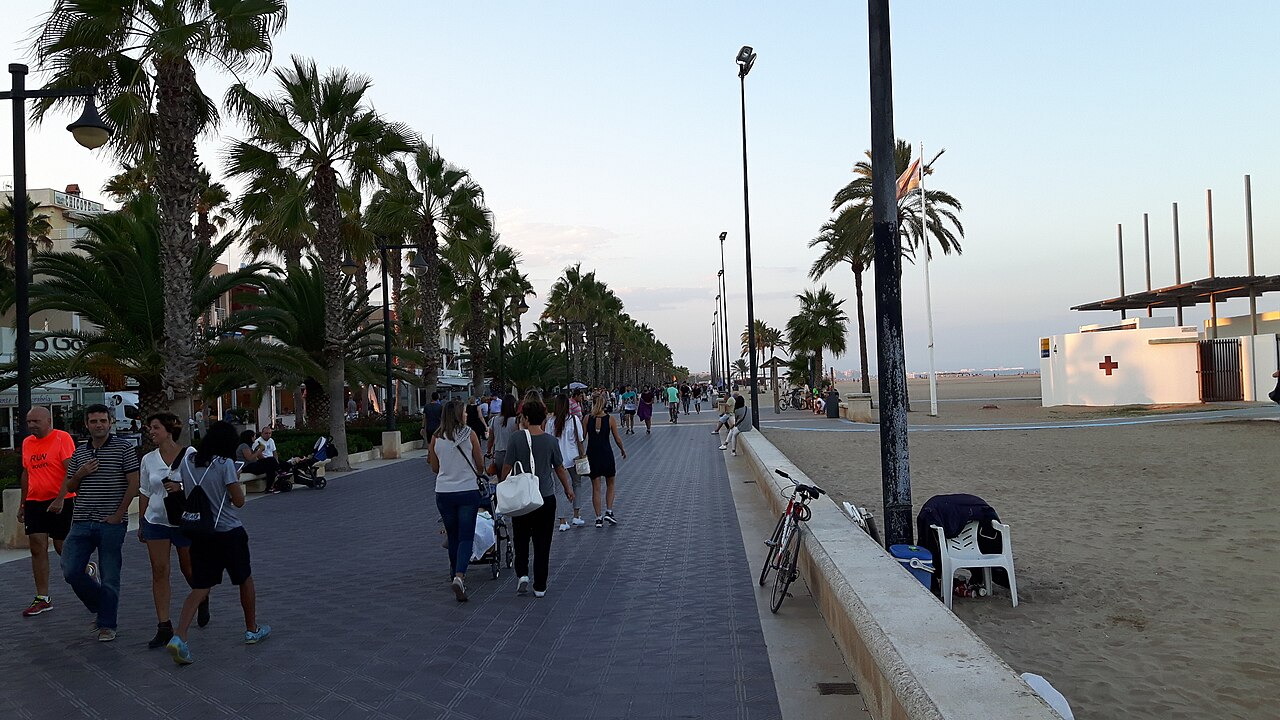
A continuous line from the cathedral through the old town, then down the former riverbed to Calatrava’s complex.
Drinking water
- Water
- Drinking water 70 m from stop 1
- Drinking water 50 m from stop 2
- Drinking water 130 m from stop 3
- Drinking water 70 m from stop 4
- Drinking water 100 m from stop 5
Places mapped by volunteers on OpenStreetMap; opening times and taps change, so check before relying on one. © OpenStreetMap contributors
Segments
-
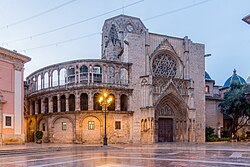 The Cathedral & the Holy Chalice chapel
Plaza de la Reina → Valencia Cathedral
City streets and squares
Begin at the cathedral, consecrated after the Christian conquest of 1238 and grown over the centuries into a mix of Gothic, Romanesque and Baroque. Its chapel holds the Santo Cáliz, an ancient agate cup that the Catholic Church has long venerated as the Holy Grail. The octagonal Miguelete bell tower alongside can be climbed for a first look over the old town. Allow about 75 minutes.
About this place
Valencia Cathedral, at greater length the Metropolitan Cathedral–Basilica of the Assumption of Our Lady of Valencia, also known as St Mary's Cathedral, is a Catholic church in Valencia, Spain.
Read more on Wikipedia Photo: Fernando Pascullo · CC BY-SA 4.0 -
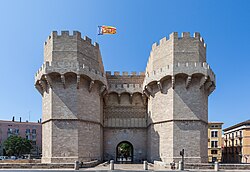 The Torres de Serranos
Valencia Cathedral → Torres de Serranos
City streets
Walk north to the Serranos towers, built at the end of the fourteenth century as one of the twelve gates in the city's Christian wall and among the largest Gothic city gates in Europe. Climb to the top for the view back over the tiled roofs of the old town toward the cathedral. About 45 minutes.
About this place
The Serrans Gate or Serranos Gate, also known as Serrans Towers or Serranos Towers is one of the twelve gates that formed part of the ancient city wall, the Christian Wall, of the city of Valencia, Spain. It was built in Valencian Gothic style at the end of the 14th century.
Read more on Wikipedia Photo: Diego Delso · CC BY-SA 4.0 -
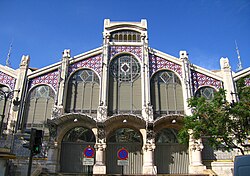 The Central Market
Torres de Serranos → Mercado Central
City streets
Cut back through the old town to the Central Market, a vast covered hall of iron, glass and coloured tile opened in 1928 and one of the largest fresh-food markets in Europe. Wander the stalls of Valencian oranges, rice, hams and horchata before moving on. About 40 minutes.
About this place
Mercado Central or Mercat Central is a public market located across from the Llotja de la Seda and the Church of Santos Juanes in central Valencia, Spain. It is one of the main works of the Valencian Art Nouveau.
Read more on Wikipedia Photo: Felivet · Public domain -
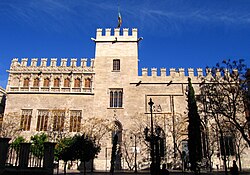 The Llotja de la Seda (Silk Exchange)
Mercado Central → Llotja de la Seda
City streets
Cross the square to the Silk Exchange, a late Valencian Gothic hall built between the 1480s and the 1540s when Valencia was a Mediterranean trading power. Its Contract Hall, roofed by tall spiralling columns like stone palm trees, earned it a place on the UNESCO World Heritage list in 1996. About 40 minutes.
About this place
The Lonja de la Seda ; or Llotja de la Seda (Valencian: [ˈʎɔdʒa ðe la ˈseða]; or alternatively in English "Silk Exchange", is a late Valencian Gothic-style civil building in Valencia, Spain. It is a principal tourist attraction in the city.
Read more on Wikipedia Photo: Felivet · Public domain -
 The Turia Garden
Llotja de la Seda → Jardín del Turia
Flat park paths
Drop into the old bed of the Turia river, diverted south after the flood of 1957 and reborn as a green corridor running about nine kilometers across the city, crossed by its historic stone bridges overhead. Follow it southeast — the long, shaded, level heart of the walk — toward the sea end. About 75 minutes on foot.
About this place
The Turia Garden is a public urban park located in the former riverbed of the Turia River in the city of Valencia, Spain. The park spans approximately 136 hectares, with plans to expand to 160.5 hectares in the future. It stretches nearly 8.5 kilometers in length, which will extend to almost 10 kilometers upon completion of the final section, with an average width of about 160 meters. It is one of the largest purely urban gardens in Spain.
Read more on Wikipedia Photo: Joanbanjo · CC BY-SA 3.0 -
 The City of Arts and Sciences
Jardín del Turia → Ciutat de les Arts i les Ciències
Riverbed park and waterside walkways
End where the riverbed meets Santiago Calatrava's white complex, built from 1998 onward at the seaward end of the old channel. Walk between the eye-shaped Hemisfèric, the ribbed Science Museum, the Oceanogràfic aquarium and the Palau de les Arts opera house, all mirrored in shallow blue pools. A striking place to finish, especially near sunset.
About this place
The City of Arts and Sciences is a cultural and architectural complex in the city of Valencia, Spain. It is the most important modern tourist destination in the city of Valencia and one of the 12 Treasures of Spain.
Read more on Wikipedia Photo: Unknown authorUnknown author · Public domain
Comments
Sign in to join the conversation.
No comments yet — be the first.