A single line south-west across Barcelona, from the Eixample’s Modernista showpieces into the old Roman and medieval town.
Segments
- The Sagrada Família
Sagrada Família metro station → Sagrada Família basilica
City streets
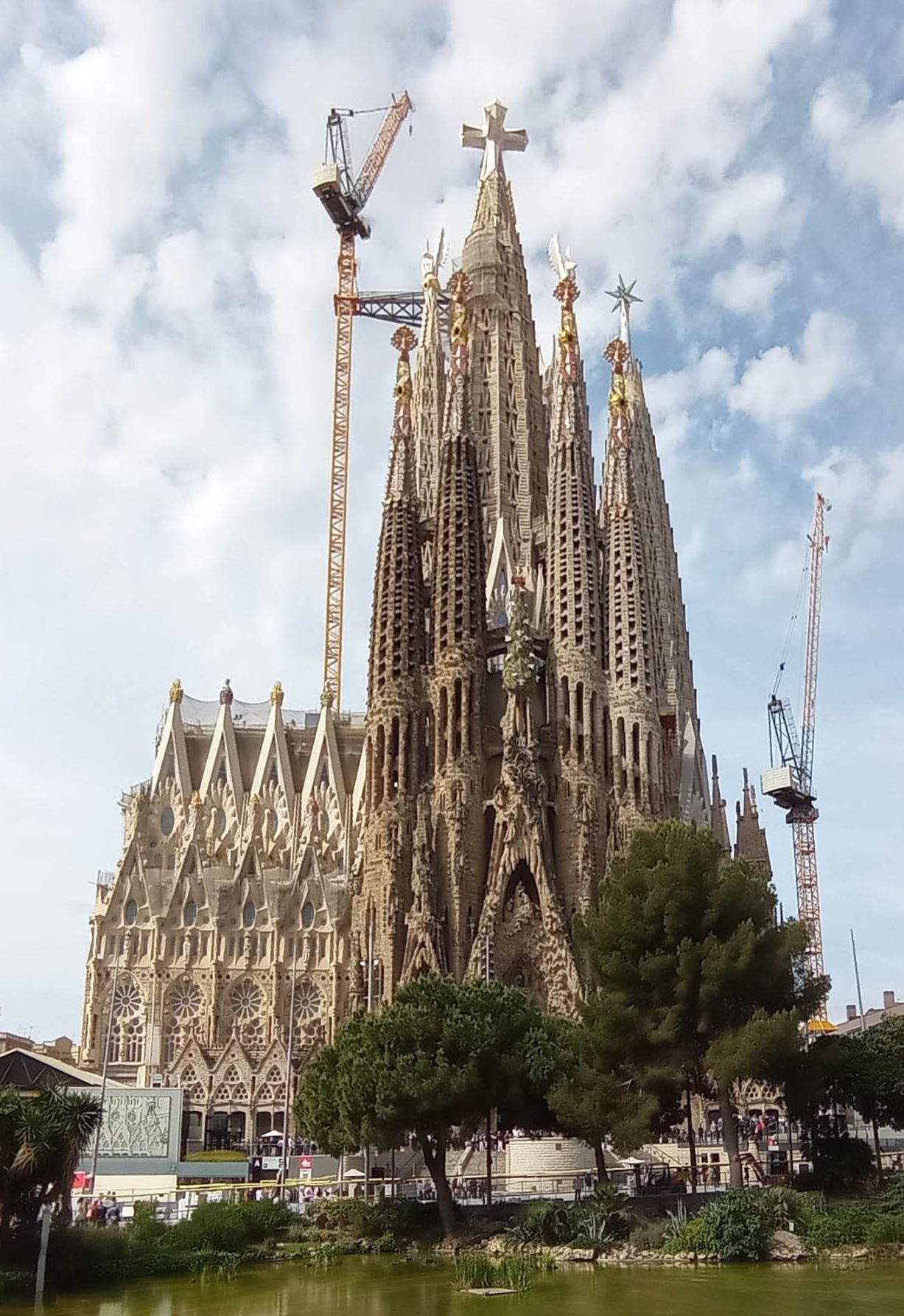
Begin at Gaudí's masterwork, the great expiatory basilica begun in 1882 and still rising. Inside, stone columns branch like a forest and the light pours through walls of stained glass. Gaudí is buried in the crypt; the church was consecrated by the pope in 2010 and works toward completion. Allow about 75 minutes.
-
 To Casa Milà (La Pedrera)
Sagrada Família → Casa Milà
City streets
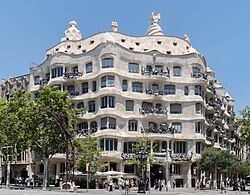
Walk south-west across the grid of the Eixample to Casa Milà, nicknamed 'La Pedrera' — the stone quarry — for its rippling limestone façade. Gaudí's last private commission, finished in 1912, is crowned by a rooftop of warrior-like chimneys. About 25 minutes on foot.
About this place
Casa Milà, popularly known as La Pedrera in reference to its unconventional rough-hewn appearance, is a Modernista building in Barcelona, Catalonia, Spain. It was the last private residence designed by architect Antoni Gaudí and was built between 1906 and 1912.
Read more on Wikipedia Photo: Thomas Ledl · CC BY-SA 4.0 -
 Casa Batlló & Passeig de Gràcia
Casa Milà → Casa Batlló
City streets
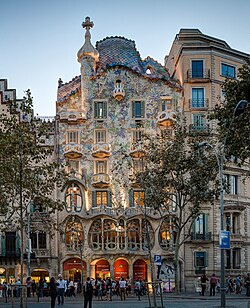
Stroll down Passeig de Gràcia, Barcelona's grandest avenue, to Casa Batlló — a remodel of 1904–06 with a scaly, dragon-back roof, balconies like carnival masks and a shimmering blue tiled light-well. It sits on the 'Block of Discord', where the era's rival architects built side by side. About 45 minutes with a look inside.
About this place
Casa Batlló is a building in the center of Barcelona, Spain. It was designed by Antoni Gaudí, and is considered one of his masterpieces. A remodel of a previously built house, it was redesigned in 1904 by Gaudí and has been refurbished several times since. Gaudí's assistants Domènec Sugrañes i Gras, Josep Canaleta and Joan Rubió also contributed to the renovation project.
Read more on Wikipedia Photo: ChristianSchd · CC BY-SA 3.0 -
 Down La Rambla
Casa Batlló → La Rambla
City streets
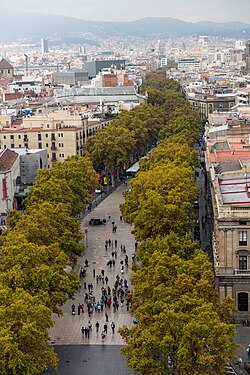
Continue to Plaça de Catalunya, the city's central square, and start down La Rambla — the tree-lined pedestrian spine that runs to the sea. Pass the Miró pavement mosaic and duck into La Boqueria, the cathedral of Barcelona's food markets, for a juice or jamón. About 30 minutes.
About this place
La Rambla can refer to:Hispanic term with similar meaning as Esplanade Arroyo (creek), a seasonally dry stream bed, rambla in Arabic
Read more on Wikipedia Photo: Ralf Roletschek · GFDL 1.2 -
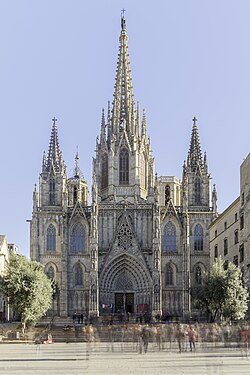 Into the Barri Gòtic
La Rambla → Barcelona Cathedral
Medieval lanes
Turn off the boulevard into the Barri Gòtic, the medieval heart built over Roman Barcino. Its narrow stone lanes open suddenly onto the Cathedral of Santa Eulàlia, whose cloister keeps thirteen white geese. Nearby stand fragments of the Roman wall and the Plaça del Rei. About 40 minutes.
About this place
The Cathedral of the Holy Cross and Saint Eulalia, also known as Barcelona Cathedral, is the seat of the archbishop of Barcelona in Catalonia, Spain. The cathedral was constructed from the thirteenth to fifteenth centuries, with the principal work done in the fourteenth century. The cloister, which encloses the Well of the Geese (Font de les Oques), was completed in 1448. In the late nineteenth century, the neo-Gothic façade was constructed over the undistinguished exterior that was common to Catalan churches.
Read more on Wikipedia Photo: Fernando · CC BY-SA 4.0 -
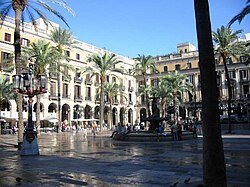 To Plaça Reial
Barcelona Cathedral → Plaça Reial
Medieval lanes
Finish in Plaça Reial, an arcaded nineteenth-century square just off La Rambla, ringed by palm trees and cafés and lit by two lamp-posts designed by the young Gaudí. A perfect place to sit with a vermouth and watch the day end.
About this place
The Royal Square is a square in the Barri Gòtic of Barcelona, Catalonia, Spain. It is close to La Rambla, and is a popular tourist attraction, especially at night. The plaza hosts many restaurants and some of the city's most famous nightclubs, including Sidecar, Jamboree, Karma and the historic and reinvented speakeasy cocktail bar Nou Pipa Club. The square is the site of the Hotel Roma Reial and is also known for its many outdoor venues. It is a popular meeting place in the summer, during the annual La Mercè festival in September when open-air concerts take place, and during other celebrations such as New Year's Eve.
Read more on Wikipedia Photo: Mac9 · CC BY-SA 3.0
Comments
Sign in to join the conversation.
No comments yet — be the first.