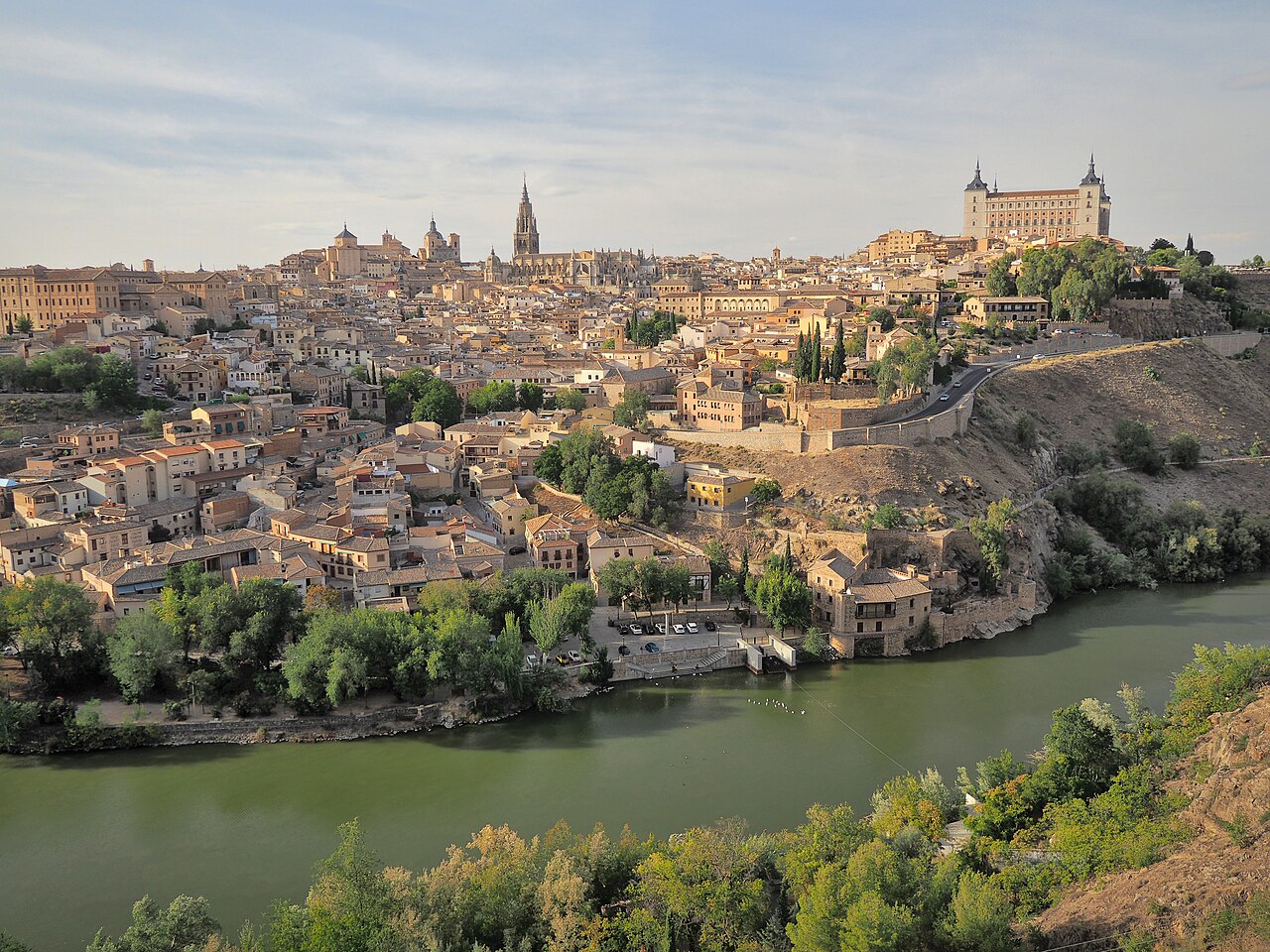
A single loop from the city’s monumental gate up through the cathedral quarter, down into the Judería, and back to the Alcázar above the river.
Segments
- Puerta de Bisagra and the climb into the old town
Puerta de Bisagra Nueva → Plaza de Zocodover
Cobbled streets, steady uphill
Start at Toledo's best-known gate. It is Moorish in origin, but the great twin-towered front you see was largely built in 1559 by Alonso de Covarrubias and carries the coat of arms of Emperor Charles V — a Christian emperor's badge bolted onto an Islamic gate, which is the whole city in one object. From here climb into the walled town, past the Mudéjar brick belfries, to the triangular Plaza de Zocodover. About 30 minutes.
-
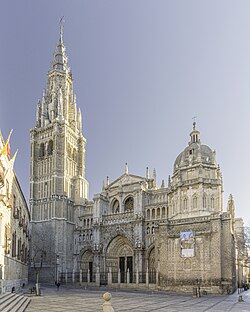 Toledo Cathedral
Plaza de Zocodover → Toledo Cathedral
Narrow lanes
One of the three great 13th-century High Gothic cathedrals of Spain, begun in 1226 and vaulted over the central nave by 1493. Its unusual five-nave plan exists because the builders set out to cover the whole footprint of the city's former main mosque, and the cloister took the old sahn — so the mosque's ground plan is still dictating the shape of the church. Look for the Transparente, the Baroque light-shaft cut through the ambulatory vault, and the Mudéjar multifoil arches in the triforium. Allow about 90 minutes.
About this place
The Primatial Metropolitan Cathedral of Saint Mary of the Assumption, is a Roman Catholic cathedral in Toledo, Spain. It is the seat of the Metropolitan Archdiocese of Toledo. Since 1088, it holds the honorific title of Primatial, granted by Urban II, establishing a higher rank over the rest in the Iberian Peninsula.
Read more on Wikipedia - Santa María la Blanca
Toledo Cathedral → Calle Reyes Católicos
Narrow lanes, downhill
The strangest and most moving building in Toledo: a synagogue, raised for the city's Jewish community, in a Mudéjar style whose horseshoe arches and pine-cone capitals sit close to 12th-century Almohad work in Morocco — and later taken over as a church. Dating is disputed; scholars variously argue for around 1180 or around 1205. After the pogroms of 1391 it was sacked and appropriated by the Church, and consecrated in the early 15th century, though sources disagree on the exact year. The white horseshoe arcades under a plain roof are still the plainest, best argument for what 'three cultures' actually meant. About 30 minutes.
-
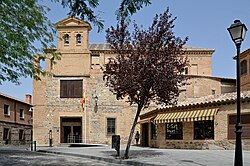 El Tránsito synagogue & the Sephardic Museum
Santa María la Blanca → Calle Samuel Leví
Narrow lanes
Built in 1357 as an annex to the palace of Samuel HaLevi, treasurer to King Peter of Castile, and designed by the master mason Don Meir Abdeil. The prayer hall's upper walls carry dense Mudéjar stucco and Hebrew inscriptions, with a women's gallery above. It became a church after the expulsion of 1492 and briefly served as barracks in the Napoleonic wars; since 1910 it has housed the Sephardic Museum, which tells the story of Jewish Spain and the Sephardim up to 1492 and after. Allow about an hour.
About this place
The Synagogue of El Tránsito, also known as the Synagogue of Samuel ha-Levi or Halevi, is a former Jewish congregation and synagogue, located at on Calle Samuel Levi, in the historic old city of Toledo, in the province of Castilla-La Mancha, Spain.
Read more on Wikipedia - San Juan de los Reyes
El Tránsito → Monastery of San Juan de los Reyes
Narrow lanes
The Franciscan monastery the Catholic Monarchs built between 1477 and 1504, in the extravagant Isabelline style, as their intended burial place — a plan abandoned once Granada fell. The two-storey cloister is the finest thing here. Note the chains hung along the outer walls, said to be those of Christian captives freed at Granada: a monument raised at the exact moment the three-culture city was being dismantled, a few minutes' walk from two synagogues. About 45 minutes.
-
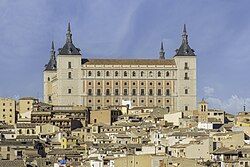 The Alcázar and the Tagus gorge
San Juan de los Reyes → Alcázar of Toledo
Cobbled streets and riverside path, uphill finish
Finish by climbing back across the town to the Alcázar, the square stone fortress on the highest point, framed by four tall corner towers. Most of what stands was rebuilt between 1939 and 1957 after the building was wrecked in the Civil War siege; it now holds the Army Museum. Then walk out to the walls above the Tagus — the longest river in the Iberian Peninsula — and look down into the gorge that wraps the city on three sides and explains why Toledo is where it is. Best in the last hour of light.
About this place
The Alcázar of Toledo is a stone fortification located in the highest part of Toledo, Spain. It is a large quadrangular building measuring 60 meters on a side, framed by four large towers 60 meters high, each crowned by the typical Madrid spire. Most of the building was rebuilt between 1939 and 1957 after the siege of the Alcázar during the Spanish Civil War.
Read more on Wikipedia
Comments
Sign in to join the conversation.
No comments yet — be the first.