City walk Granada — Alhambra & Albaicín, Spain

Granada on Foot: the Alhambra, the Albaicín and Sacromonte

One full day walking from the Nasrid palaces and the Generalife gardens down into the whitewashed lanes of the Albaicín, ending with sunset at San Nicolás and the cave quarter of Sacromonte.

Granada on Foot: the Alhambra, the Albaicín and Sacromonte
Photo: Jebulon · CC0
Duration
1 day
Distance
6 km
Walking time (est.)
2 h
Ascent
200 m
Difficulty
Easy
Best season
March–May and September–November; avoid the fierce Andalusian midsummer heat

Walking

    Your location stays on this phone. It is never sent, stored or put in a link.

    Packing list

    Getting there and back

    Start
    Alhambra main entrance
    Finish
    Sacromonte

    One-way: plan your trip back

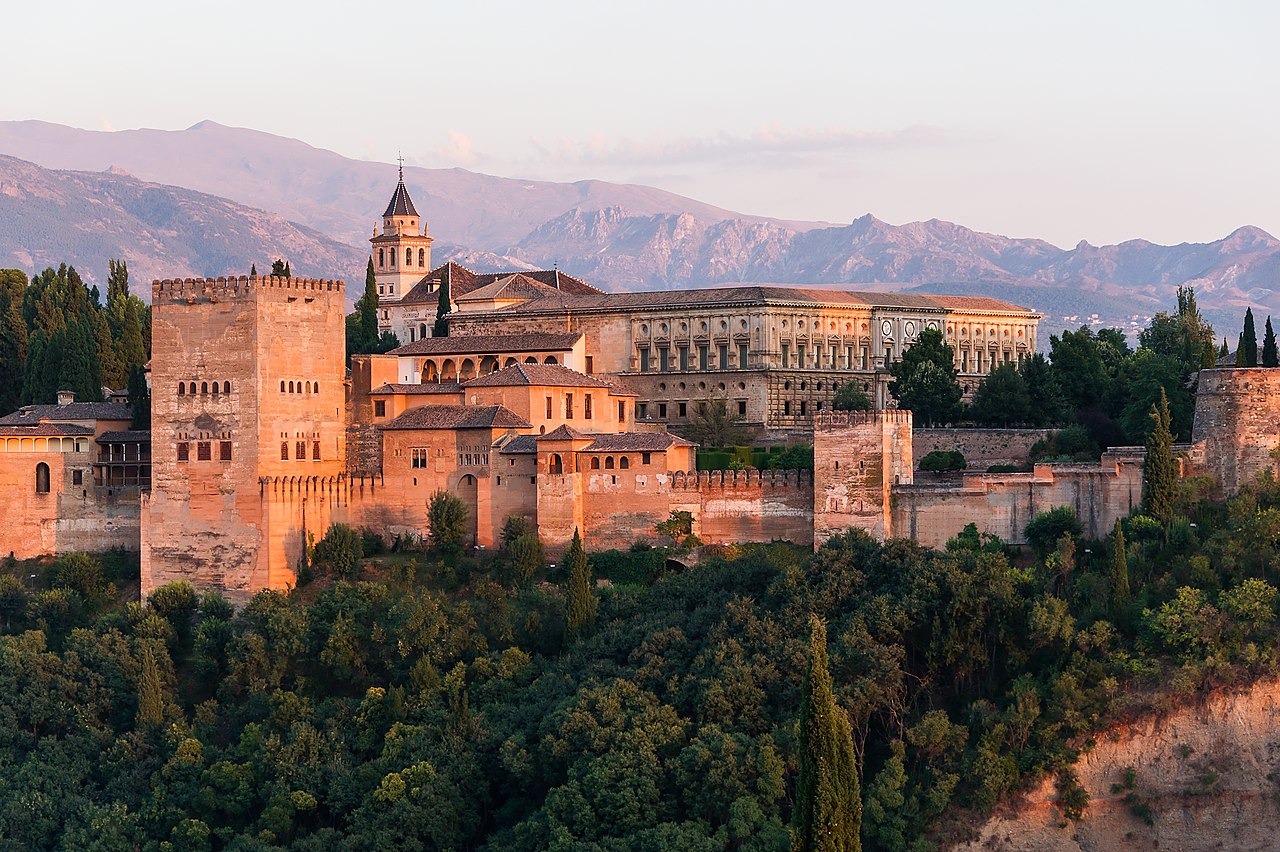
    Granada holds the only well-preserved palace complex to survive from the medieval Islamic world, and it sits on a ridge looking straight across at the hillside neighbourhood that grew up with it. Walking the two in a single day — the Alhambra in the morning, the Albaicín in the afternoon — is the best way to understand how they belong to each other.

    The day is easy underfoot but not flat: expect steep cobbled lanes, worn paving and a fair amount of stepped climbing between the river and the miradors.

    Getting there. Granada’s centre is compact and walkable. Small C-line minibuses grind up to both the Alhambra and the Albaicín from Plaza Isabel la Católica if you would rather not climb; the nearest airports are Granada–Jaén and Málaga, with regular buses and trains into the city.

    Permits & tickets. This is the one thing not to improvise. The Nasrid Palaces require a timed-entry ticket booked well in advance — entry is for a specific half-hour slot, the daily allocation is capped, and popular dates sell out weeks ahead. Book on the official site, bring the ID you booked with, and arrive early: miss your slot and the ticket is void. The Generalife and Alcazaba are included in the general Alhambra ticket; the Albaicín, the Mirador de San Nicolás and the streets of Sacromonte are free.

    Good to know:

    Tips & Insights for this route Planning this route? Read our practical tips before you go — 3 tips. Read the tips

    Elevation profile

    Highest point
    782 m Day 1
    Lowest point
    712 m Day 1
    Total descent
    77 m

    Point at the profile, or focus it and use the arrow keys, to see that spot on the map.

    Terrain heights along a straight line between each day’s stops, not along the footpath, so a pass or a switchback the path takes can be missing. Descent and walking times use the same line.

    Elevation data: Terrain Tiles (Mapzen, AWS Open Data)

    Day by day

    DayDistanceAscentDescent (est.)Walking time (est.)
    Day 1 Hardest dayFrom the Alhambra to Sacromonte
    Distance6 kmAscent200 mDescent (est.)77 mWalking time (est.)2 h

    Flights on Kayak Car rental on Localrent Travel eSIM on Airalo

    Day 1

    From the Alhambra to Sacromonte

    Alhambra main entrance → Sacromonte 6 km 200 m 2 h

    A single downhill-trending line across Granada’s two facing hills, timed so that the climb is done early and the viewpoint arrives at golden hour.

    Drinking water

    Places mapped by volunteers on OpenStreetMap; opening times and taps change, so check before relying on one. © OpenStreetMap contributors

    Segments

    1. The Alhambra: Nasrid Palaces and the Alcazaba 1.5 km 60 m Map

      Alhambra main entrance → Alcazaba towers

      Paved palace paths and stairs

      Enter at your booked slot for the Nasrid Palaces — the Comares palace with its long still reflecting pool, the Court of the Lions with its ring of slender columns, and room after room of carved stucco and tilework. Then walk west to the Alcazaba, the oldest surviving part of the complex, and climb its watchtower for the view over the whole city. Allow about two hours.

    2. The Generalife gardens
      The Generalife gardens 1 km 40 m Map

      Alcazaba → Generalife

      Garden paths and steps

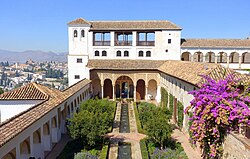
      Uphill and east of the palaces lies the Generalife, the summer estate and country retreat of the Nasrid rulers of Granada. Water is the whole idea here: channelled, jetted and stepped down the hillside through courtyards of clipped hedge and cypress. About an hour.

      About this place

      The Generalife was a summer palace and country estate of the Nasrid rulers of the Emirate of Granada in Al-Andalus. It is located directly east of and uphill from the Alhambra palace complex in Granada, Spain.

      Read more on Wikipedia Photo: Daderot · CC BY-SA 4.0
    3. Down into the Albaicín's carmen lanes
      Down into the Albaicín's carmen lanes 2 km 70 m Map

      Generalife → Albaicín

      Steep cobbled lanes and steps

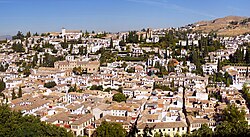
      Drop to the Darro river and climb the far bank into the Albaicín, which still keeps the medieval street plan it had under the Nasrids and is a World Heritage Site in its own right. Wander the lanes between the carmenes — walled houses whose gardens you glimpse through gateways — with no particular destination. About 90 minutes.

      About this place

      The Albaicín, also spelled Albayzín, is a neighbourhood of Granada, Spain. It is centered around a hill on the north side of the Darro River which passes through the city. The neighbourhood is notable for its historic monuments and for largely retaining its medieval street plan dating back to the Nasrid period, although it nonetheless went through many physical and demographic changes after the end of the Reconquista in 1492. It was declared a World Heritage Site in 1994, as an extension of the historic site of the nearby Alhambra.

      Read more on Wikipedia Photo: Bert K. · CC BY 2.0
    4. Sunset at the Mirador de San Nicolás 0.5 km 30 m Map

      Albaicín lanes → Mirador de San Nicolás

      Cobbled streets and steps

      Climb to the terrace beside the church of San Nicolás, where the whole Alhambra stands opposite on its ridge with the snow-streaked Sierra Nevada behind it. Come well before sunset — it is the most famous viewpoint in the city and it fills up, usually to the sound of a guitar.

    5. The cave quarter of Sacromonte
      The cave quarter of Sacromonte 1 km 0 m Map

      Mirador de San Nicolás → Sacromonte

      Hillside lanes

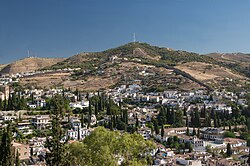
      Follow the ridge east into Sacromonte, the neighbourhood of whitewashed cave dwellings cut into the hillside and long associated with Granada's Roma community and with flamenco. End the day at a zambra performance or simply on a wall watching the last light leave the Alhambra.

      About this place

      Sacromonte, sometimes also called Sacramonte, is a traditional neighbourhood in the eastern area of the city of Granada in Andalusia, Spain. It is one of the six neighbourhoods that make up the urban district of Albayzín and borders the neighbourhoods of Albayzín, San Pedro, Realejo-San Matías, El Fargue and Haza Grande.

      Read more on Wikipedia Photo: Jebulon · CC0
    Partner link: if you book through it we may earn a commission, at no extra cost to you. It does not change what we recommend. How this works

    Tips & Insights

    Packing list

    Filled in for this route from the kit a walk like this needs and the gear its tips mention. Tick things off as you pack.

    Clothing and footwear
    Gear
    Health and sun
    Water and food

    Nasrid Palaces

    • Your ticket has a boarding-pass-style time slot — miss it and you're not getting in

      The Nasrid Palaces, the ornate heart of the Alhambra, admit visitors only in the specific window printed on the ticket, with no re-entry once it passes. The official booking portal is where to buy — the Access Pavilion ticket office also sells same-day when any are left, and authorised agents hold a share of capacity — and the palace slots for summer and Easter week sell out weeks ahead, mornings first.

    Planning the day

    • Book the Alhambra before you book anything else in Granada

      Because the Nasrid Palace slot is the bottleneck for the whole day, fix the Alhambra time first and build the Albaicín and Sacromonte legs of the walk around it, rather than the other way round.

    Sacromonte

    • The cave quarter is a neighborhood, not an open-air museum

      Some of Sacromonte’s whitewashed cave-houses are still lived in as homes, while others have become small flamenco venues or museums; either way, the lanes are someone’s street, which is worth remembering with a camera in hand, especially in the evening.

    Comments