
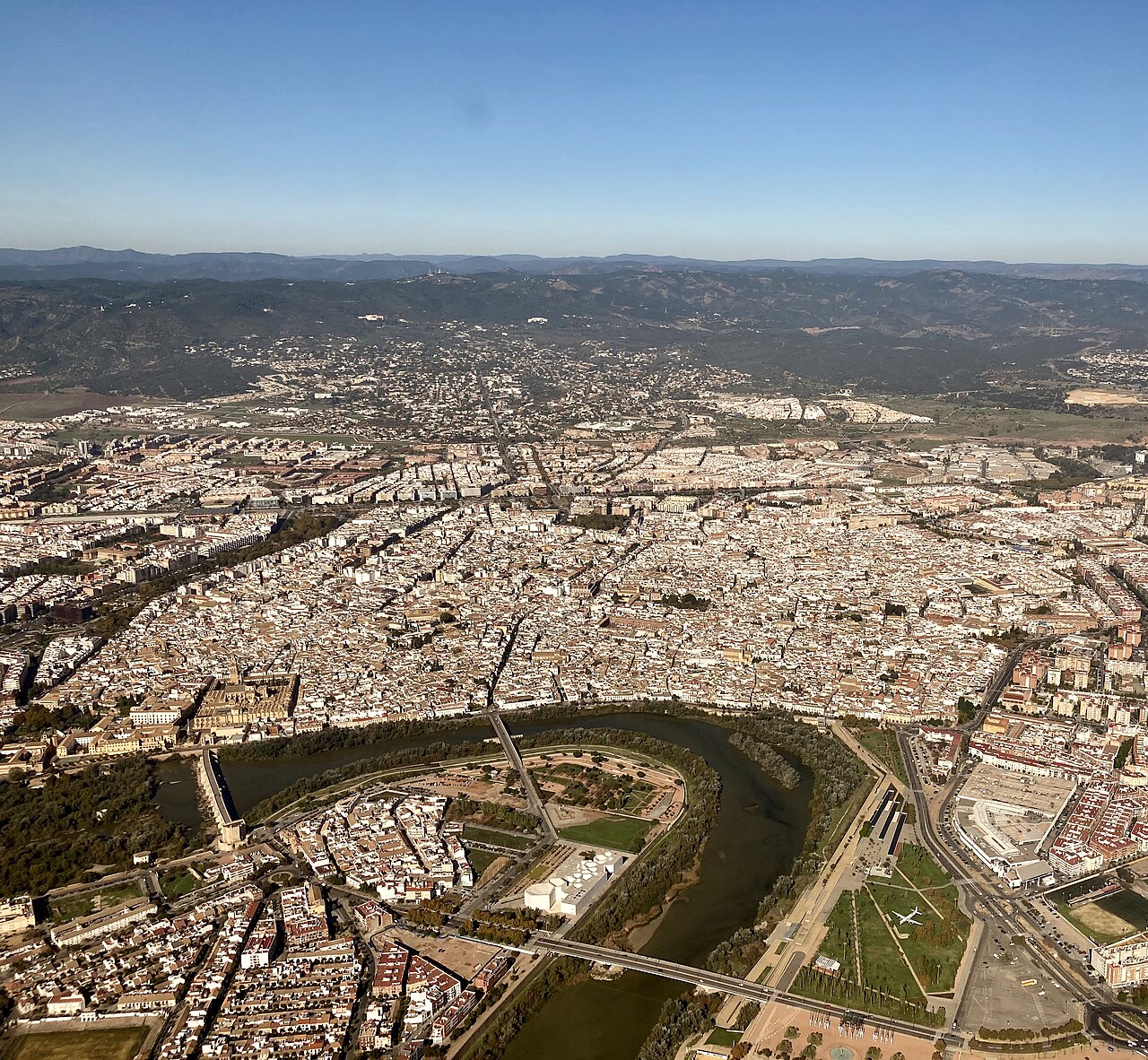
A continuous loop from the Mosque–Cathedral down to the Roman bridge, back through the Jewish quarter and the Alcázar, and out to the patios of San Basilio.
Drinking water
- Water
- Drinking water 80 m from stop 1
- Drinking water 150 m from stop 2
- Drinking water 40 m from stop 3
- Drinking water 140 m from stop 4
- Drinking water 30 m from stop 5
Places mapped by volunteers on OpenStreetMap; opening times and taps change, so check before relying on one. © OpenStreetMap contributors
Segments
-
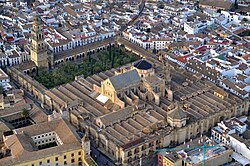 The Mosque–Cathedral (Mezquita)
Patio de los Naranjos → Mosque–Cathedral of Córdoba
City streets and courtyards
Begin in the great mosque begun in 785 under Abd al-Rahman I, whose interior opens into a famous forest of columns carrying red-and-white double arches. After the Christian conquest a Renaissance cathedral nave was built into the middle of the prayer hall in the sixteenth century, leaving the two faiths interlocked under one roof. It was listed by UNESCO in 1984. Allow about 90 minutes.
About this place
The Mosque–Cathedral of Córdoba is the cathedral of the Roman Catholic Diocese of Córdoba in the Spanish region of Andalusia. Officially called the Cathedral of Our Lady of the Assumption, it is dedicated to the Assumption of Mary. Due to its status as a former mosque, it is also known as the Mezquita and, in a historical sense, as the Great Mosque of Córdoba.
Read more on Wikipedia Photo: Toni Castillo Quero · CC BY-SA 2.0 -
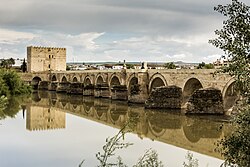 The Roman bridge over the Guadalquivir
Mosque–Cathedral of Córdoba → Puente Romano
City streets and paved bridge
Walk down through the Puerta del Puente to the Roman bridge, which crosses the Guadalquivir on a line of stone arches. Roman in origin — first built around the early first century BC — it was repaired and rebuilt many times over the centuries and carried the main road south for most of the city's history. It is now for pedestrians only. About 30 minutes with the crossing.
About this place
The Roman bridge of Córdoba is in the Historic centre of Córdoba, Andalusia, southern Spain
Read more on Wikipedia Photo: Rafesmar · CC BY-SA 4.0 -
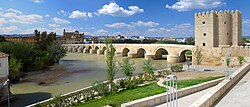 The Calahorra tower
Puente Romano → Torre de la Calahorra
Paved bridge and riverbank
At the far end of the bridge stands the Calahorra, a fortified gate of Islamic origin that guarded the southern approach to the city. It now houses a small museum on the shared Muslim, Jewish and Christian culture of medieval al-Andalus, and its roof gives the classic view back across the river to the Mezquita. About 45 minutes.
About this place
The Calahorra tower is a fortified gate in the historic centre of Córdoba, Spain. The edifice is of Islamic origin.
Read more on Wikipedia Photo: Wolfgang Manousek from Dormagen, Germany · CC BY 2.0 -
 The Judería and the Synagogue
Torre de la Calahorra → Córdoba Synagogue
Narrow lanes and small squares
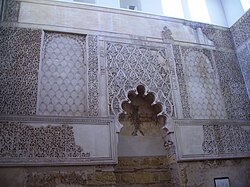
Recross the bridge and climb into the Judería, the old Jewish quarter — a maze of whitewashed lanes and flowered courtyards around the Calle de los Judíos. Its small Mudéjar synagogue, completed in 1315, is one of only three medieval synagogues to survive in Spain, the other two in Toledo. Get pleasantly lost between the walls. About 60 minutes.
About this place
The Córdoba Synagogue is a historic former Jewish congregation and synagogue located at 20 Calle de los Judíos in the Jewish Quarter of Córdoba, Andalusia. Completed in 1315, with its Mudéjar design attributed to Isaac Makheb, the synagogue's small size points to it possibly being the private synagogue of a wealthy resident. It is also possible that Córdoba's complex of buildings was a yeshiva, kollel, or beth midrash. Another possibility is that it was initially a local trade guild's workroom or a residence before converting to a synagogue.
Read more on Wikipedia Photo: Américo Toledano · CC BY-SA 3.0 -
 The Alcázar de los Reyes Cristianos
Córdoba Synagogue → Alcázar de los Reyes Cristianos
City streets, fortress halls and garden paths
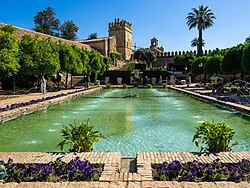
Head down to the riverside fortress-palace that gives the route its royal chapter. Rebuilt in the fourteenth century, it served as a residence of Ferdinand and Isabella, who are said to have received Columbus here before his first voyage. Leave time for the terraced gardens with their long reflecting pools. About 75 minutes.
About this place
The Alcázar de los Reyes Cristianos, also known as the Alcázar of Córdoba, is a medieval alcázar located in the historic centre of Córdoba, next to the Guadalquivir River and near the Mosque-Cathedral. The fortress served as one of the primary residences of Isabella I of Castile and Ferdinand II of Aragon.
Read more on Wikipedia Photo: Ajay Suresh from New York, NY, USA · CC BY 2.0 -
 The patios of San Basilio
Alcázar de los Reyes Cristianos → San Basilio (Alcázar Viejo)
Quiet residential lanes
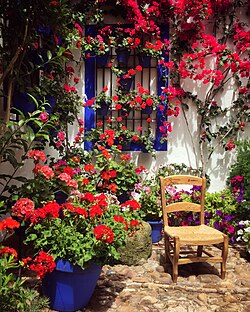
Finish in San Basilio, the Alcázar Viejo neighbourhood whose private courtyards are the epicentre of Córdoba's Courtyards Festival, held each early May since 1921 and inscribed on UNESCO's Intangible Cultural Heritage list in 2012. Residents fill the walls with geraniums and jasmine in painted pots; a handful of patios stay open to visitors year-round. A quiet place to end the day.
About this place
The Courtyards Festival of Córdoba is a courtyard competition in Córdoba, Spain held since 1921 and generally held during the first and second week of the month of May. Participants decorate and open their courtyards for free so that they can be visited during festival hours. In 1980 they were declared a Fiestas of National Tourist Interest of Spain, and after a long process, they managed to be add to the Representative List of the Intangible Cultural Heritage of Humanity by UNESCO on December 6, 2012.
Read more on Wikipedia Photo: Elena.laps · CC BY-SA 4.0
Comments
Sign in to join the conversation.
No comments yet — be the first.