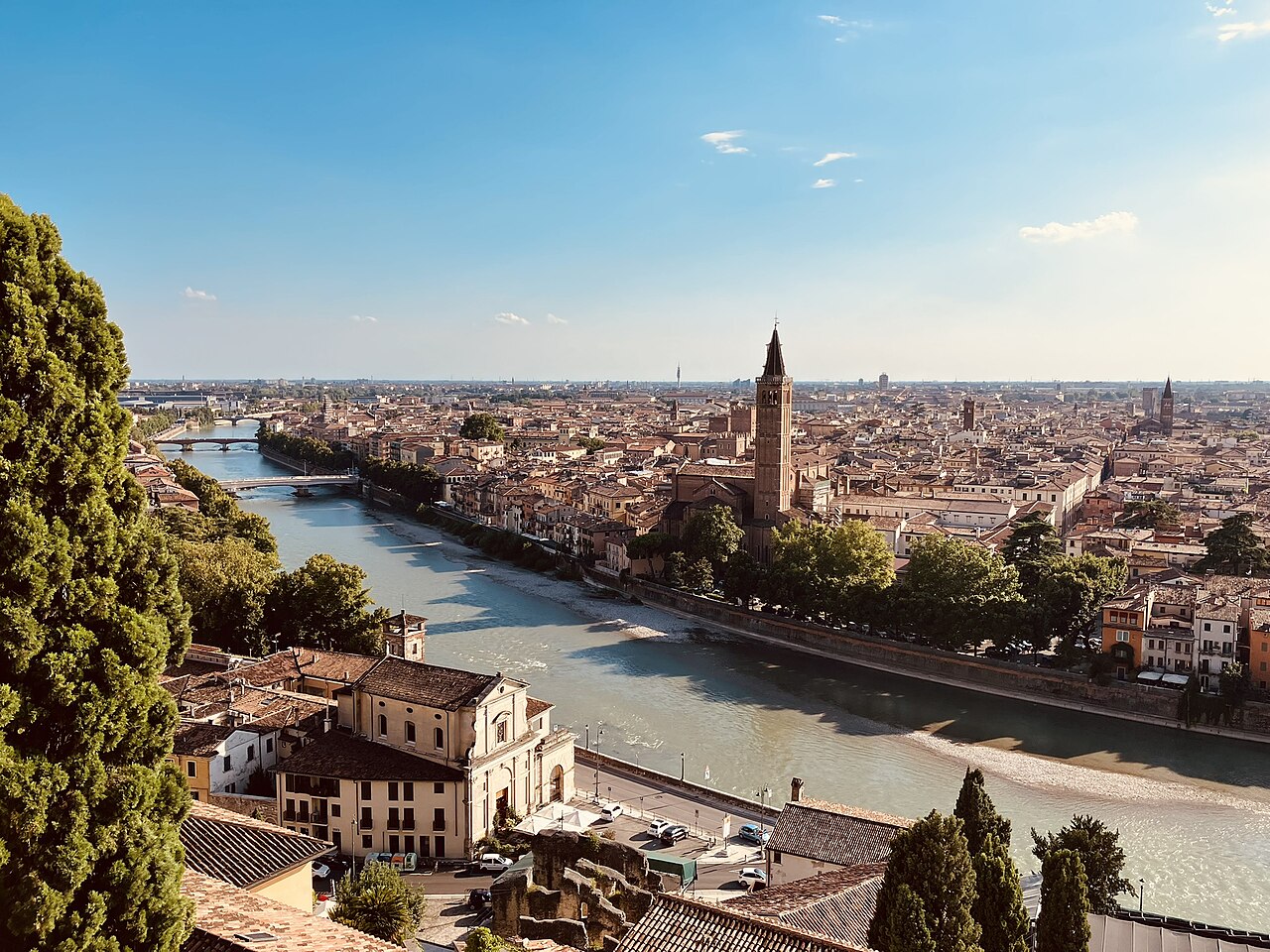
A continuous line from Piazza Bra north through the market squares, then southwest to the castle and back to the river.
Segments
-
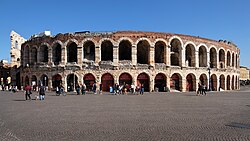 The Roman Arena
Piazza Bra → Verona Arena
City streets and paved square
Begin in Piazza Bra at the Verona Arena, the Roman amphitheatre built in the first century AD and among the best-preserved to survive. It once held a crowd of about 30,000, and since 1913 it has staged one of the world's great open-air opera festivals each summer. Climb the tiers and look down into the arena floor. Allow about 60 minutes.
About this place
The Verona Arena is a Roman amphitheatre located in the historic center of Verona, Italy. It is among the best-preserved ancient amphitheatres to have survived into the modern era. This remarkable state of preservation is largely due to systematic restoration efforts that began in the 16th century.
Read more on Wikipedia -
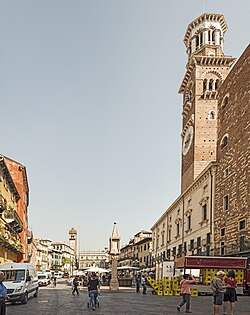 Piazza delle Erbe
Verona Arena → Piazza delle Erbe
City streets
Walk north up Via Mazzini, Verona's elegant shopping street, to Piazza delle Erbe. The square sits on the site of the Roman forum and has been a market for centuries, ringed by frescoed palazzi and overlooked by the tall Torre dei Lamberti. At its centre a fountain carries the Madonna Verona, a statue assembled around a Roman-era figure. About 30 minutes.
About this place
Piazza delle Erbe is a square in Verona, northern Italy. It was once the town's forum during the time of the Roman Empire.
Read more on Wikipedia - Juliet's House & balcony
Piazza delle Erbe → Casa di Giulietta
City streets
A short walk down Via Cappello reaches the Casa di Giulietta, a medieval house that once belonged to the Dal Cappello family — a name close enough to Shakespeare's Capulets to invite the connection. Be clear-eyed about it: the celebrated balcony was only added in the 1930s, and the tie to the fictional Juliet is a 20th-century tourist attachment, not a genuine historical site. The courtyard, its bronze Juliet statue and the letter-covered walls are free to enter; the house museum charges a small fee. About 20 minutes.
- Piazza dei Signori & the Scaliger Tombs
Casa di Giulietta → Piazza dei Signori
City streets and paved squares
Continue to Piazza dei Signori, the dignified civic square framed by the Palazzo del Podestà, the arcaded Loggia del Consiglio and a brooding statue of Dante, who spent years of his exile in Verona. Just beside it stand the Scaliger Tombs, five Gothic funerary monuments of the della Scala family who ruled the city from the 13th to the late 14th century. About 30 minutes.
-
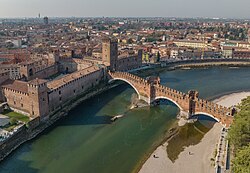 Castelvecchio
Piazza dei Signori → Castelvecchio
City streets
Head southwest toward the river to Castelvecchio, the red-brick fortress the della Scala lords built in the 1350s and now the city's civic museum, famously restored in the 20th century by the architect Carlo Scarpa. Its fortified Ponte Scaligero, with swallow-tail battlements, strides across the Adige beside it. About 45 minutes.
About this place
Castelvecchio is a castle in Verona, northern Italy. It is the most important military construction of the Scaliger dynasty that ruled the city in the Middle Ages.
Read more on Wikipedia -
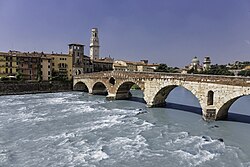 The Adige and Ponte Pietra
Castelvecchio → Ponte Pietra
Riverside streets
Finish by following the Adige — the second-longest river in Italy — upstream to the Ponte Pietra, a Roman arch bridge first completed around 100 BC and the oldest in Verona. Blown up in the last days of the Second World War, it was rebuilt in the 1950s using the original stones recovered from the riverbed. From the far bank, or the Roman theatre on the slope above it, the view back over the rooftops closes the day. About 40 minutes.
About this place
The Ponte Pietra is a Roman arch bridge crossing the Adige River in Verona, Italy. The bridge was completed in 100 BC, and the Via Postumia from Genoa to Aquileia passed over it. It is the oldest bridge in Verona.
Read more on Wikipedia
Comments
Sign in to join the conversation.
No comments yet — be the first.