A single easy loop through the oldest part of Siena, from the Piazza del Campo to the contrada lanes, never straying far from the Duomo.
Segments
- Piazza del Campo & the Palio
Via di Città → Piazza del Campo
Brick-paved streets and square
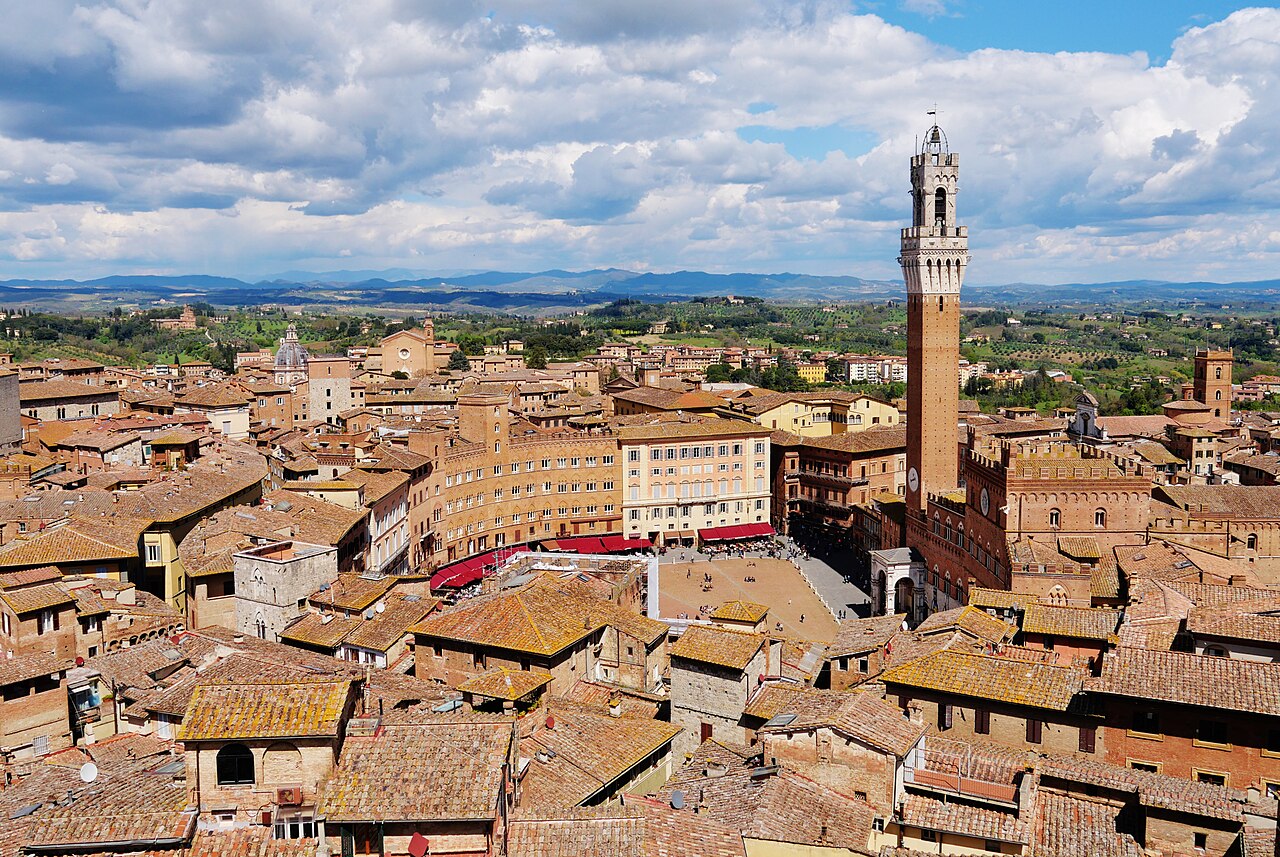
Begin in the scallop-shaped Piazza del Campo, regarded as one of the greatest medieval squares in Europe. Its red brick fans down toward the Palazzo Pubblico, and the Fonte Gaia fountain marks the upper edge. Twice each summer, on 2 July and 16 August, the square is packed with earth and becomes the track for the Palio, the bareback horse race run between the city's contrade. Allow about 30 minutes to take it in.
- The Torre del Mangia
Piazza del Campo → Top of the Torre del Mangia
Stone tower staircase
Rising from the Palazzo Pubblico on the Campo is the Torre del Mangia, built in 1338–1348 and, at about 100 metres, once among the tallest secular towers in medieval Italy. The narrow climb to the top is steep but rewards you with a sweeping view over the terracotta rooftops and out to the Tuscan hills. Allow about 45 minutes, including any wait at the entrance.
- Siena Cathedral & the Piccolomini Library
Piazza del Campo → Piazza del Duomo
City lanes, some uphill
Climb the lanes to the Duomo, a medieval cathedral dedicated to the Assumption of Mary and wrapped in bands of black-and-white marble. Inside, look down at the elaborate inlaid marble floor and step into the Piccolomini Library, its walls covered in bright frescoes celebrating the life of the Sienese pope Pius II. Allow about 75 minutes.
- The Baptistery
Piazza del Duomo → Battistero di San Giovanni
Steps behind the cathedral
Tucked beneath the choir of the cathedral, reached by steps down its rear flank, is the Baptistery of San Giovanni. Its centrepiece is a hexagonal baptismal font ringed with gilded bronze and marble panels by leading early-Renaissance sculptors. It is small and easily missed — allow about 30 minutes.
- The contrade lanes
Battistero di San Giovanni → The old-town contrade
Steep medieval lanes
Finish by wandering out into the contrade, the seventeen historic wards that divide the old city. Each is named for an animal or symbol — the wolf, the snail, the tortoise — and marks its territory with painted flags, plaques and small fountains. Let yourself get pleasantly lost among the steep lanes; this is where Siena's living identity is easiest to feel. Allow about an hour to wander.
Comments
Sign in to join the conversation.
No comments yet — be the first.