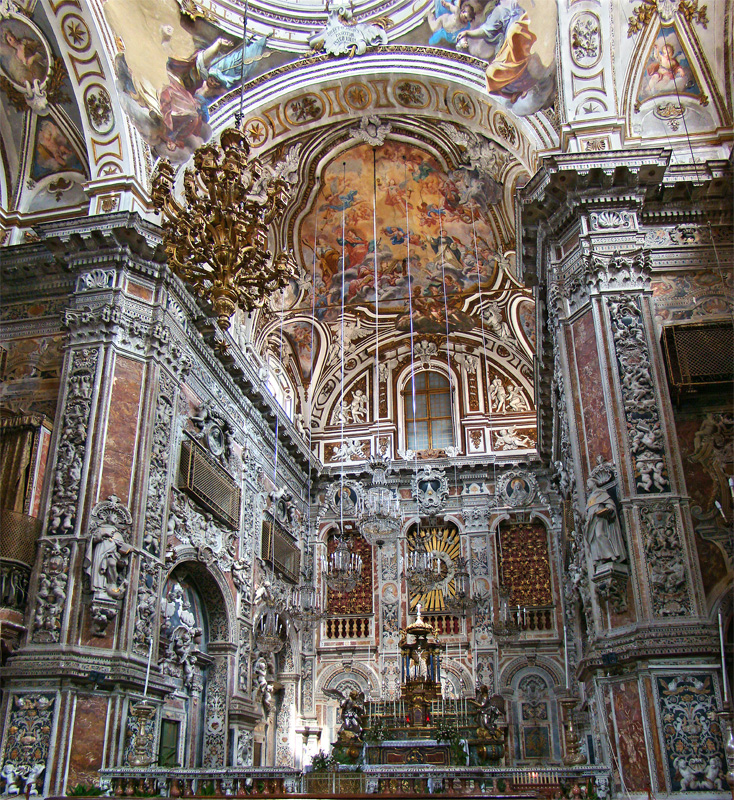
A loop from the Baroque crossroads at the city’s centre out to the Norman palace, through the markets, and back to the opera house.
Segments
- Quattro Canti
Via Maqueda → Piazza Vigliena
City streets
Start where the city organises itself: a Baroque octagon, officially Piazza Vigliena, where Via Maqueda crosses the Corso Vittorio Emanuele and the corners of Palermo's four ancient quarters — Kalsa, Seralcadi, Albergaria and Castellammare — meet at a single point. Each concave facade is stacked with fountains, seasons, kings and patron saints. Fontana Pretoria and the Norman church of La Martorana are a few steps away and worth the detour. About 30 minutes.
About this place
Quattro Canti, officially known as Piazza Vigliena, is a Baroque square in Palermo, region of Sicily, Italy; it is considered the center of the historic quarters of the city. The site is the intersection of two major streets in Palermo, the Via Maqueda and the Corso Vittorio Emanuele, and at this intersection are the corners of all four of the ancient quarters of Palermo: the Kalsa (SE); Seralcadi (SW); Albergaria (NW); and Castellammare (NE). On the southwest corner stands the church of San Giuseppe dei Padre Teatini. A few steps away along the flank of this church, behind the Southeast corner building, along Via Maqueda is the Piazza and Fontana Pretoria, sandwiched between this church and Santa Caterina. A few more steps reaches San Cataldo and the ancient Norman church of La Martorana. About 500 meters west along the Cassaro is the piazza of the Cathedral of Palermo and the adjacent Palazzo dei Normanni.
Read more on Wikipedia -
 Palermo Cathedral
Quattro Canti → Piazza della Cattedrale
City streets
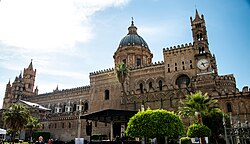
Walk about 500 m west along the Cassaro — the city's oldest street — to a cathedral that refuses to be one thing. Founded by the Normans in the 12th century on the site of a mosque, it has been added to and altered ever since, ending with an 18th-century dome; a Quranic inscription still survives on one of the portico columns. Inside are the porphyry tombs of Sicily's kings, including Frederick II. About 45 minutes.
About this place
Palermo Cathedral is the cathedral church of the Roman Catholic Archdiocese of Palermo, located in Palermo, Sicily, southern Italy. It is dedicated to the Assumption of the Virgin Mary. As an architectural complex, it is characterized by the presence of different styles, due to a long history of additions, alterations and restorations, the last of which occurred in the 18th century.
Read more on WikipediaPhoto: Julian Lupyan · CC0
-
 Palazzo dei Normanni & the Cappella Palatina
Palermo Cathedral → Piazza Indipendenza
City streets, gentle rise
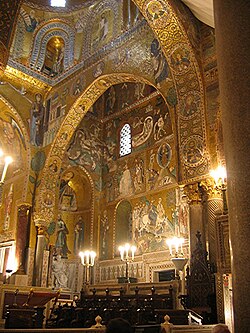
Continue up to the oldest royal residence in Europe — seat of the Norman kings, imperial seat of Frederick II, and since 1946 home of the Sicilian Regional Assembly. Upstairs, the Cappella Palatina is the single best room in Sicily: Byzantine gold mosaics, Norman architecture and a honeycombed muqarnas ceiling painted by Fatimid craftsmen, all in one 12th-century chapel. Give it an hour and don't rush the ceiling.
About this place
The Palatine Chapel /ˈpælətaɪn ˈtʃæpəl/ is the royal chapel of the Norman Palace in Palermo, Sicily. This building is a mixture of Byzantine, Norman, and Fatimid architectural styles, showing the tricultural state of Sicily during the 12th century after Roger I and Robert Guiscard conquered the island.
Read more on WikipediaPhoto: No machine-readable author provided. Urban~commonswiki assumed (based on copyright claims). · CC BY-SA 3.0
- Ballarò market
Palazzo dei Normanni → Ballarò, Albergaria quarter
Narrow market lanes
Drop off the monumental route into the Albergaria quarter and Palermo's oldest and busiest food market. Awnings, crates of citrus and swordfish, vendors calling prices in a sing-song Sicilian chant that has been compared to a souk — which is more or less what it descends from. Eat here: panelle, arancine, sfincione. Go in the morning. About 45 minutes.
-
 Vucciria
Ballarò → Piazza Caracciolo
City streets and narrow alleys
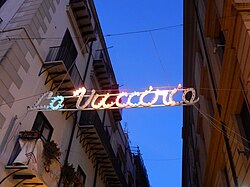
Cut back across the centre into the Castellammare quarter for the second market — a warren of pedestrian alleys and small piazzas between San Domenico and Via Roma. Half-derelict, graffitied and much diminished as a food market, but it has become the city's late-night street-food and drinking quarter, and the noise after dark is extraordinary. About 45 minutes.
About this place
La or a Vuccirìa is an ancient, large market or bazaar area and neighborhood, with shops and tables selling products, produce, and foodstuffs located in the ancient quarter of Castellammare of central Palermo, region of Sicily, Italy. It consists of numerous pedestrian alleys and small piazzas in a crowded urban setting, is generally bounded to the North by the church and piazza of San Domenico, to the West by Via Roma, Palermo, and to the South by Via Vittorio Emanuele. Despite the dilapidated buildings and graffiti, the bustling spectacle of hawkers vociferously proffering their wares and the many food and drink establishments and dives, often open till late at night, are a draw for tourism in Palermo.
Read more on WikipediaPhoto: Pmk58 · CC BY-SA 4.0
-
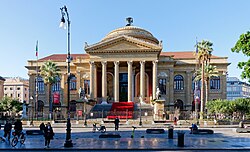 Teatro Massimo
Vucciria → Piazza Verdi
City streets
Finish up Via Maqueda at the largest opera house in Italy and one of the largest in Europe, opened in the 1890s and famous for its acoustics. Climb the steps between the bronze lions — you will recognise them from the closing scene of The Godfather Part III. Take the guided tour if you can, or a performance if you can time it. About 1 hour for the tour.
About this place
The Teatro Massimo Vittorio Emanuele is an opera house and opera company located on the Piazza Verdi in Palermo, Sicily. It was dedicated to King Victor Emanuel II. It is the biggest in Italy, and one of the largest of Europe, renowned for its perfect acoustics.
Read more on WikipediaPhoto: Holger Uwe Schmitt · CC BY-SA 4.0
Comments
Sign in to join the conversation.
No comments yet — be the first.