From the moats of Osaka Castle, south through a food market and an old entertainment quarter, ending among the neon of Dōtonbori and a lantern-lit alley behind it.
Segments
-
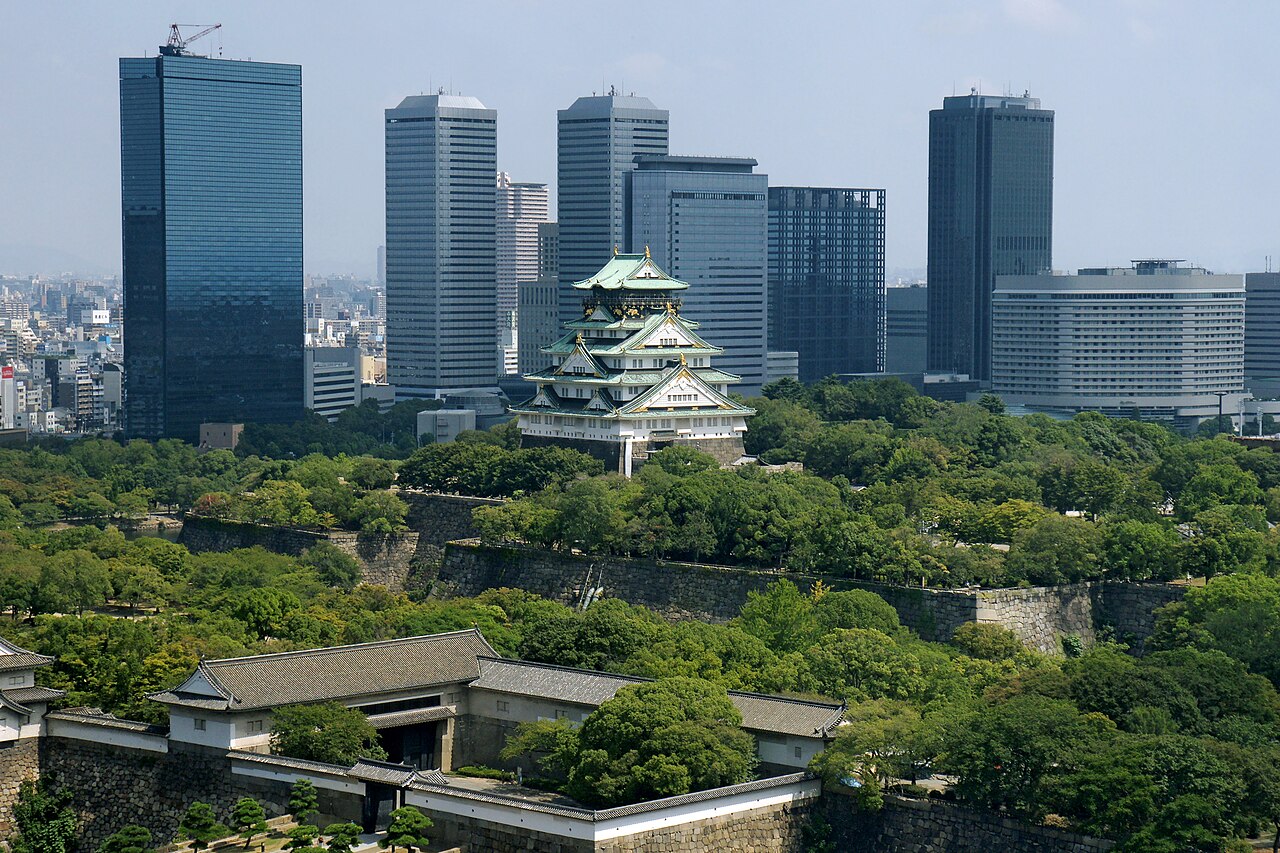
 Osaka Castle
Osakajōkōen station → Castle tower
Park paths and castle steps
One of Japan's most famous landmarks, in Chūō ward, and a major player in the unification of the country during the sixteenth-century Azuchi–Momoyama period. The tower you climb is a ferroconcrete reconstruction; inside it works as a museum, with cases of artifacts relating to the original structure. Allow about an hour and a half.
About this place
Osaka Castle is a Japanese castle in Chūō-ku, Osaka, Japan. The castle is one of Japan's most famous landmarks and played a major role in the unification of Japan during the sixteenth century of the Azuchi–Momoyama period.
Read more on WikipediaPhoto: 663highland · CC BY 2.5
-
 Osaka Castle Park & the moats
Castle tower → Tanimachi 4-chōme
Park paths
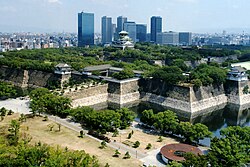
Circle out through the park that surrounds the keep, past broad moats and the enormous cut stones of the walls. It is one of the city's best-loved cherry-blossom grounds, and free to walk at any hour.
About this place
Osaka Castle Park is a public urban park and historical site situated at Osaka-Jō in Chūō-ku, Osaka, Japan. It lies on the south of the Ōkawa and occupies a large area in the center of the city of Osaka. This park is the second largest park in the city.
Read more on WikipediaPhoto: 663highland · CC BY 2.5
- Kuromon Ichiba market
Tanimachi 4-chōme → Kuromon Ichiba
City streets and covered arcade
A long covered market street near Nipponbashi, and the reason Osaka is nicknamed the nation's kitchen. Stalls sell fresh fish, produce and local specialities, and many will grill or slice what you buy and hand it over on the spot. Come hungry; come in the morning.
-
 Shinsekai & Tsūtenkaku
Kuromon Ichiba → Tsūtenkaku
City streets
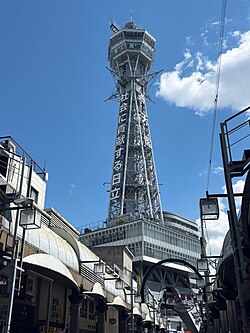
A neighbourhood laid out in 1912 with New York as the model for its southern half and Paris for its northern, built around a Luna Park that closed in 1923. The steel Tsūtenkaku tower still stands at its centre — about 108 metres tall, with an observation deck at 91 metres. The streets below are the home of kushikatsu, battered and deep-fried skewers of more or less anything.
About this place
Tsūtenkaku is a tower and landmark of Osaka, Japan, and advertises the Hitachi company. It is located in the Shinsekai district of Naniwa-ku, Osaka. Its total height is 108 metres (354 ft); the main observation deck is at a height of 91 metres (299 ft). It is owned by Tsūtenkaku Kanko Co., Ltd. .
Read more on WikipediaPhoto: Sakai Yayoi · CC0
-
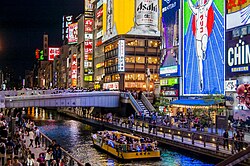 Dōtonbori & the Glico sign
Tsūtenkaku → Dōtonbori canal
Canal-side streets
The district runs along the Dōtonbori canal through Namba, in Chūō ward. Historically a theatre quarter, it is now the city's loudest nightlife strip, defined by huge illuminated signboards — a mechanical crab, a blowfish, and the Glico running man, who has been sprinting over the canal since the 1930s. Best after dark.
About this place
Dōtonbori or Dōtombori is a district in Osaka, Japan. Known as one of Osaka's principal tourist and nightlife areas, the area runs along the Dōtonbori canal from Dōtonboribashi Bridge to Nipponbashi Bridge in the Namba district of the city's Chūō ward. Historically a theater district, it is now a popular nightlife and entertainment area characterized by its eccentric atmosphere and large illuminated signboards.
Read more on WikipediaPhoto: Type specimen · CC BY-SA 3.0
-
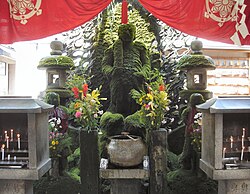 Hōzen-ji Yokochō
Dōtonbori canal → Hōzen-ji Yokochō
Flagstone alley
Duck one street back from the noise into a narrow lantern-lit alley of flagstones and small restaurants. At its heart is Hōzen-ji, a Jōdo-shū temple, and its Mizukake Fudō statue — so thoroughly furred with moss from generations of visitors ladling water over it that the figure has all but disappeared.
About this place
Hōzen-ji (法善寺) is a Buddhist temple of the Jōdo-shū sect in Chūō-ku, Osaka, Japan. The temple is located in the Dotonbori district, near Namba Station. It has a reputation in Japan for helping women who are about to give birth.
Read more on WikipediaPhoto: +- from jawp · CC BY-SA 3.0
Comments
Sign in to join the conversation.
No comments yet — be the first.