City walk Montreal — Old Montreal, Canada

Old Montreal on Foot: From Place d'Armes to the Clock Tower

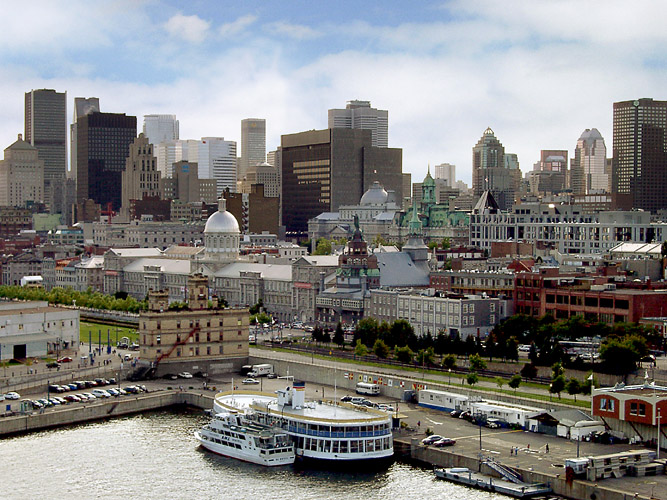
A compact half-day through the city's founding streets: the Notre-Dame Basilica, the ruins under Pointe-à-Callière, cobbled Rue Saint-Paul, Place Jacques-Cartier, the sailors' chapel and the river at the Old Port.

Old Montreal on Foot: From Place d'Armes to the Clock Tower
Photo: User Gjm130 on en.wikipedia · CC BY-SA 3.0
Duration
1 day
Distance
3.5 km
Walking time (est.)
1 h
Difficulty
Easy
Best season
May–October, with December a close second for the lights and the snow

Walking

    Your location stays on this phone. It is never sent, stored or put in a link.

    Packing list

    Getting there and back

    Start
    Place-d'Armes metro station
    Finish
    Clock Tower, Old Port

    One-way: plan your trip back

    Montreal started here, in 1642, as a fortified mission called Ville-Marie on a point of land where a small river met the St. Lawrence. The whole of Old Montreal fits into well under a square kilometre between Rue McGill and Rue Saint-André, and almost every street in it still follows the lines the French laid down. Walk it slowly and you pass through three and a half centuries in an afternoon: a Gothic Revival church big enough for thousands, the stone foundations of the first settlement, a nineteenth-century market hall that briefly served as a parliament, and the quays where the port did its work until it moved downstream in 1976.

    This route is short and flat, which is the point. It runs west to east: from Place d’Armes down to the founding site at Pointe-à-Callière, along the cobbles of Rue Saint-Paul, up and down the slope of Place Jacques-Cartier, past the sailors’ chapel of Notre-Dame-de-Bon-Secours, and out onto the Old Port promenade to finish under the Clock Tower. Budget three to four hours if you go inside the basilica and the museum, less than two if you only walk.

    Getting there. Start at Place-d’Armes metro station on the orange line; Square-Victoria–OACI (orange) and Champ-de-Mars (orange) also serve the district, and Champ-de-Mars is the easiest station to walk back to at the end. Driving into Old Montreal is not worth it: streets are narrow, some are closed to cars in summer, and parking is scarce and expensive.

    Permits & tickets. The streets, squares and Old Port promenade are free. The Notre-Dame Basilica charges admission for visits, and its evening sound-and-light show, AURA, is a separate ticket; both can be booked online. Pointe-à-Callière and the chapel museum are paid. Hours and prices change, so check the official sites before you go.

    Good to know:

    Tips & Insights for this route Planning this route? Read our practical tips before you go — 9 tips. Read the tips

    Elevation profile

    Highest point
    22 m Day 1
    Lowest point
    8 m Day 1
    Total descent
    14 m

    Point at the profile, or focus it and use the arrow keys, to see that spot on the map.

    Terrain heights along a straight line between each day’s stops, not along the footpath, so a pass or a switchback the path takes can be missing. Descent and walking times use the same line.

    Elevation data: Terrain Tiles (Mapzen, AWS Open Data)

    Day by day

    DayDistanceAscentDescent (est.)Walking time (est.)
    Day 1 Hardest dayPlace d'Armes to the Clock Tower
    Distance3.5 kmAscentNot recordedDescent (est.)14 mWalking time (est.)1 h

    Flights on Kayak Car rental on Localrent Travel eSIM on Airalo

    Day 1

    Place d'Armes to the Clock Tower

    Place-d'Armes metro station → Clock Tower, Old Port 3.5 km 1 h

    A flat, compact walk from Montreal’s grandest square to the river, following the city’s history from its founding site to its old working port.

    Drinking water

    Places mapped by volunteers on OpenStreetMap; opening times and taps change, so check before relying on one. © OpenStreetMap contributors

    Segments

    1. Place d'Armes and the Notre-Dame Basilica
      Place d'Armes and the Notre-Dame Basilica 0.4 km Map

      Place-d'Armes metro station → Place d'Armes

      City sidewalk and paved square

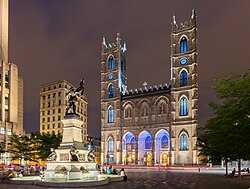
      Walk a few minutes south from the station into the square that has been the heart of the old town since the 1690s. The basilica fills its south side: a Gothic Revival church designed by the New York architect James O'Donnell and built in 1824–1829, its twin towers finished decades later. Inside, Victor Bourgeau's deep blue and gold interior and the 1891 Casavant organ, with some 7,000 pipes, explain why it draws millions of visitors a year. The monument in the middle of the square honours Paul de Chomedey de Maisonneuve, the city's founder. Allow about 60 minutes with a visit inside.

      About this place

      The Basilica of Our Lady of Montreal, also known as Notre-Dame Basilica of Montreal, is a minor basilica of the Catholic Church in the historic Old Montreal district of Montreal in Quebec, Canada. It is located at 110 Notre-Dame Street West, on the corner of Saint Sulpice Street. It is situated next to the Saint-Sulpice Seminary and faces the Place d'Armes square.

      Read more on Wikipedia Photo: Diego Delso · CC BY-SA 4.0
    2. Down to the founding site at Pointe-à-Callière
      Down to the founding site at Pointe-à-Callière 0.5 km Map

      Place d'Armes → Pointe-à-Callière Museum

      Gently descending city streets

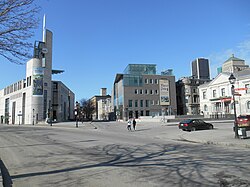
      Head downhill toward the river to the spot where Maisonneuve and the first French settlers landed in 1642. Pointe-à-Callière, opened in 1992 for the city's 350th birthday, is built on pilings directly over what it shows: the remains of Fort Ville-Marie, Montreal's first Catholic cemetery and an old collector sewer you can walk through underground. Even if you skip the museum, the square outside is the true starting line of the city. Allow 60 to 90 minutes inside.

      About this place

      Pointe-à-Callière Museum is a museum of archaeology and history in Old Montreal, Quebec, Canada. It was founded in 1992 as part of celebrations to mark Montreal's 350th birthday. The museum has collections of artifacts from the First Nations of the Montreal region that illustrate how various cultures coexisted and interacted, and how the French and British empires influenced the history of this territory over the years. The site of Pointe-à-Callière has been included in Montreal’s Birthplace National Historic Site since its designation in 1924.

      Read more on Wikipedia Photo: Jeangagnon · CC BY-SA 3.0
    3. Rue Saint-Paul
      Rue Saint-Paul 0.8 km Map

      Pointe-à-Callière Museum → Place Jacques-Cartier

      Cobbled street, uneven in places

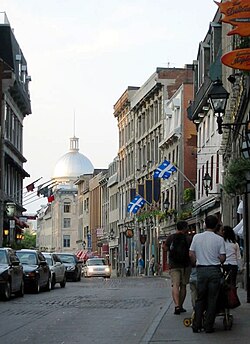
      Turn east along Montreal's oldest street, laid out in 1672 on the line of a path beside the first fort and named for Maisonneuve. Much of it is still cobbled, lined with grey-stone warehouses turned into galleries, shops and small hotels. It was the city's main street for generations, and at this pace, with the river a block to your right, you can see why. About 20 minutes.

      About this place

      Saint Paul Street is a street in the Old Montreal historic area of Montreal, Quebec.

      Read more on Wikipedia Photo: Payton Chung from Chicago, USA · CC BY 2.0
    4. Place Jacques-Cartier and City Hall
      Place Jacques-Cartier and City Hall 0.4 km Map

      Rue Saint-Paul → Montreal City Hall

      Sloping cobbled square

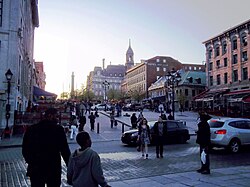
      Climb the long, sloping square that runs from the waterfront up to Rue Notre-Dame. It began as the gardens of an eighteenth-century château and became a market after the château burned in 1803; the column at the top, raised in 1809 for Admiral Nelson, is the city's oldest public monument (the statue on it is now a replica). Across Rue Notre-Dame stands the Second Empire City Hall, rebuilt inside its original walls after a 1922 fire. From its balcony in 1967 Charles de Gaulle called out 'Vive le Québec libre'. About 30 minutes.

      About this place

      Place Jacques-Cartier is a square located in Old Montreal, Quebec, Canada. It is an entrance to the Old Port of Montreal.

      Read more on Wikipedia Photo: Jeangagnon · CC BY-SA 4.0
    5. The sailors' chapel and Bonsecours Market
      The sailors' chapel and Bonsecours Market 0.5 km Map

      Montreal City Hall → Notre-Dame-de-Bon-Secours Chapel

      City streets and cobbles

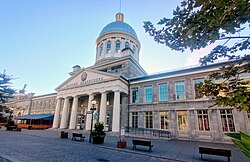
      Drop back down to Rue Saint-Paul and walk east to the long silver dome of Bonsecours Market, a Neoclassical hall finished in 1847 that was the city's main market for a century, housed the Legislative Assembly of the Province of Canada in 1849 and later served as city hall. Just past it is the Notre-Dame-de-Bon-Secours Chapel, founded by Marguerite Bourgeoys in 1655 and rebuilt in 1771, known as the Sailors' Church for the mariners who came to pray here. The small museum inside includes a climb up the tower for a view over the port. About 45 minutes.

      About this place

      Bonsecours Market is a two-story domed public market located in Montreal, Quebec, Canada at 350 Rue Saint-Paul in Old Montreal. For more than 100 years, it was the main public market in the Montreal area. It also briefly accommodated the Parliament of United Canada for one session in 1849.

      Read more on Wikipedia Photo: Dpalma01 · CC BY-SA 4.0
    6. The Old Port to the Clock Tower
      The Old Port to the Clock Tower 0.9 km Map

      Notre-Dame-de-Bon-Secours Chapel → Clock Tower, Old Port

      Waterfront promenade and quays

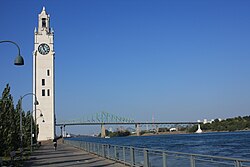
      Cross Rue de la Commune (watch for the bike path) and walk out along the quays of the Old Port, which stretches for more than two kilometres along the St. Lawrence. Finish at the white Clock Tower on the Quai de l'Horloge, completed in 1922 as a memorial to Canadian sailors lost in the First World War. When it is open to visitors, its 192 steps lead up to views of the Jacques Cartier Bridge and the river. From here, Champ-de-Mars metro is about a 15-minute walk uphill. About 30 minutes.

      About this place

      The Montreal Clock Tower, also known as the Sailor's Memorial Clock, is located in the borough of Ville-Marie and is situated in the Old Port of Montreal. The construction of the tower began in 1919, and was finished in 1922. The Clock Tower is 45 m (148 ft) tall with 192 steps from the bottom to the top of the tower. It has three observation stops along the staircase and the outside walls of the Clock Tower are white in colour. The structure consists of the principal tower as well as a smaller tower that is 12 m (39 ft) and architecturally similar to the main tower. The two towers are connected by a white 13 m (42 ft) curtain wall. The tower consists of four translucent clock faces. These are each 3.7 m (12 ft) in diameter and were designed by the English engineering firm Gillett & Johnston.

      Read more on Wikipedia Photo: MattiPaavola · CC BY-SA 3.0
    Partner link: if you book through it we may earn a commission, at no extra cost to you. It does not change what we recommend. How this works

    Tips & Insights

    Packing list

    Filled in for this route from the kit a walk like this needs and the gear its tips mention. Tick things off as you pack.

    Clothing and footwear
    Gear
    Health and sun
    Water and food

    Best time to go

    • Summer evenings and December afternoons

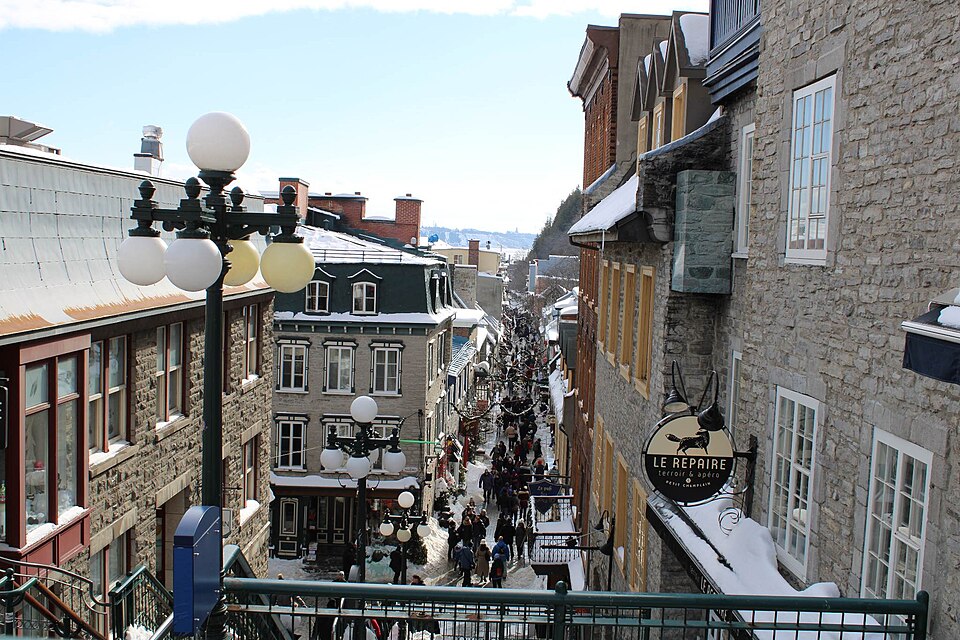
      From late spring to early autumn Place Jacques-Cartier is closed to cars and fills with terraces and street performers, and the Old Port promenade is at its best in the long evening light. December is the other great month: the old stone streets under snow, the basilica lit up, and far fewer people. Midsummer weekend afternoons are the most crowded time to come.

    Getting there

    • Three orange-line stations, one for each end

      Take the metro to Place-d’Armes to start, and leave from Champ-de-Mars when you finish at the east end. Square-Victoria–OACI is the third station on the district’s western edge. All three are on the orange line, so a single transit fare covers the day.

    Tickets & reservations

    • Book the basilica, especially for AURA

      Visiting the Notre-Dame Basilica is ticketed, and the evening AURA light show sells out on summer weekends and holidays. Buy online for a specific time, and check the basilica’s calendar first: services and ceremonies close it to visitors. The official site lists current hours and prices.

    Where to stay

    • Sleep in the old town, or just outside it

      Staying inside Old Montreal means boutique hotels in converted stone warehouses and banks, and having the streets to yourself early in the morning and late at night. It is the most atmospheric base in the city and also the priciest. Downtown hotels around Square-Victoria and Rue McGill cost less and are a ten-minute walk away, with the metro at the door.

    Food

    • Eat one street back from the squares

      The terraces directly on Place Jacques-Cartier are about the view more than the food. Walk one block over to Rue Saint-Paul or Rue Notre-Dame, where the restaurants are aimed at Montrealers as much as visitors, or pick up something at the cafés in and around Bonsecours Market.

    With kids

    • The Old Port is the reward

      Children tend to wilt in the basilica and come alive at the waterfront. The Old Port has the Montreal Science Centre, Canada’s tallest Ferris wheel (La Grande roue de Montréal), a small urban beach by the Clock Tower, and in summer pedal boats and quadricycles to rent. Save it for the end of the walk as the payoff.

    Local insights

    • Look up at Place d'Armes

      Stand by the Maisonneuve Monument and turn slowly: the basilica on one side, the domed Bank of Montreal head office (1859) opposite, the New York Life Building of 1887 (the city’s first high-rise) and the Art Deco Aldred Building of 1931. Few squares anywhere show a city’s history this compactly.

    Safety

    • Cobbles, cyclists and ice

      Old Montreal is safe to walk day and night. The real hazards are underfoot: uneven cobbles, the two-way bike path along Rue de la Commune, and black ice on the sloping streets in winter. Ice cleats that slip over your shoes are cheap and make a January visit far more pleasant.

    Smart savings

    • Most of the best of it is free

      The squares, the facades, Rue Saint-Paul and the whole Old Port promenade cost nothing. If you want to pay for just one interior, make it either the basilica or Pointe-à-Callière, depending on whether you are more drawn to architecture or archaeology.

    Comments