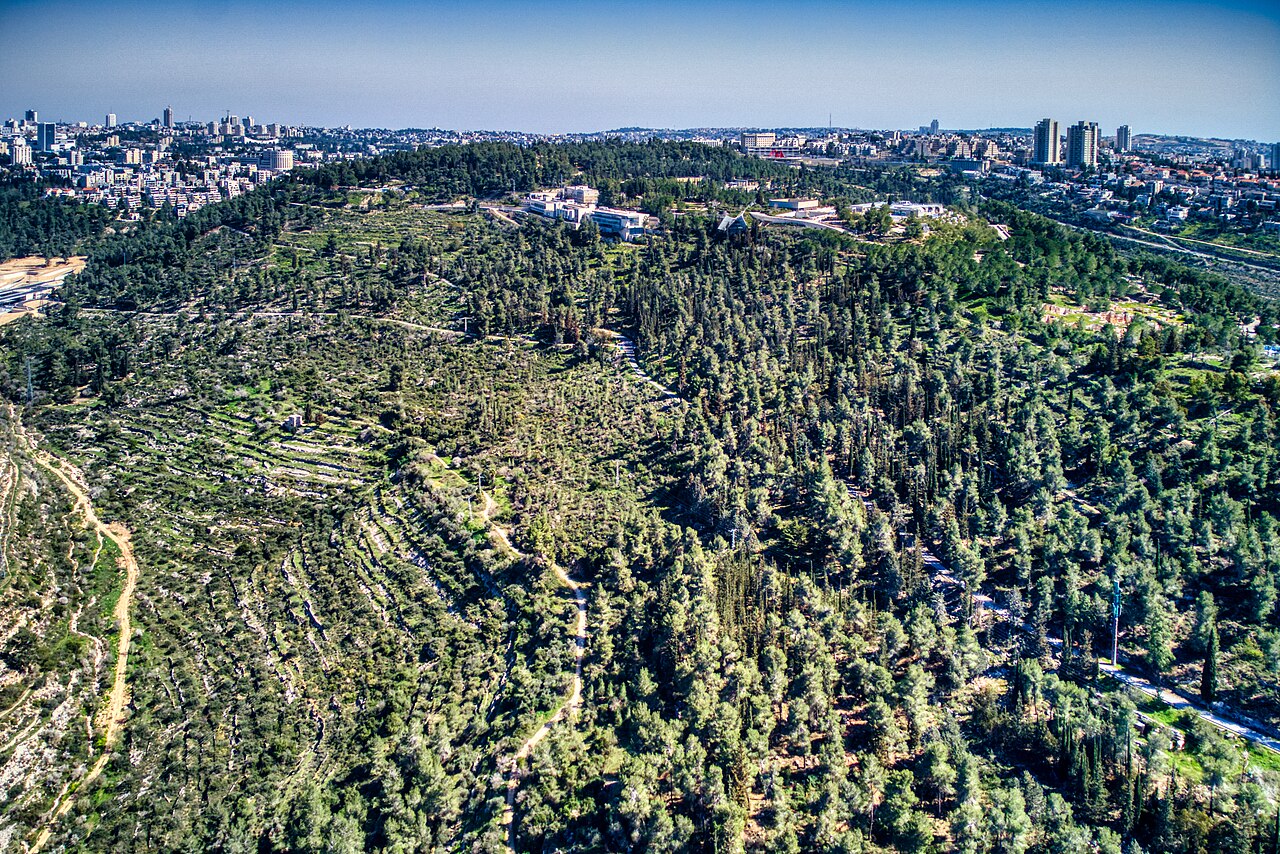
From Herzl’s grave at the top of the hill, down through the cemetery, and across to Yad Vashem.
Segments
- Herzl's grave and the Herzl Museum
Mount Herzl light rail station → Herzl's grave
Paved paths
The hill is named for Theodor Herzl, the founder of political Zionism, who died in Austria in 1904. His remains were brought to Jerusalem in 1949 and reburied here in a state ceremony. The grave is a single block of black granite at the summit, inscribed only with his name. The Herzl Museum at the entrance covers his life and work. Allow about 60 minutes with the museum.
- The plot of the nation's leaders
Herzl's grave → National leaders' section
Paved paths and steps
The southern slope, set aside in 1952, holds the graves of Israeli presidents, prime ministers and Zionist leaders. Five prime ministers are buried here: Levi Eshkol, Golda Meir, Yitzhak Shamir, Yitzhak Rabin and Shimon Peres. Rabin, assassinated in 1995, is buried beside his wife Leah. About 30 minutes.
- The national military cemetery
National leaders' section → Military cemetery
Paved paths and steps
The northern slope has been Israel's national military cemetery since 1949. It holds the graves of about 22,700 soldiers and members of the security forces killed since 1860. The graves are laid out in terraced rows by war and by unit; the headstones are uniform. The Memorial Hall and its eternal flame stand at the top of the section, and the Victims of Acts of Terror Memorial, opened in 1997, is nearby. About 45 minutes.
- The Holocaust History Museum
Mount Herzl → Yad Vashem entrance
Paved path or free shuttle
Yad Vashem was established by an act of the Knesset in 1953 and occupies about 180 dunams (roughly 45 acres) on the Mount of Remembrance. The Holocaust History Museum, designed by Moshe Safdie and opened in 2005, is a prism-shaped corridor cut through the hillside. Its galleries run chronologically from pre-war Jewish life in Europe to the end of the war, using documents, artefacts and recorded survivor testimony. Entry is free. Under-10s are not admitted. Allow about 2 to 3 hours.
- The Hall of Names and the Children's Memorial
Holocaust History Museum → Children's Memorial
Paved paths
The Hall of Names, at the end of the museum route, is the repository for the names of Holocaust victims. Photographs of the dead line a ten-metre cone above; a matching cone is cut into the rock below, its base filled with water. The surrounding shelves hold the Pages of Testimony — about 2.8 million had been collected as of November 2025 — each one a form filled in by a relative or acquaintance recording a single victim. Names not yet recovered account for the empty shelves. The Children's Memorial, a separate underground structure also designed by Safdie, commemorates the roughly 1.5 million Jewish children killed in the Holocaust. A small number of candles are reflected through mirrors into a dark chamber. A recording reads out names, ages and countries of origin. About 45 minutes for both.
-
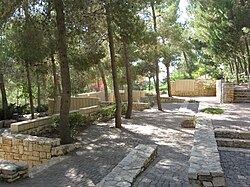 The Avenue of the Righteous and the Valley of the Communities
Children's Memorial → Valley of the Communities
Paved paths and gravel
The Avenue and Garden of the Righteous Among the Nations honour non-Jews who risked their lives to save Jews during the Holocaust. Trees and plaques carry the names of those recognised by the state; as of 2024 the title had been conferred on 28,707 people. The Valley of the Communities is a 2.5-acre excavation into the bedrock, cut into a series of connected courtyards walled in Jerusalem stone. The names of more than 5,000 Jewish communities destroyed or damaged in the Holocaust are carved into the walls, grouped by region. It is open air, and open to visitors of all ages. About 60 minutes.
About this place
The Garden of the Righteous Among the Nations is part of the much larger Yad Vashem complex located on the Mount of Remembrance in Jerusalem. Along with some two dozen different structures within the Yad Vashem memorial – which is the second most-visited destination in the country after the Western Wall – the Garden of the Righteous is meant to honor those non-Jews who during the Holocaust risked their lives to save Jews from extermination by the Nazis.
Read more on Wikipedia
Comments
Sign in to join the conversation.
No comments yet — be the first.