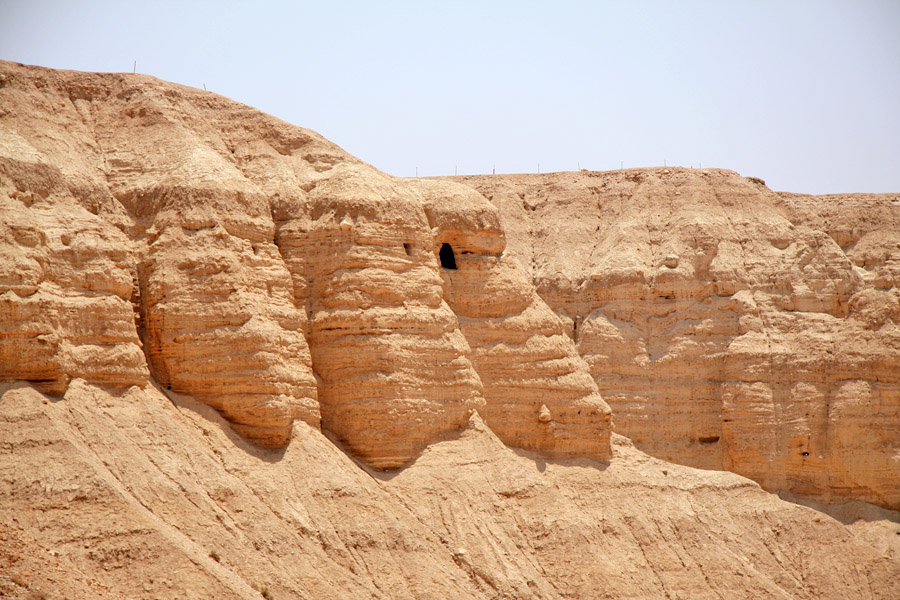
An easy loop across the marl plateau, from the settlement ruins out to the cave viewpoints and back through the water system.
Segments
- The settlement
Visitor centre → Main ruins
Flat marl and stone paths
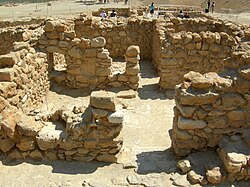
Begin among the low stone walls of the settlement itself. First built in the Hasmonean period, probably in the second century BCE, and occupied until the Romans destroyed it around 68 CE, the complex held a tower, workrooms, a pottery kiln and communal spaces. It is small — a walk of minutes end to end — but every room here has been weighed in the debate over who lived at Qumran. About 20 minutes.
-
 The caves and the Dead Sea Scrolls
Main ruins → Cave viewpoint
Flat plateau, cliff-edge viewpoints
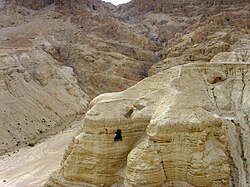
Look out toward the caves that made Qumran famous. Nearly 900 manuscripts were recovered from eleven caves between 1947 and 1956, most written on parchment. The richest was Cave 4, cut into the marl within sight of the settlement, which alone yielded thousands of fragments from hundreds of separate scrolls — biblical books, hymns and the community's own rules. About 30 minutes.
About this place
The Qumran Caves are a series of caves, both natural and artificial, found around the archaeological site of Qumran in the Judaean Desert. It is in these caves that the Dead Sea Scrolls were discovered.
Read more on WikipediaPhoto: Effi Schweizer · Public domain
- The ritual baths and the scriptorium
Cave viewpoint → Stepped baths and long room
Stone steps and ruins
Several large stepped pools cut into the site are usually read as miqva'ot, Jewish ritual baths, some divided so that the ritually pure and impure would not touch on the stairs — though scholars still debate which pools were baths and which were simple cisterns. Nearby stood the long room de Vaux named the scriptorium, where he found inkwells and the remains of plastered writing surfaces, and argued the scrolls were copied. About 25 minutes.
- The aqueduct and the cisterns
Scriptorium → Water channels and cisterns
Flat paths beside channels
None of this could exist without water. A plastered aqueduct caught the flash floods that poured off the cliffs through the wadi and carried them into a chain of stepped cisterns and pools across the site, storing a year's supply in a place with almost no rain. Trace the channel and you understand how a community survived on a shadeless plateau above the saltiest sea on earth. About 20 minutes.
-
 The Essene hypothesis and its debates
Cisterns → Visitor centre
Flat path to visitor centre
Close the loop with the question the whole site poses. Roland de Vaux believed Qumran was home to the Essenes, an ascetic Jewish community of the Second Temple period, who wrote and hid the scrolls. Others read the same ruins as a Hasmonean fort, a wealthy manor, or a pottery workshop and trading post — pointing to coins and fine goods that sit awkwardly with a life of monastic isolation. The argument is unresolved, and that is part of the pleasure of standing here. About 20 minutes.
About this place
The Essenes or Essenians were a mystic Jewish community during the Second Temple period that flourished from the 2nd century BCE to the 1st century CE.
Read more on WikipediaPhoto: Wilson44691 · Public domain
Comments
Sign in to join the conversation.
No comments yet — be the first.