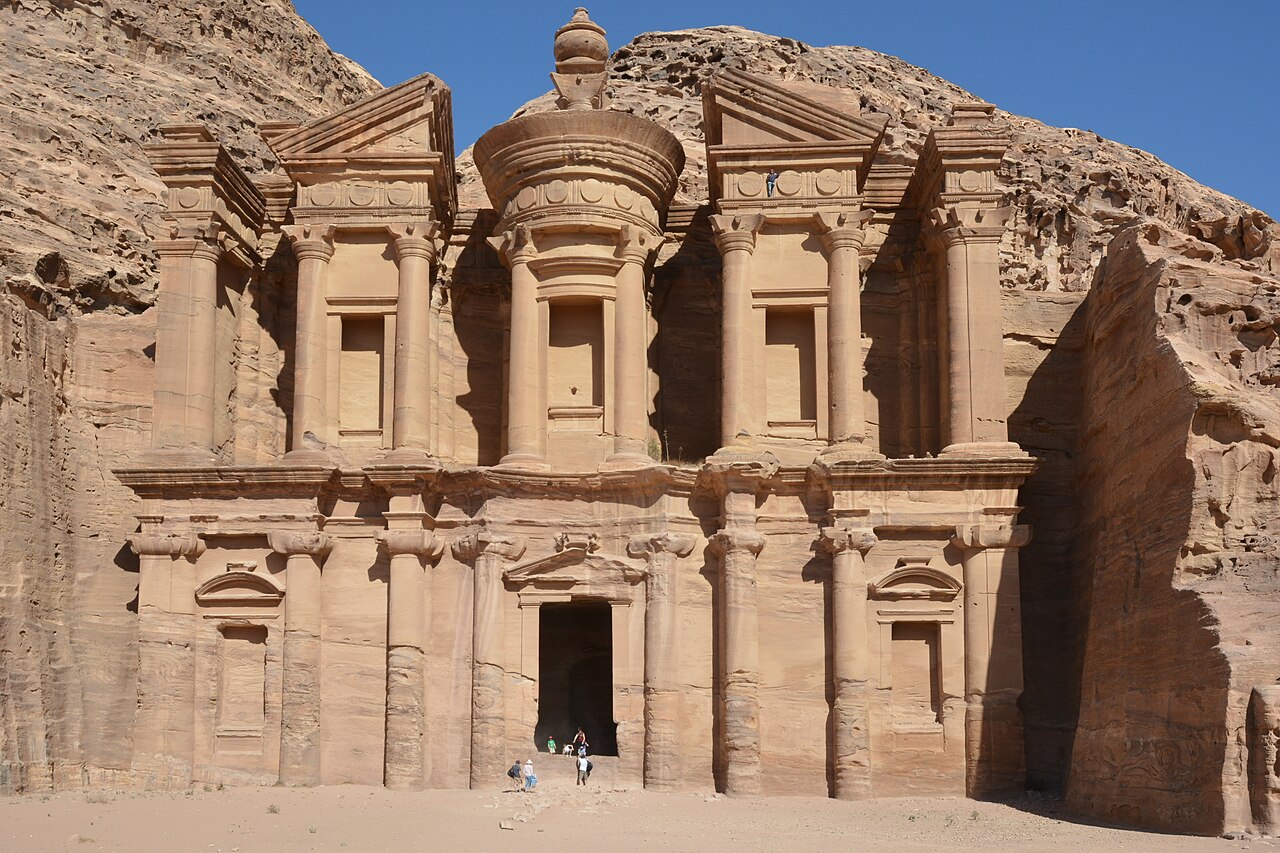
A single long day on foot into the heart of Petra and back, taking in every headline monument and the demanding climb to Ad Deir.
Segments
-
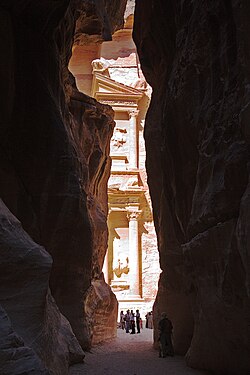 Through the Siq
Petra Visitor Centre → The Treasury
Sandy path through a narrow gorge
From the entrance, pass the Djinn Blocks and the Obelisk Tomb, then enter the Siq — a natural chasm barely three metres wide in places that winds for over a kilometre between cliffs up to 180 metres high. Water channels cut by the Nabataeans line both walls. About 40 minutes of gentle descent to the dramatic reveal at the end.
About this place
The Siq is the main entrance to the ancient Nabatean city of Petra in southern Jordan. Also known as Siqit, it is a dim, narrow gorge and winds its way approximately 1.2 kilometres and ends at Petra's most elaborate ruin, Al-Khazneh. A wide valley outside leading to the Siq is known as the Bab as-Sīq.
Read more on Wikipedia Photo: David Bjorgen · CC BY-SA 3.0 -
 The Treasury (Al-Khazneh)
End of the Siq → Treasury forecourt
Open sandy plaza
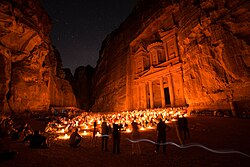
The Siq opens onto Petra's most famous facade — Al-Khazneh, the 'Treasury', nearly 40 metres tall and carved directly into the cliff around the 1st century, most likely as a royal tomb. It is at its best in the morning light. About 20 minutes to take it in.
About this place
Al-Khazneh, also known as Khaznat el-Far'oun, is one of the most elaborate rock-cut tombs in Petra, a city of the Nabatean Kingdom inhabited by the Arabs in ancient times. As with most of the other buildings in this ancient town, including the Monastery, this structure was carved out of a sandstone rock face.
Read more on Wikipedia Photo: Susanahajer · CC BY-SA 3.0 - Street of Facades & the Theatre
The Treasury → The Nabataean Theatre
Wide sandy valley
The gorge widens into the Outer Siq, its walls lined with the Street of Facades — more than forty tombs and houses carved into the rock. Beyond them stands the Theatre, cut from the mountain in Nabataean fashion to seat around 6,000. About 25 minutes.
- The Royal Tombs
The Nabataean Theatre → The Urn Tomb terrace
Rock-cut steps and terraces
Cross the valley and climb to the Royal Tombs strung along the cliff of Al-Khubtha — the Urn, Silk, Corinthian and Palace tombs. The Urn Tomb, from about 70 AD, rises on a great arched terrace with sweeping views back over the city. About 45 minutes with the climb.
-
 Colonnaded Street & Qasr al-Bint
The Royal Tombs → Qasr al-Bint
Ancient paving and sandy track
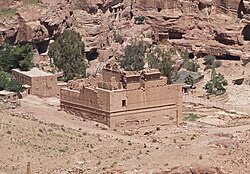
Descend to the old city centre and walk the Colonnaded Street, the Roman-era main road, past the ruined temples to Qasr al-Bint — one of the few free-standing buildings to survive, and the trailhead for the Monastery. About 30 minutes.
About this place
The Qasr al-Bint is a religious temple in the Nabataean city of Petra. It faces the Wadi Musa and is located to the northwest of the Great Temple and the southwest of the Temple of the Winged Lions. One of the best preserved ancient structures surviving in Petra today, it stands near the monumental gate and was a key focal point on the colonnaded street, as well as a focus of religious worship.
Read more on Wikipedia Photo: Bernard Gagnon · CC BY-SA 3.0 -
 Up to the Monastery (Ad Deir)
Qasr al-Bint → The Monastery (Ad Deir)
Roughly 800 rock-cut steps
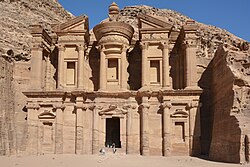
The final effort: a climb of some 800 rock-cut steps up a side canyon to Ad Deir, the Monastery. Larger even than the Treasury at 47 metres wide and 48 tall, this 3rd-century BC monument is the grand finale of Petra. Rest at the cafe opposite, then begin the long walk back out. Allow 2–3 hours return.
About this place
Ed-Deir, also spelled el-Deir and ad-Deir/ad-Dayr, is a monumental building carved out of rock in the ancient city of Petra in southern Jordan. The Deir was probably carved in the mid-first century AD.
Read more on Wikipedia Photo: Azurfrog · CC BY-SA 3.0
Comments
Sign in to join the conversation.
No comments yet — be the first.