← All routes
City walk Nara — Nara Park, Japan

Nara Park: Kōfuku-ji to Naramachi

Japan's first permanent capital in a single day — a five-storied pagoda, hundreds of free-roaming deer, the Great Buddha in the world's great wooden hall, a lantern-lined shrine approach and an Edo-era merchant quarter.

Nara Park: Kōfuku-ji to Naramachi
Photo: Feri88 · CC BY 3.0
Duration
1 days
Distance
6 km
Difficulty
Easy
Best season
Late March–May (cherry blossom and fresh green) and late October–November (autumn colour)

Nara was Japan’s capital in the eighth century, and an unusual amount of it survived. Almost everything worth seeing sits inside or beside one large park, which makes this one of the easiest great walks in the country: about 6 km on flat paths and gentle rises, with no navigation to speak of.

The deer are the other reason people come. Several hundred of them roam the park freely, protected for centuries as messengers of the gods, and they are entirely unbothered by people.

Getting there. Kintetsu Nara Station sits at the park’s western edge, about 45 minutes from Kyoto and under an hour from Osaka. JR Nara Station is about a 15-minute walk further west. The walk ends in Naramachi, a short stroll back to either.

Permits & tickets. No permit needed. The park itself and the Kasuga-taisha approach are free. Kōfuku-ji’s Eastern Golden Hall, the Tōdai-ji Great Buddha Hall and the Kasuga-taisha inner precinct each charge a small admission — expect a few hundred yen apiece.

Good to know:

Day 1

Pagoda, deer, Great Buddha and the old town

Kōfuku-ji → Naramachi 6 km
Navigate this day

From a hilltop pagoda across open deer parkland to Japan’s largest Buddha, up a forested lantern avenue, then down into a quarter of Edo-period merchant houses.

Segments

  1. Kōfuku-ji
    Kōfuku-ji 0.5 km 📍 Map

    Kintetsu Nara Station → Kōfuku-ji five-storied pagoda

    Paved streets and temple steps

    The temple of the Fujiwara clan, and one of Nara's UNESCO World Heritage sites. Its five-storied pagoda is among the tallest in Japan and long vied with Tō-ji in Kyoto for the title. The Eastern Golden Hall charges a small admission; the grounds are open and free. Allow about 45 minutes.

    About this place

    Kōfuku-ji is a Buddhist temple in Japan that was once one of the powerful Nanto Shichi Daiji 'Seven Great Temples' in the city of Nara. The temple is the national headquarters of the East Asian Yogācāra school. It is part of the Historic Monuments of Ancient Nara, a World Heritage Site.

    Read more on Wikipedia ↗

    Photo: 663highland · CC BY-SA 4.0

  2. Nara Park and the deer 1.2 km 📍 Map

    Kōfuku-ji → Nandai-mon gate

    Open parkland paths

    Cross the open lawns where several hundred sika deer wander among the trees. They are wild but thoroughly used to people, and can be fed the crackers sold at park stalls — expect to be followed. The path runs east past ponds and stone lanterns to Tōdai-ji's colossal Nandai-mon gate and its pair of guardian statues.

  3. Tōdai-ji and the Great Buddha
    Tōdai-ji and the Great Buddha 0.4 km 📍 Map

    Nandai-mon gate → Great Buddha Hall

    Temple precinct

    The Daibutsu-den houses the Great Buddha, the largest bronze Buddha statue in Japan, and is itself said to be among the largest wooden buildings in the world — and the present hall is smaller than the original. Small admission. Allow about an hour, and climb on to the Nigatsu-dō terrace above for a free view back over the city.

    About this place

    Tōdai-ji is a Buddhist temple complex that was once one of the powerful Seven Great Temples, located in the city of Nara, Japan. The construction of the temple was an attempt to imitate Chinese temples from the much-admired Tang dynasty. Though it was originally founded in the year 738 CE, Tōdai-ji was not opened until the year 752 CE. The temple has undergone several reconstructions, including one initiated by Minamoto Yoritomo in 1181 which included the standardization of existing buildings and the strengthening of visible pillars. Since then, one of the most significant reconstruction took place in 1709. However, it was on the verge of collapse in the late 19th century due to the weight of its huge roof. The collapse was prevented through a first restoration (1904–1913), and its current appearance was completed using steel framing between 1974 and 1980. Its Great Buddha Hall houses the world's largest bronze statue of the Buddha Vairocana, known in Japanese as Daibutsu (大仏). The temple also serves as the Japanese headquarters of the Kegon school of Buddhism. The temple is a listed UNESCO World Heritage Site as one of the "Historic Monuments of Ancient Nara", together with seven other sites in the city of Nara.

    Read more on Wikipedia ↗

    Photo: Wiiii · CC BY-SA 3.0

  4. The Kasuga-taisha lantern approach
    The Kasuga-taisha lantern approach 1.6 km 📍 Map

    Tōdai-ji → Kasuga-taisha

    Gravel forest avenue, gentle climb

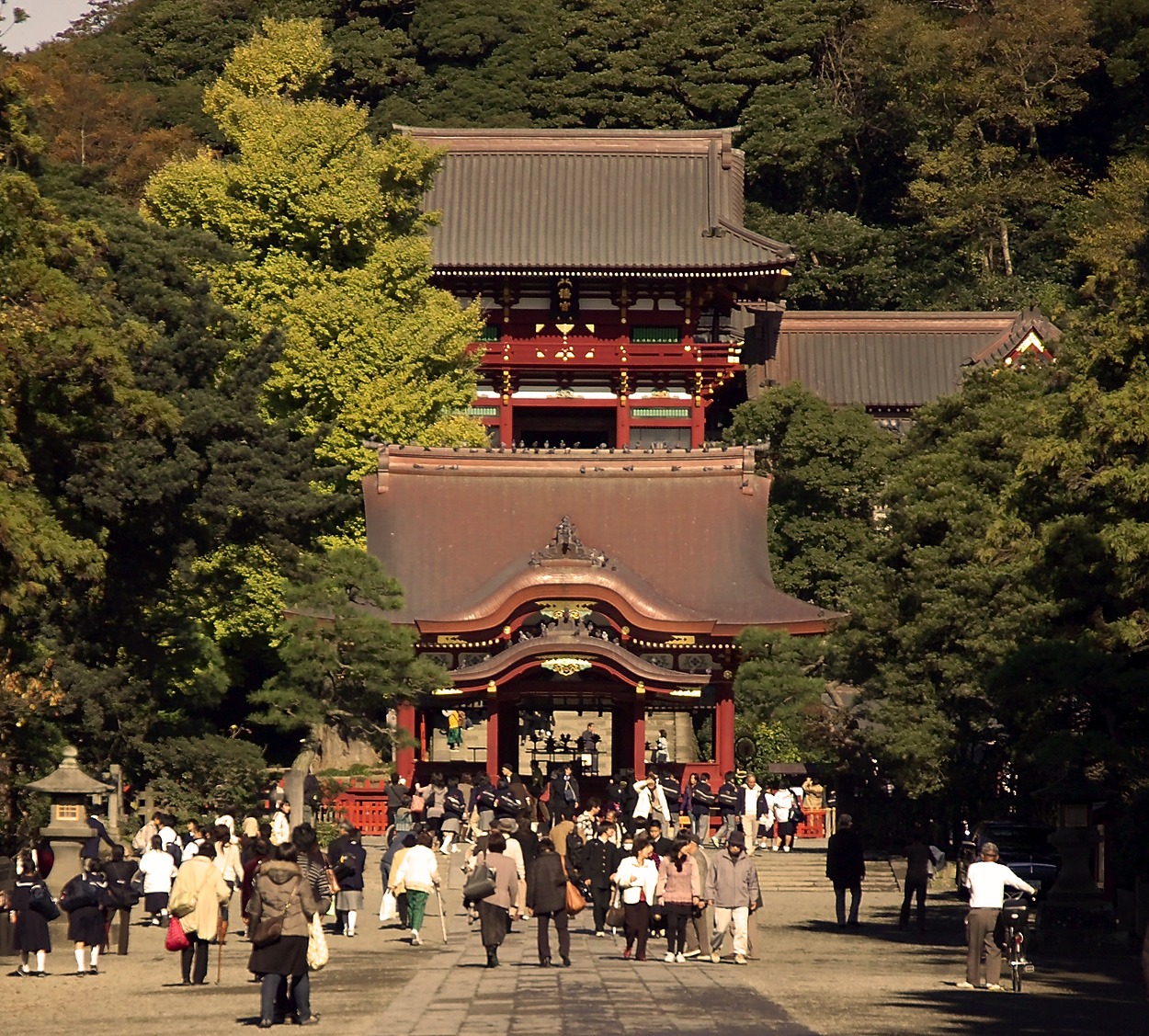
    A long wooded avenue climbs gently into the primeval forest of Mount Kasuga, flanked the whole way by stone lanterns — roughly two thousand of them, moss-covered and donated over the centuries. At the top, the vermilion shrine hangs hundreds of bronze lanterns from its eaves. The approach is free; the inner precinct charges a small fee.

    About this place

    Kasuga-taisha (春日大社) is a Shinto shrine in Nara, Nara Prefecture, Japan. It is the shrine of the Fujiwara family, established in 768 CE and rebuilt several times over the centuries. The interior is famous for its many bronze lanterns, as well as the many stone lanterns that lead up to the shrine.

    Read more on Wikipedia ↗

    Photo: 663highland · CC BY 2.5

  5. Naramachi old town 2.3 km 📍 Map

    Kasuga-taisha → Naramachi

    Park paths and narrow streets

    Drop back down through the park and head south into Naramachi, the former merchant quarter, where narrow lanes of Edo-period machiya townhouses now hold cafés, craft shops, small museums and a working sake brewery offering tastings. A quiet, low-key end to the day, about ten minutes' walk from Kintetsu Nara Station.
Comments