
Blog
Yosemite Mist Trail or the Valley Floor
In short
Choose the Mist Trail when you want the waterfalls at peak flow: about 11 km and 880 m, graded hard, in May and June. Choose the valley floor when you want an easy day among the walls: about 13 km and 150 m, walkable year-round, with spring for water and autumn for quiet meadows.
Come for the water, or come for the walls
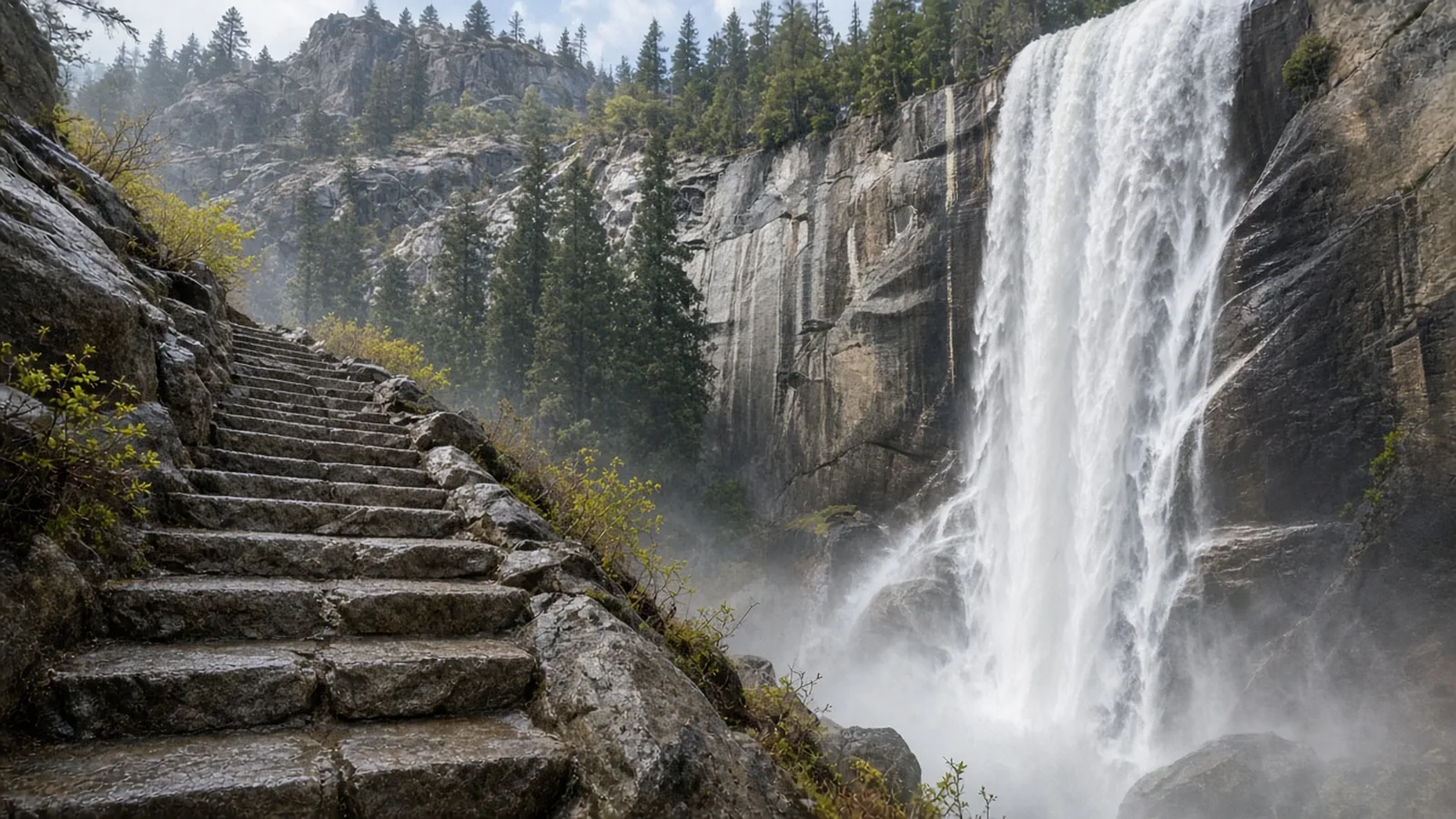
The Mist Trail and the valley floor are both in Yosemite Valley, and they are not substitutes. The Mist Trail is about 11 km and 880 m of ascent, graded hard: a granite staircase in the spray of Vernal Fall, on to the top of Nevada Fall, and back. The valley floor is about 13 km and 150 m, graded easy: Tunnel View, Bridalveil Fall, the El Capitan meadow, the base of Yosemite Falls, Cook’s Meadow under Half Dome.
Choose the Mist Trail if the waterfalls are the reason for the trip and you can walk a hard day in May or June, when the flow peaks. Choose the valley floor if you want the walls without the staircase, if the group is mixed, or if you are here outside that short season of heavy water. The floor is walkable all year. The Mist Trail’s listed season is not.
The Mist Trail, for the weeks the water is the point
From Happy Isles the path follows the Merced up a staircase of granite. In the strong flow, the spray off Vernal Fall throws rainbows across the rock. The distance is short. The grade is not. About 880 m of ascent on wet stone is a full day, and the steps beside Vernal stay slick well into summer. Waterproofs and grip matter more than a heroic pace.
The season the page gives you, for peak flow, is late spring to early summer: May and June. That is snowmelt. By late summer the same falls can shrink to a trickle. A September or October visit can still be a walk. It is not the walk this page is recommending. Start early. The shuttle and the parking fill, and the granite is hot by midday. The trailhead is Happy Isles, at the east end of the valley, on the free shuttle.
No permit is required for the day hike to the two falls. Camping in Little Yosemite Valley is a different permission, a wilderness permit. Continuing to the top of Half Dome is another one again, and the cables are up only roughly from late May to mid-October. Do not let that second season confuse the first. The waterfall reason ends with June. The cable reason, if you even hold that permit, runs longer. They are not one trip you can slide into autumn and keep the same point.
The valley floor, when the day should stay easy
The valley is a glacial trench about 12 km long and on the order of 900 to 1,000 m deep, and almost everything people mean by Yosemite is visible from the bottom of it. This day strings the viewpoints together on foot. Nothing is steep. Most of the paths are paved or evenly graded. The free shuttle, running about every 15 minutes through the year, lets you start, stop or reverse almost anywhere. Tunnel View is the exception: it sits on the road in, off the shuttle line, so most people are dropped there or drive.
The floor is walkable year-round. The page still has opinions about when to come. Spring and early summer are for the waterfalls at full snowmelt. Autumn is for quieter meadows and colour. Yosemite Falls, about 739 m and the highest in the park, is the one that misleads people: spectacular in May, and able to thin to a trickle or dry up by late summer. Bridalveil is the reliable fall, and it flows all year. If water is the reason, do not arrive in September and expect the tall one to perform. If meadows and granite are the reason, autumn is the page’s quiet season.
The full Valley Loop is about 21 km. This route is the highlights, about 13 km and 150 m, and it can be cut shorter at a shuttle stop. Stay on the boards and paths in the meadows. They are the fragile part of an easy day, which is easy to forget when the walking itself asks so little.
A season that does not transfer from one path to the other
May and June are the overlap, and they are the only months when the Mist Trail is doing what you came for. In those weeks a fit walker can do the staircase for the water and still use the valley floor as a second, easy day. That pairing is the best version of a short Yosemite trip. June as a walking month, with this trail in it, is Where to walk in June.
After June, the reasons diverge. The floor stays open, and by autumn it is the walk the page prefers for quiet. The Mist Trail may still be passable, and the flow may already be disappointing. July is a poor month to cross an ocean for the spray. October is a valley month if you want meadows more than thunder. It is not a Mist Trail month.
Winter is a valley-floor possibility the Mist Trail page never offers you. The easy grade, the shuttle and Bridalveil’s year-round flow are why. Snow and ice on a wet granite staircase is not a casual extension of the May hike. If the road is open and the day is cold, stay on the floor.
A plain way to decide
Walk the Mist Trail if you want Vernal and Nevada at peak flow, you are happy with a hard 11 km and 880 m, and your dates are May or June. Start early. Wear shoes that can handle wet rock. Leave Half Dome out of the plan unless you already hold that separate permit.
Walk the valley floor if 150 m of ascent is the right demand, if you want El Capitan and Half Dome as views rather than as efforts, or if your dates are outside the waterfall peak. Thirteen kilometres, easy, can still fill a day because you will stop. In autumn, that is the point.
Do not flip a coin on the morning, and do not do the Mist Trail in the low-water months out of a sense that the famous path must be the better path. In May it is. In October the floor is the one the season still supports.
Questions
- When is the Mist Trail at its best?
- May and June, when snowmelt puts Vernal and Nevada Falls in full flow. By late summer the same water can shrink to a trickle. The steps stay wet and slippery well into the season, so grip matters.
- Is the valley floor open outside summer?
- Yes. The page says the floor is walkable year-round. Spring and early summer are for waterfalls at full flow. Autumn is for quieter meadows. Yosemite Falls can fade by late summer. Bridalveil flows all year.
- Do you need a permit?
- Not for either day hike. A wilderness permit is a separate requirement if you camp in Little Yosemite Valley, and Half Dome is its own permit, with cables up roughly from late May to mid-October.
- Which is the harder day?
- The Mist Trail, graded hard, with about 880 m of climbing in 11 km. The valley floor is graded easy: about 13 km and only 150 m. The full valley loop is longer, about 21 km. This route is the highlights, and the shuttle can shorten it.
Sources
Routes in this post
-
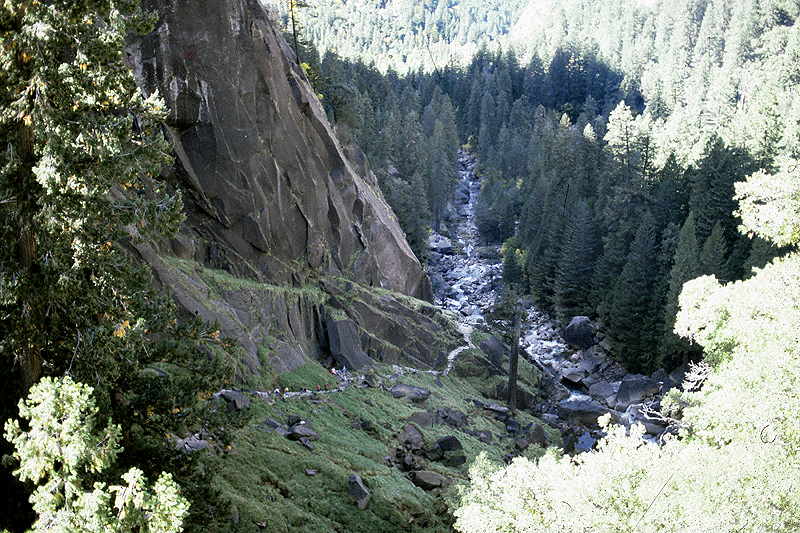 Photo: TFNorman · Public domainTrek USA
Yosemite's Mist Trail: Vernal & Nevada Falls
One of Yosemite's greatest day hikes — a steep granite staircase drenched in waterfall spray, climbing past Vernal Fall to the top of Nevada Fall and looping back on the John Muir Trail.
- Duration
- 1 day
- Distance
- 11 km
- Difficulty
- Hard
-
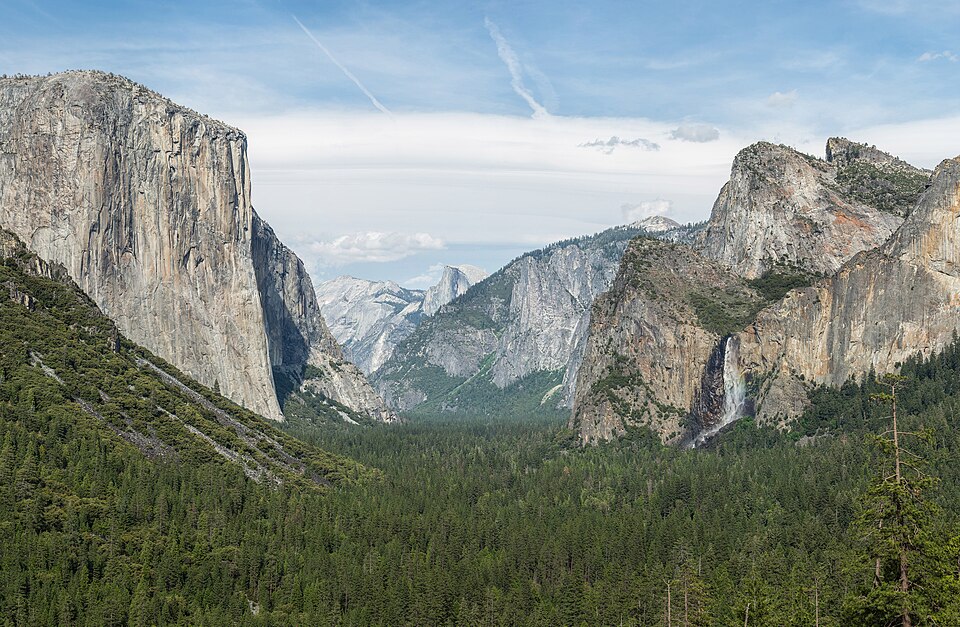 Photo: Diliff · CC BY-SA 3.0Trek USA
Yosemite Valley Floor — The Classic Day
A flat day on the floor of the valley, from the view at Tunnel View to Bridalveil Fall, El Capitan meadow, the base of Yosemite Falls and Cook's Meadow under Half Dome.
- Duration
- 1 day
- Distance
- 13 km
- Difficulty
- Easy