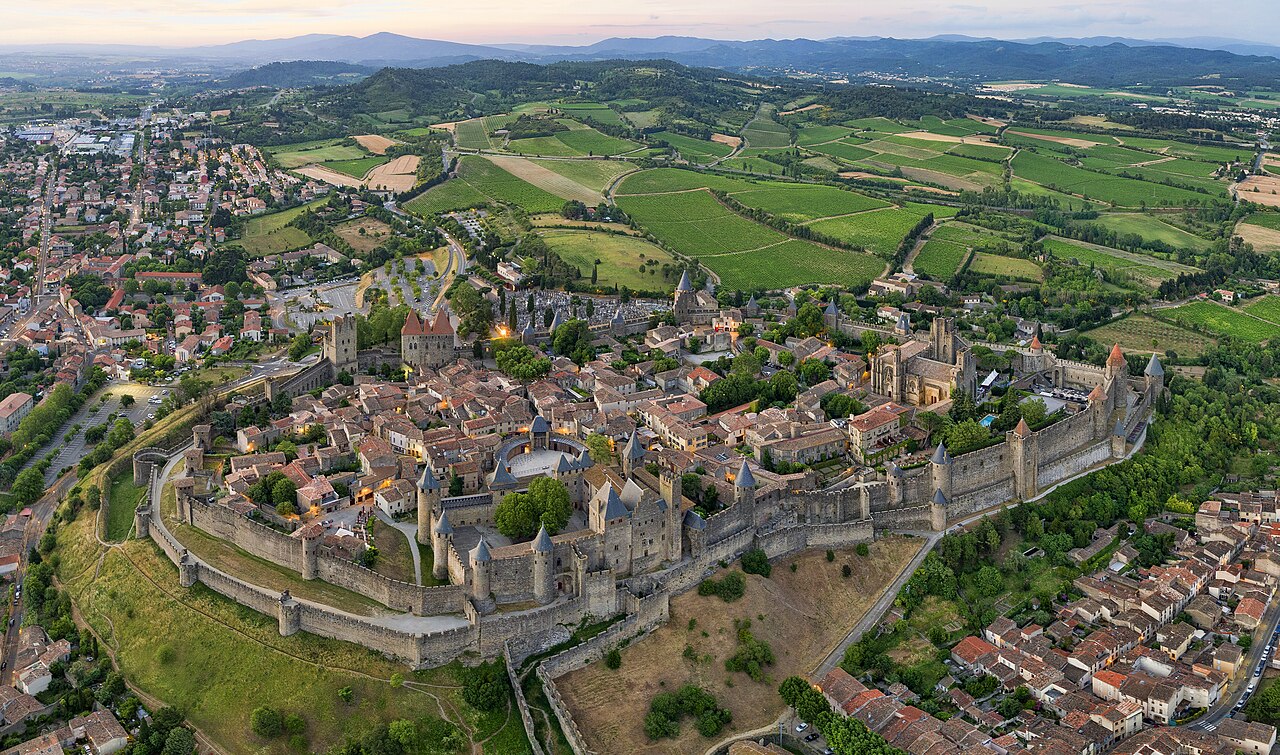
A loop of the walled citadel, then down across the Pont Vieux into the lower town.
Segments
- The double ramparts and 52 towers
Porte Narbonnaise → Château Comtal gate
Cobbled streets and stone ramps
Enter through the Porte Narbonnaise and get the shape of the place before anything else: about three kilometres of double surrounding walls with 52 towers set into them, an inner ring and an outer ring with a gap between. The oldest fabric is Roman — the original defences had somewhere between about 34 and 40 towers, spaced roughly 18 to 30 metres apart — and the rest is medieval and 19th-century, layered on top. Look up at the pointed slate roofs as you go; you will hear about them shortly. About 45 minutes.
- Château Comtal
Château Comtal gate → Château Comtal ramparts walkway
Castle stairs and wall walkways
A castle inside a castle: the fortress of the viscounts, built at the beginning of the 12th century and then heavily strengthened between about 1240 and 1250 with round towers, a barbican and a moat — a lord defending himself from his own town as much as from anyone outside it. The ticket includes the walkway along a stretch of the ramparts, which is the single best thing here: you finally see the double walls from above, and the countryside beyond. Allow about 90 minutes.
- Basilica of Saints Nazarius and Celsus
Château Comtal → Place Saint-Nazaire
Cobbled streets
The minor basilica at the southern end of the Cité, a national monument in the Gothic-Romanesque tradition. Construction was authorised in 1096 by the Trencavel viscount with a papal blessing, and the seam shows: a heavy Romanesque nave running into a Gothic choir and transept full of stained glass, some of the oldest in the south of France. It is free, cool, and mercifully quiet. About 30 minutes.
- The lices, between the walls
Place Saint-Nazaire → Porte d'Aude
Grass and gravel between the ramparts
Walk the lices — the corridor of open ground between the inner and outer walls, once the killing ground for anyone who got through the first ring, later squatted by houses that Viollet-le-Duc's restorers cleared away. It is free to walk and it is where the Cité stops being a postcard: you are down at the base of the masonry, and you can read the joins between Roman courses, medieval work and 19th-century repair with your own eyes. This is also the best place to judge the restoration for yourself. About 45 minutes.
- Pont Vieux and the lower town
Porte d'Aude → Bastide Saint-Louis
Steep lane, stone bridge, city streets
Drop down the hill and cross the river Aude on the Pont Vieux, the medieval bridge that carried everyone between the citadel and the settlements below. Stop halfway across and turn round — this is the view of the Cité, the whole hill and its towers at once, and it costs nothing. On the far bank is the Bastide Saint-Louis, the gridded lower town where Carcassonne actually lives: a market square, plane trees, and prices that are not aimed at tourists. About 60 minutes.
Comments
Sign in to join the conversation.
No comments yet — be the first.