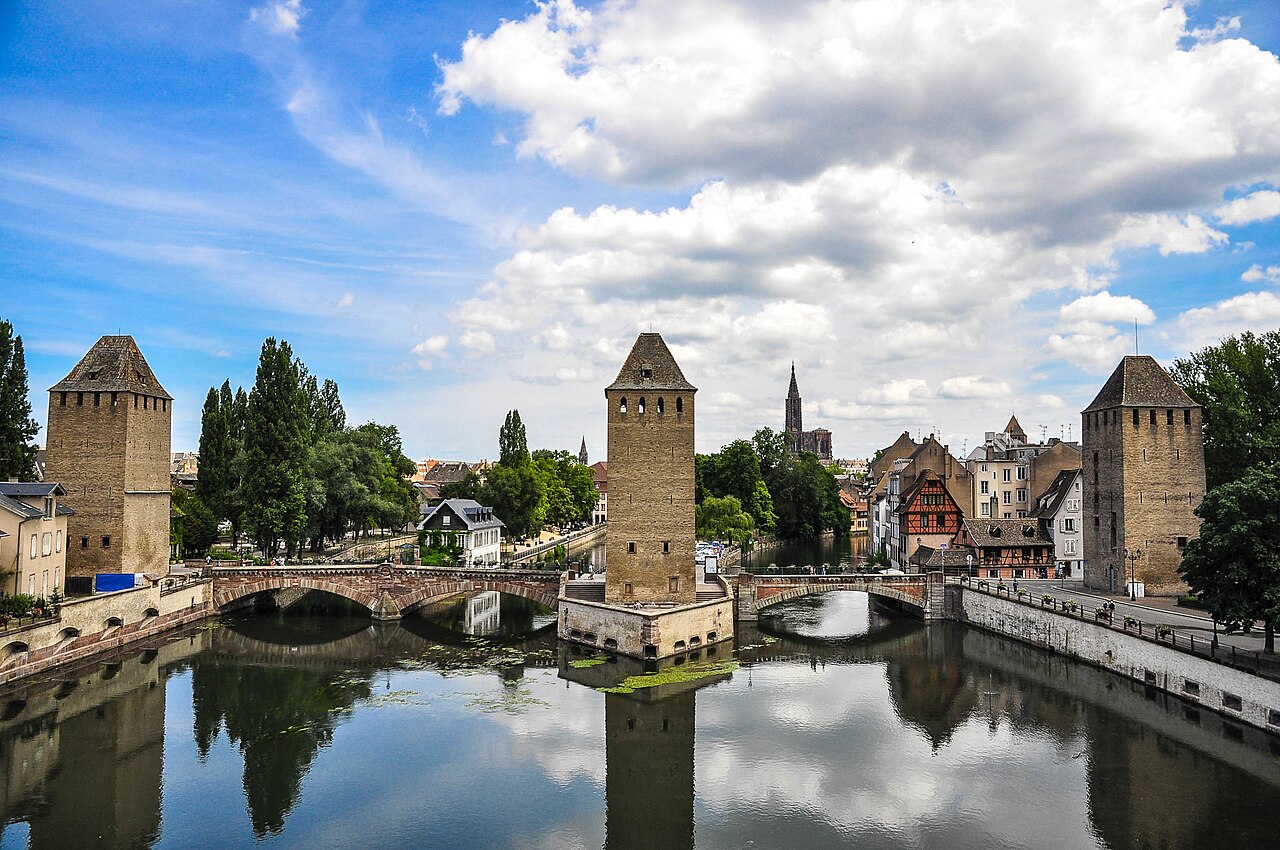
A continuous line across the Grande Île, from the cathedral and its clock through the old streets to La Petite France, the covered bridges, and the Palais Rohan.
Segments
-
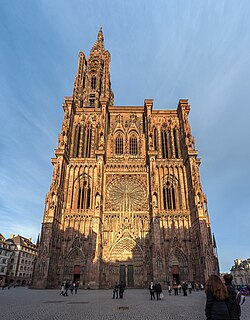 Strasbourg Cathedral
Place de la Cathédrale → Cathedral interior
City streets
Begin beneath the great cathedral of Notre-Dame, built of rose-pink Vosges sandstone and crowned by a single spire rising about 142 metres. Completed in 1439, it was the tallest building in the world for more than two centuries. Step inside for the Gothic nave and the stained glass. Allow about 45 minutes.
About this place
Strasbourg Cathedral or the Cathedral of Our Lady of Strasbourg, also known as Strasbourg Minster, is a Catholic cathedral in Strasbourg, Alsace, France. Although considerable parts of it are still in Romanesque architecture, it is widely considered to be among the finest examples of Rayonnant Gothic architecture. Architect Erwin von Steinbach is credited for major contributions from 1277 to his death in 1318, and beyond through his son Johannes von Steinbach, and his grandson Gerlach von Steinbach, who succeeded him as chief architects. The Steinbachs' plans for the completion of the cathedral were not followed through by the chief architects who took over after them, and instead of the originally envisioned two spires, a single, octagonal tower with an elongated, octagonal crowning was built on the northern side of the west facade by master Ulrich Ensingen and his successor, Johannes Hültz. The construction of the cathedral, which had started in the year 1015 and had been relaunched in 1190, was finished in 1439.
Read more on Wikipedia - The astronomical clock
Cathedral interior → South transept
Indoors
In the south transept stands the famous astronomical clock, its present mechanism built in the 1840s on the site of two earlier clocks. Each day at half past noon a procession of carved figures — the apostles passing before Christ — sets in motion. Arrive early to get a place. About 30 minutes.
- Maison Kammerzell
South transept → Place de la Cathédrale
City streets
Just across the square stands the Kammerzell House, one of the most ornate late-Gothic merchant houses in the region. Its carved stone ground floor dates from 1427 and its richly worked timber upper storeys from 1589; today it holds a restaurant. About 15 minutes to admire the facade.
-
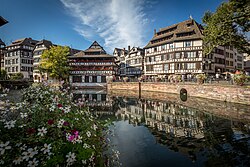 La Petite France
Place de la Cathédrale → Quartier de la Petite France
Cobbled quays
Walk west to the old tanners' and millers' quarter, where half-timbered houses from the 16th and 17th centuries lean over the canals of the Ill. Their steep roofs once dried hides in the open air. This is the postcard image of Strasbourg. About 45 minutes to wander the quays.
About this place
The Petite France, in Alsatian dialect: Französel; "Little France"), also known as the Quartier des Tanneurs is the south-western part of the Grande Île of Strasbourg, France, the most central and characteristic island of the city that forms the historic centre.
Read more on Wikipedia - The covered bridges
Quartier de la Petite France → Ponts Couverts
Riverside paths
At the western tip of the island stand the Ponts Couverts, three bridges and four towers built in the 13th century to defend the city where the Ill divides into channels. Their covered roofs are long gone, but the name and the squat medieval towers remain. Cross to the Barrage Vauban terrace for the classic view back. About 30 minutes.
About this place
The Ponts Couverts are a set of three bridges and four towers that make up a defensive work erected in the 13th century on the River Ill in Strasbourg, France. The three bridges cross the four river channels of the Ill that flow through Strasbourg's historic Petite France quarter. The Ponts Couverts have been classified as a Monument historique since 1928.
Read more on Wikipedia -
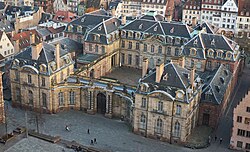 The Palais Rohan
Ponts Couverts → Palais Rohan
City streets
Loop back along the river to the Palais Rohan, the 1730s residence of the city's prince-bishops built right beside the cathedral. Behind its grand classical front it now holds three museums — of fine arts, decorative arts, and archaeology. A calm, grand place to end the day. About 60 minutes if you go inside.
About this place
The Palais Rohan in Strasbourg is the former residence of the prince-bishops and cardinals of the House of Rohan, an ancient French noble family originally from Brittany. It is a major architectural, historical, and cultural landmark in the city. It was built next to Strasbourg Cathedral in the 1730s, from designs by Robert de Cotte, and is considered a masterpiece of French Baroque architecture. Since its completion in 1742, the palace has hosted a number of French monarchs such as Louis XV, Marie Antoinette, Napoleon and Joséphine, and Charles X.
Read more on Wikipedia
Comments
Sign in to join the conversation.
No comments yet — be the first.