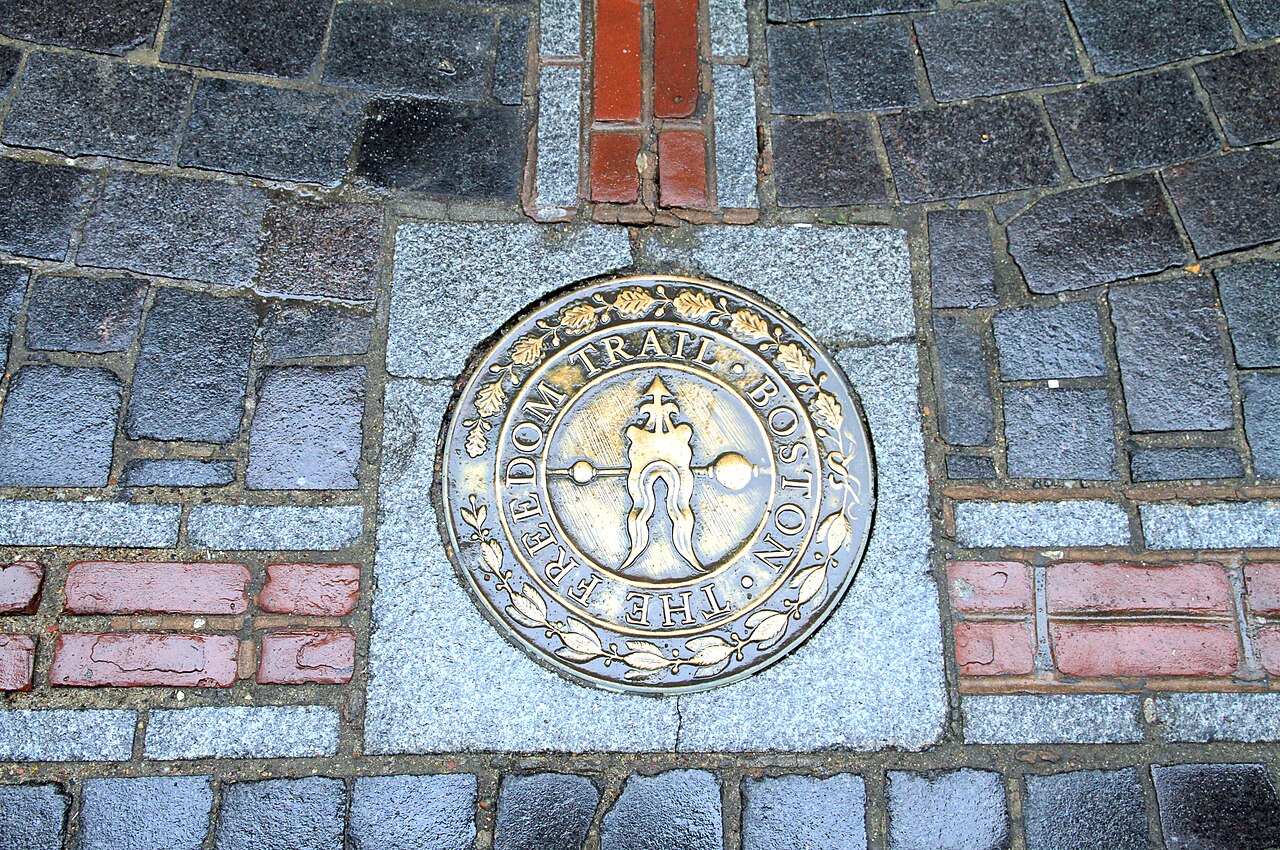
Follow the red line north and east from Boston Common through the old town and the North End, then across the river to Bunker Hill and the Navy Yard.
Segments
-
Boston CommonPark Street station β Boston Common visitor center
Park paths
Start on Boston Common, the oldest public park in the country, in use since 1634 and once a cattle pasture and militia training field. The Freedom Trail's red line begins here at the visitor center. Free and open daily; allow about 20 minutes to find your feet.
About this place
The Boston Common is a public park in downtown Boston, Massachusetts. It is the oldest city park in the United States. Boston Common covers 50 acres (20Β ha) of land bounded by five major Boston streets: Tremont Street, Park Street, Beacon Street, Charles Street, and Boylston Street.
Read more on Wikipedia βPhoto: AbhiSuryawanshi Β· CC BY-SA 4.0
-
The Massachusetts State HouseBoston Common β Massachusetts State House
City sidewalks and a short rise
Climb Beacon Hill to the State House, seat of the Massachusetts government, its golden dome a landmark above the Common. Designed by Charles Bulfinch and opened in 1798, it stands on land once owned by John Hancock. Free guided tours run on weekdays; about 20 minutes from outside.
About this place
The Massachusetts State House, also known as the Massachusetts Statehouse or the New State House, is the state capitol and seat of government for the Commonwealth of Massachusetts, located in the Beacon Hill neighborhood of Boston. The building houses the Massachusetts General Court and the offices of the Governor of Massachusetts. The building, designed by architect Charles Bulfinch, was completed in January 1798 at a cost of $133,333, and has repeatedly been enlarged since. It is one of the oldest state capitols in current use. It is considered a masterpiece of Federal architecture and among Bulfinch's finest works, and was designated a National Historic Landmark for its architectural significance.
Read more on Wikipedia βPhoto: King of Hearts Β· CC BY-SA 4.0
-
Granary Burying GroundMassachusetts State House β Granary Burying Ground
City sidewalks
Follow the line down to the city's third-oldest cemetery, founded in 1660 on Tremont Street. Here lie Revolutionary figures including Paul Revere, John Hancock, Samuel Adams and the victims of the Boston Massacre. Free and open; about 20 minutes among the old slate stones.
About this place
The Granary Burying Ground in Massachusetts is the city of Boston's third-oldest cemetery, founded in 1660 and located on Tremont Street. It is the burial location of Revolutionary War-era patriots, including Paul Revere, the five victims of the Boston Massacre, and three signers of the Declaration of Independence: Samuel Adams, John Hancock, and Robert Treat Paine. The cemetery has 2,345 grave-markers, while historians estimate that as many as 5,000 people are buried there.
Read more on Wikipedia βPhoto: Miguel Hermoso Cuesta Β· CC BY-SA 4.0
-
Faneuil Hall & Quincy MarketGranary Burying Ground β Faneuil Hall & Quincy Market
City sidewalks
Reach Faneuil Hall, the marketplace and meeting hall opened in 1742 and nicknamed the 'Cradle of Liberty' for the revolutionary speeches made inside. Beside it, the long granite halls of Quincy Market, built in 1826, now hold food stalls and shops. Free to enter; a good 45 minutes, longer if you eat.
About this place
Faneuil Hall is a historic building in Downtown Boston, Massachusetts, United States. Opened in 1742, the building was designed by artist John Smibert as a marketplace and meeting hall. Faneuil Hall is sometimes referred to as "the Cradle of Liberty", having been the site of many speeches, debates, and other events over its history. Over the years, the building, and especially its Great Hall meeting room, has received commentary for its symbolism. Faneuil Hall is part of Boston National Historical Park and is designated as a National Historic Landmark. It is owned by the Boston government and operated as part of the Faneuil Hall Marketplace.
Read more on Wikipedia βPhoto: Eric Kilby from Somerville, MA, USA Β· CC BY-SA 2.0
-
Paul Revere's House & the Old North ChurchFaneuil Hall β Old North Church, North End
Narrow North End streets
Wind into the North End to the Paul Revere House, the patriot's former home and the oldest surviving building in downtown Boston, then on to the Old North Church of 1723, the city's oldest standing church, where the signal lanterns of Revere's ride were hung. The house charges a small fee; the church is free to enter. About 50 minutes for both.
About this place
Old North Church is an Episcopal church on Salem Street in the North End neighborhood of Boston, Massachusetts, United States. The church, built in 1723, is the oldest standing church in the city. Old North Church is notable for its role in Paul Revere's midnight ride on April 18, 1775, when two lanterns in the steeple were illuminated, alerting Patriots of British military movements amid the American Revolutionary War. The congregation continues to host services there, while the secular nonprofit Old North Illuminated oversees tourism and preservation efforts. One of the landmarks on Boston's Freedom Trail, the Old North Church is designated a National Historic Landmark and a Boston Landmark, and it is part of the Boston National Historical Park.
Read more on Wikipedia βPhoto: Seasider53 Β· CC BY 4.0
-
Bunker Hill & USS ConstitutionOld North Church β USS Constitution, Charlestown Navy Yard
Bridge crossing, streets and monument steps
Cross the Charlestown Bridge to the Bunker Hill Monument, a granite obelisk on Breed's Hill marking the 1775 battle, with an optional climb of its inner staircase. Finish at the Charlestown Navy Yard aboard USS Constitution, 'Old Ironsides', the world's oldest commissioned warship still afloat. Both are free; boarding the ship needs photo ID and a short screening. Around 90 minutes with the walk.
About this place
USS Constitution, also known as Old Ironsides, is a three-masted wooden-hulled heavy frigate of the United States Navy. She is the world's oldest commissioned warship still afloat. She was launched in 1797, one of six original frigates authorized for construction by the Naval Act of 1794 and the third constructed. The name "Constitution" was among ten names submitted to President George Washington by Secretary of War Timothy Pickering in March or May for the frigates that were to be constructed. Joshua Humphreys designed the frigates to be the young Navy's capital ships, and so Constitution and her sister ships were larger and more heavily armed and built than standard frigates of the period. She was built at Edmund Hartt's shipyard in the North End of Boston, Massachusetts. Her first duties were to provide protection for American merchant shipping during the Quasi-War with France and to defeat the Barbary pirates in the First Barbary War.
Read more on Wikipedia βPhoto: (U.S. Navy photo by Seaman Matthew R. Fairchild/Released) 140704-N-OG138-866 Β· Public domain
Comments
Sign in to join the conversation.
No comments yet β be the first.