← All routes
City walk England — Bath & Somerset, United Kingdom

Bath: A Georgian Walk, From Roman Spring to Royal Crescent

One easy day through a honey-coloured city — the Roman Baths, the abbey, the great Georgian set pieces, and a bridge with shops all the way across.

Bath: A Georgian Walk, From Roman Spring to Royal Crescent
Photo: Diliff · CC BY 2.5
Duration
1 days
Distance
4 km
Difficulty
Easy
Best season
May–September

Bath is a city in Somerset named after the baths the Romans built here, and the whole place is a World Heritage Site. Two eras stack on one spot: a Roman temple complex raised over a hot spring between about 60 and 70 AD, and then, seventeen centuries later, a speculative Georgian resort town of pale limestone built to take the waters and be seen doing it.

This walk is short — about four kilometres — and almost flat until you climb gently up to the Circus and the Crescent. What it lacks in distance it makes up for in density: you can stand in a Roman bathhouse, walk into a Perpendicular Gothic abbey, and be inside John Wood’s Georgian masterplan, all within twenty minutes on foot.

Getting there. Bath Spa station is about 90 minutes by direct train from London Paddington, and about 15 minutes from Bristol. Everything on this route is within walking distance of the station.

Permits & tickets. The Roman Baths charge admission and are much better with a pre-booked timed slot. Bath Abbey invites a donation. The Royal Crescent, the Circus and Pulteney Bridge are free to walk; No. 1 Royal Crescent, the restored townhouse museum, is ticketed.

Good to know:

Day 1

Roman Bath to Georgian Bath

Roman Baths → Bath Assembly Rooms 4 km
Navigate this day

A compact circuit from the hot spring at the city’s origin out to the grandest terrace in Britain and back to the river.

Segments

  1. The Roman Baths
    The Roman Baths 0.2 km 📍 Map

    Abbey Churchyard → The Great Bath

    City streets and stone flooring

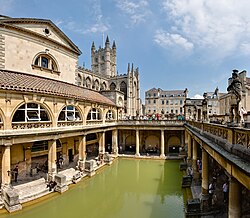
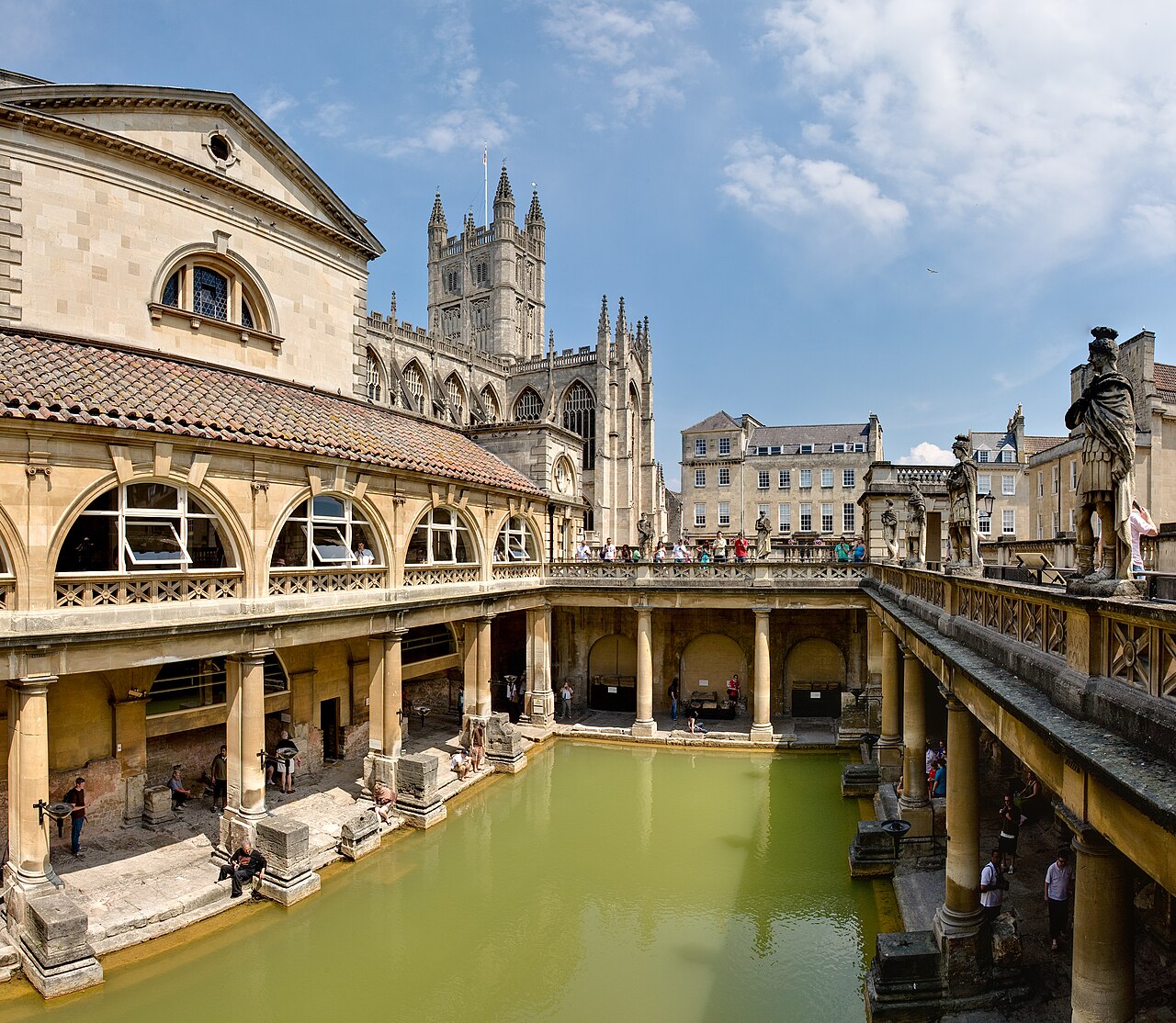
    Start where the city started. A temple was built over the hot spring between about 60 and 70 AD, in the first decades of Roman Britain, and the settlement of Aquae Sulis grew around it. The bathing complex ran until the end of Roman rule in the 5th century. Walk the Great Bath at its original level, look at the gilt bronze head of Sulis Minerva, and read the curse tablets thrown into the water. Allow about 2 hours.

    About this place

    The Roman Baths are well-preserved thermae in the city of Bath, Somerset, England. A temple was constructed on the site between 60 and 70 AD in the first few decades of Roman Britain. Its presence led to the development of the small Roman urban settlement known as Aquae Sulis around the site. The Roman baths—designed for public bathing—were used until the end of Roman rule in Britain in the 5th century AD. According to the Anglo-Saxon Chronicle, the original Roman baths were in ruins a century later. The area around the natural springs was redeveloped several times during the Early and Late Middle Ages.

    Read more on Wikipedia ↗

    Photo: Diliff · CC BY 2.5

  2. Bath Abbey
    Bath Abbey 0.1 km 📍 Map

    The Great Bath → Bath Abbey

    Paved churchyard

    Next door, and a thousand years later. Founded in the 7th century, reorganised in the 10th and rebuilt in the 12th and 16th, the abbey is one of the finest examples of Perpendicular Gothic in the West Country — all vertical lines, fan vaulting and glass. Look for the stone angels climbing ladders up the west front. About 40 minutes.

    About this place

    The Abbey Church of Saint Peter and Saint Paul, commonly known as Bath Abbey, is a parish church of the Church of England and former Benedictine monastery in Bath, Somerset, England. Founded in the 7th century, it was reorganised in the 10th century and rebuilt in the 12th and 16th centuries; major restoration work was carried out by Sir George Gilbert Scott in the 1860s. It is one of the most significant examples of Perpendicular Gothic architecture in the West Country. The medieval abbey church served as a sometime cathedral of a bishop. After long contention between churchmen in Bath and Wells the seat of the Diocese of Bath and Wells was later consolidated at Wells Cathedral. The Benedictine community was dissolved in 1539 during the Dissolution of the Monasteries.

    Read more on Wikipedia ↗
  3. Up to the Circus
    Up to the Circus 1 km 📍 Map

    Bath Abbey → The Circus

    City streets, gentle uphill

    Walk north through Milsom Street and up Gay Street into the Georgian city proper. The Circus is a ring of large townhouses forming a circle with three entrances, designed by John Wood the Elder and built between 1754 and 1768 — a pre-eminent example of Georgian architecture, and best experienced by standing in the middle of it and turning around. About 30 minutes.

    About this place

    The Circus is a historic ring of large townhouses in the city of Bath, Somerset, England, forming a circle with three entrances. Designed by architect John Wood, the Elder, it was built between 1754 and 1768, and is regarded as a pre-eminent example of Georgian architecture. "Circus" (Latin) means a ring, oval or circle in English. The construction has been designated as a Grade I listed building.

    Read more on Wikipedia ↗
  4. The Royal Crescent
    The Royal Crescent 0.3 km 📍 Map

    The Circus → Royal Crescent

    City streets and lawn

    Brock Street delivers you, deliberately, without warning: thirty terraced houses laid out in one sweeping curve above a great open lawn, designed by John Wood the Younger and built between 1767 and 1774. It is among the greatest examples of Georgian architecture anywhere. No. 1 Royal Crescent is furnished as it would have been in the 1770s. About 60 minutes.

    About this place

    The Royal Crescent is a row of 30 terraced houses laid out in a sweeping crescent in the city of Bath, England. Designed by the architect John Wood, the Younger, and built between 1767 and 1774, it is among the greatest examples of Georgian architecture to be found in the United Kingdom and is a Grade I listed building. Although some changes have been made to the various interiors over the years, the Georgian stone facade remains much as it was when first built.

    Read more on Wikipedia ↗

    Photo: Wikimedia Commons · Public domain

  5. Down to Pulteney Bridge
    Down to Pulteney Bridge 1.4 km 📍 Map

    Royal Crescent → Pulteney Bridge

    City streets, gentle downhill

    Drop back through town to the River Avon. Designed by Robert Adam in a Palladian style and completed by 1774, Pulteney Bridge is one of only four bridges in the world with shops across its full span on both sides — you can cross it without realising you are on a bridge at all. View it from the Parade Gardens side, above the curved weir. About 45 minutes.

    About this place

    Pulteney Bridge is a bridge over the River Avon in Bath, England. It was completed by 1774, and connected the city with land in Bathwick which Sir William Pulteney and his family wished to develop. Designed by Robert Adam in a Palladian style, it is one of only four bridges in the world to have shops across its full span on both sides. It has been designated as a Grade I listed building. The bridge is named after Frances Pulteney, wife of the Scottish lawyer and politician Sir William Pulteney, 5th Baronet. Frances was a first cousin once removed of William Pulteney, 1st Earl of Bath. She inherited the Earl's substantial fortune in Somerset after his death in 1764. The rural Bathwick estate, which Frances and William inherited in 1767, was across the river from the city and could be reached only by ferry. William made plans to create a new town, which would become a suburb to the historic city of Bath, but first he needed a better river crossing.

    Read more on Wikipedia ↗

    Photo: Diego Delso · CC BY-SA 4.0

  6. The Assembly Rooms
    The Assembly Rooms 1 km 📍 Map

    Pulteney Bridge → Bath Assembly Rooms

    City streets, gentle uphill

    Finish where Georgian Bath actually happened. Designed by John Wood the Younger in 1769 and now a Grade I listed visitor attraction, the Assembly Rooms were the social engine of the spa town — the ball room, tea room and card room where the season's dancing, gossip and matchmaking took place. Jane Austen's Bath is this building. About 40 minutes.
    About this place

    The Bath Assembly Rooms, designed by John Wood, the Younger in 1769, are a set of assembly rooms located in the heart of the World Heritage City of Bath in England which are now open to the public as a visitor attraction. They are designated as a Grade I listed building.

    Read more on Wikipedia ↗

    Photo: Mark Anderson · CC BY-SA 2.0

Comments