Blog
Petra on Foot: The Siq, the Tombs and the Monastery
In short
Petra on this route is a moderate one-day walk of 14 km and 600 m, through the Siq and the Treasury to the Royal Tombs and about 800 steps up to the Monastery. Go from March to May or September to November, start at opening, and carry water. Entry needs a ticket. This guide does not quote a price.
One long day, in spring or autumn, on foot
Petra on this route is a moderate one-day walk: 14 km and 600 m of ascent, from the visitor centre through the Siq to the Treasury, on past the Royal Tombs, and up about 800 rock-cut steps to the Monastery. You then walk back. The months on the route are March, April, May, September, October and November. That is the spring window, March to May, and the autumn window, September to November. Midsummer heat on the exposed climb is the reason June, July and August are not listed. The site sits high enough that winter can be cold, and December is not a month on this route either. If you are there outside the listed months, check hours and treat the heat or the cold as a reason to shorten the day, not as a bonus season.
The walking is not technical. Distance, stone steps and sun are the work. Expect something like 12 to 16 km by the time you have wandered the tombs and come back out, over seven or eight hours. Start at opening, around 6 am, so the Siq and the Treasury are quiet and the climb happens before the worst of the heat. Staying in Wadi Musa the night before makes that start ordinary. The town is about three hours by road from Amman and about two from Aqaba. The visitor centre is a short walk from most hotels.
The ticket, without a made-up price
Entry needs a ticket. Bring your passport. It is checked. A Jordan Pass is usually the cheaper way in, because it bundles Petra with other sites and waives the tourist visa fee if you buy it before you arrive and stay at least the number of nights the scheme requires. The pass is sold in tiers by how many consecutive days you want inside Petra. Check the current conditions before you fly. This page does not quote a price in dinars or dollars. Those numbers move, and a guessed one would be wrong on purpose.
The ticket tiers are built so a second or third consecutive day is a small step up from the one-day price. The site genuinely needs two days if you want the high places without watching the clock: the Siq, the Treasury and the city centre on day one, the longer climbs on day two. That is a structure, not a fare. Look up the current step-up before you decide you “only have time for one.”
Petra by Night is a separate ticket. It is not included in day entry and it is not included in the Jordan Pass. It runs only on set nights, and it is atmosphere and candlelight on the walk to the Treasury, not a light show. If you want it, match your nights in Wadi Musa to the current schedule when you book the hotel.
What the day contains
From the gate you pass the Djinn Blocks and the Obelisk Tomb and enter the Siq, a natural cleft barely a few metres wide in places, winding for over a kilometre between walls that rise on the order of 180 m. Nabataean water channels run along both sides. About 40 minutes of gentle descent ends at Al-Khazneh, the Treasury, a facade nearly 40 m tall, carved in the 1st century, most likely a royal tomb. Morning light is the good light. Give it twenty minutes before the plaza fills, not an hour of shopping.
The gorge then widens. The Street of Facades holds dozens of carved tombs. The Theatre, cut from the rock, seated on the order of 6,000. Then the Royal Tombs along the cliff of Al-Khubtha: the Urn, Silk, Corinthian and Palace tombs. The Urn Tomb, from about the year 70, stands on a great arched terrace. Allow the climb. It is the view back over the city, and it is also the proper path if you want the Treasury from above. Around the Treasury you will be offered informal scrambles to a viewpoint for a tip. The view is real. The footing is someone else’s problem. The Al-Khubtha trail is an engineered path and it is already in the ticket. Take that one if you want the top-down photograph, and take water.
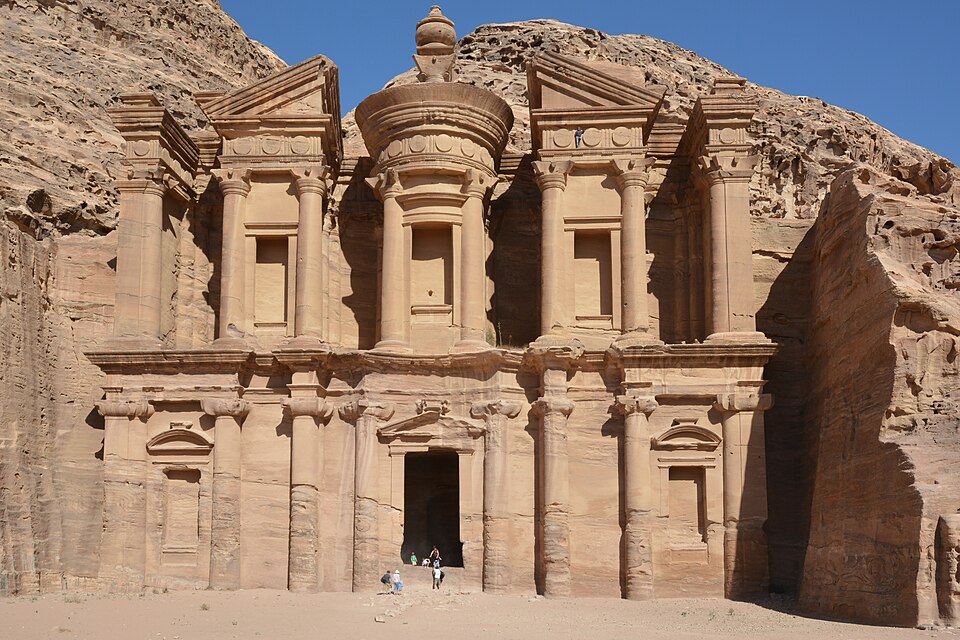
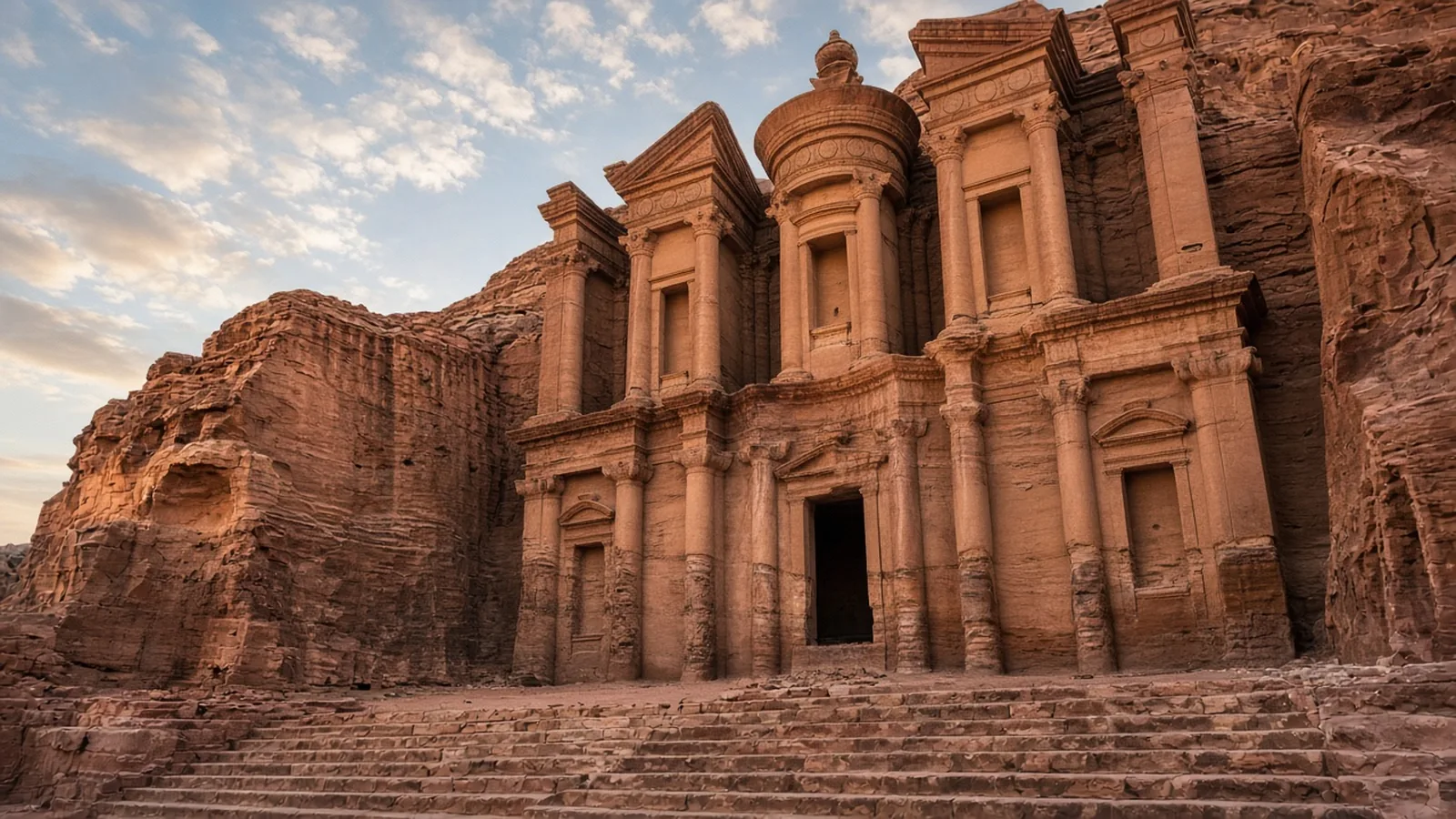
Down in the old centre, the Colonnaded Street leads to Qasr al-Bint, one of the few free-standing buildings still up, and the start of the Monastery path. Ad Deir is about 800 rock-cut steps and 2.5 km from there, gaining about 350 m. The facade is larger than the Treasury, about 47 m wide and 48 m tall. It is the farthest of the headline carvings and, for many people, the best. Late afternoon light on it is the reward for having started at 6 am. There is a cafe opposite. Rest there, then begin the long walk out. Allow two to three hours for the return to the gate. The steps are worn smooth. Walking shoes matter more here than on many mountain trails that are twice as famous.
Water, horses, and the second entrance
Carry at least two litres, more in the warmer months of the listed season, plus sun protection and something salty. Kiosks exist inside. They are sparse and expensive, and they are not a plan. Local Bedouin offer horses, donkeys and carts. The site is better walked. A ride to the Treasury shortens the approach and does nothing for the 800 steps.
A shuttle has historically run from the visitor centre to Little Petra, where a back trail crosses the ridges to the Monastery in a couple of hours. You arrive at Ad Deir from above, skip the staircase, and walk downhill through the site. You still need a valid Petra ticket. Guides can be hired at the Little Petra end. Check the current shuttle and trail the day before, rather than assuming the historical service is today’s service.
If your dates are inside March to May or September to November, you have the season. If they are a July week, you have the heat the month list refused. The other long walks are on trails. Petra will still be a full day on foot when the temperature is one you can climb in.
Questions
- How long is Petra on foot?
- The route is 14 km and 600 m, graded moderate, and a full day is often 12 to 16 km once you wander the tombs and walk back. Allow seven or eight hours, and start around opening at 6 am.
- When is the best season?
- March to May and September to November. Summer midday heat is the reason the hotter months are not listed. The site can also be cold in winter, and December is not a month on this route.
- What does the ticket involve?
- You need a ticket and your passport. A Jordan Pass can work out cheaper because it waives the visa fee if you buy it before arrival and stay the required nights. Petra by Night is a separate ticket. This page does not quote prices.
- How hard is the climb to the Monastery?
- About 800 rock-cut steps and 350 m of climbing from Qasr al-Bint. It is not technical. Worn stone and heat are the difficulty. Walking shoes matter.
- Is one day enough?
- One day covers the Siq, the Treasury, the Royal Tombs and the Monastery if you start early. The ticket structure makes a second consecutive day a small step up, and the site is easier with that extra day. Check the current step-up rather than guessing it.