Blog
When the Yoshida Trail up Mount Fuji Is Actually Open
In short
Climb the Yoshida Trail in the official season, early July to early September, and sleep in a hut near the eighth station so you can see the goraiko from the 3,776 m summit. The route is hard: 15 km and 1,471 m over two days. June is too early. Late September is too late. Book the hut before anything else.
The season is early July to early September
The Yoshida Trail is a hard two-day climb: 15 km and 1,471 m of ascent, from the Fuji Subaru Line 5th Station at 2,305 m to a hut near the eighth station, then to the summit. The official climbing season is early July to early September. The months on the route are July, August and September, and September counts only while the season is still open. June is too early. Late September is too late. Outside that window the huts, the buses and the summit facilities are shut. The mountain is closed in every practical sense, and the conditions are genuinely hazardous. A June weekend is not an early, quieter Fuji. Where to walk in June is a different list.
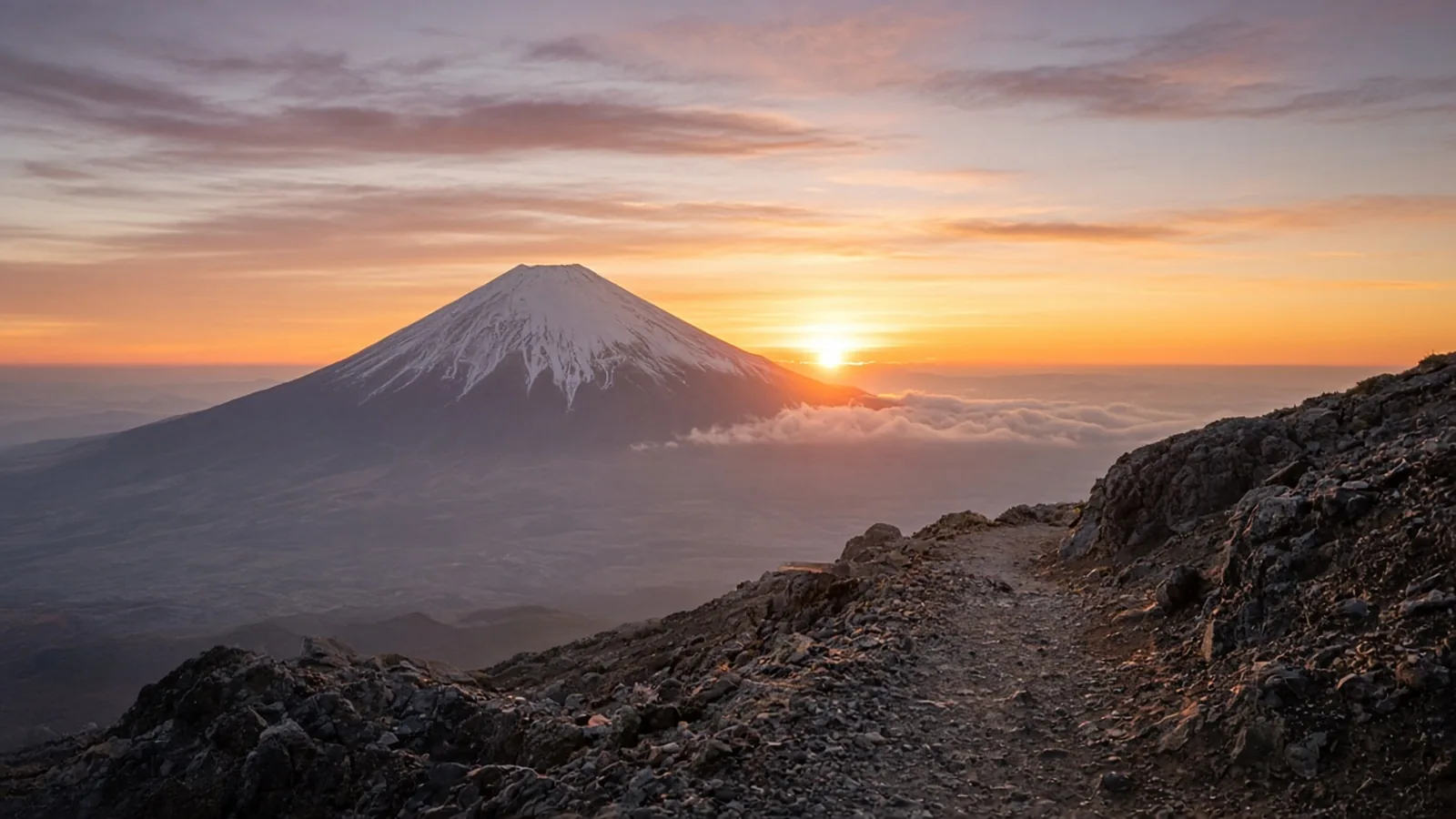
The summit people mean is Kengamine, 3,776 m, the highest point in Japan. The trail’s own summit gate is not that point. Kengamine sits a short crater-rim loop away, the Ohachimeguri, and you walk it after the sunrise if the weather and your legs still agree. The sunrise is the goraiko, the arrival of light over a sea of cloud. It is the reason the route is split across two days. It is also a cold stand-around, even in August: bitterly cold and windy. Warm layers and gloves are the packing list, not a precaution for a freak morning.
What the two days are
Day one is a half-day of about 5 km and 800 m, five to six hours, from the 5th Station to the eighth-station huts around 3,100 m. The start is gentle along the tree line, then zigzags on bare volcanic gravel to the seventh-station huts, then steeper rock to the eighth. You check in, eat early and sleep. Day two is about 10 km. You leave in the dark, climb through the ninth station and the queue on the last rock steps, pass the torii, and reach the crater rim for the goraiko. The loop to Kengamine adds a little over an hour if you do it. The descent is a different trail: long gravel switchbacks back to the 5th Station, with a fork where the Yoshida and Subashiri descents split. Miss that sign and you finish on the wrong side of the mountain. That is the classic Fuji mistake. Allow something like six to seven hours for the summit and the walk down.
The grade is hard because the air is thin, the weather turns quickly, and the gravel never lets you settle into a rhythm. The huts and the crowds do not change the grade. You also arrive at 2,305 m in one bus ride. Spend at least an hour at the 5th Station, eating and walking around, before you start up. That hour is the acclimatisation you can actually buy. Buses in season run from Shinjuku and from Kawaguchiko Station. You do not need a car, and you should not invent a lower trailhead to make the day feel more serious.
The hut is the plan
The two-day rhythm depends on a bunk near 3,100 m. Beds sell out. Sleeping on the mountain outside the huts is not an option. Book the eighth-station hut before you book anything else, and book it well ahead of the date you want. The hut reservation is also what gets you through the current access rules: hut guests are exempt from the daily climber cap, and they may pass the trail gate after it closes for the afternoon. Fit the trail reservation and the buses around the bed, not the other way around.
Since 2024 the Yoshida Trail has had a physical gate at the 5th Station, a climbing fee, a daily cap, and an online reservation. The gate closes from mid-afternoon until the small hours. Hut guests are the main exception. The details have been adjusted each season. Read the official Fuji climbing site for the current fee, cap and gate hours before you fix dates. This page does not quote the fee, because it moves. Bullet climbing, the all-night dash from the 5th Station with no sleep, is what that afternoon closure is there to stop. It is also a bad plan on its own. Hypothermia and altitude sickness account for most of the rescues. Sleep at the eighth station and you will pass the people who did not, somewhere around 3,500 m.
Water, cold, and the months that are actually open
There is no spring and no stream on the climbing routes. Every drop above the 5th Station is carried up or stored, and the huts sell drinks at prices that reflect the haul. Start with at least two litres. Refill as you go, for a fee, and do not count on a tap existing where you hope one does. A headtorch for the pre-dawn push, warm layers, gloves and cash for the huts are the essentials the route actually names. The huts are where you pay for the bed, the meal and the water.
July and August are the heart of the season. September is on the month list only because the official season runs into early September. A date in late September is past the huts and the buses. Treat it the way you treat June: too late, not a bargain. If your only free week is the last week of September, pick another trail on trails. Fuji will still be there next July.
The wooden pilgrim’s staff, the kongozue, is sold at the 5th Station and branded with a hot-iron stamp at the huts on the way up. Buy it before you start if you want the lower stamps. You cannot collect them on the way down. That is a souvenir with a sequence, not a planning problem. The planning problem is the hut, the gate, and a date inside early July to early September.
A hard day that still has a closed season
People underestimate Fuji because the buses are easy and the mountain is famous, then overestimate it by trying to climb outside the season “before the crowds.” The crowds are the open season. The closed season is no huts, no services, and weather the page calls genuinely hazardous. Go in July or August, or in the early days of September if the official dates still include them. Book the eighth-station hut first. Give the 5th Station an hour. Carry the water. Follow the descent signs. Stand for the goraiko in enough clothing that you can feel your hands, then walk the rim to 3,776 m if the sky lets you. That is the Yoshida Trail. Anything outside those weeks is a different mountain.
Questions
- When is the official Yoshida Trail season?
- Early July to early September, when the huts, buses and summit facilities are open. The months on the route are July, August and September, and September only counts while the season is still open.
- Can I climb Fuji in June?
- No. June is too early. Outside the official season there are no huts and no services, and the conditions are hazardous.
- Is late September still the season?
- No. Late September is too late. The official season ends in early September. A date after that is past the huts and the buses.
- Do I need a mountain hut?
- Yes. The two-day plan sleeps near the eighth station, around 3,100 m. Beds sell out, sleeping outside the huts is not an option, and a hut booking is what gets you through the afternoon gate closure.
- How hard is the Yoshida Trail?
- Hard, over two days, 15 km and 1,471 m. The air is thin, the weather turns quickly, and the volcanic gravel is tiring. The crowds do not lower the grade.