
Blog
The Laugavegur Trail: Season, Huts, and Four Days
In short
Walk the Laugavegur from Landmannalaugar to Thorsmork in 4 days: 55 km and 1,200 m, graded moderate, from late June to early September, the weeks the mountain huts are staffed and the highland buses run. Staffed means the wardens are there and the beds are in service. Early June is before that window, with snow still likely on the plateau. Mid-September is after it. A tent does not open a season the page says is closed.
Four days, and only while the huts are staffed
The Laugavegur is a four-day walk with a season that is shorter than the Icelandic summer people imagine. Waymark lists 4 days, 55 km and 1,200 m of ascent, graded moderate, from Landmannalaugar to Thorsmork. The season is late June to early September, when the mountain huts are staffed and open. The page also says the trail is only open once those huts are staffed. That second sentence is the one that decides an early June flight and a mid-September one.
Moderate is the grade of the walking: marked, non-technical, hut to hut, north to south. The weather does its own grading. Sun, sleet, and fog can arrive in one afternoon. The season does not stretch to meet a ticket. Late June is the start. Early September is the end. The weeks on either side are a different country, even if the road to the highlands looks passable.
June on Waymark is the month this trail begins, at the end of the month. July and August sit inside the window. September is the month it closes, early.
What the four days contain
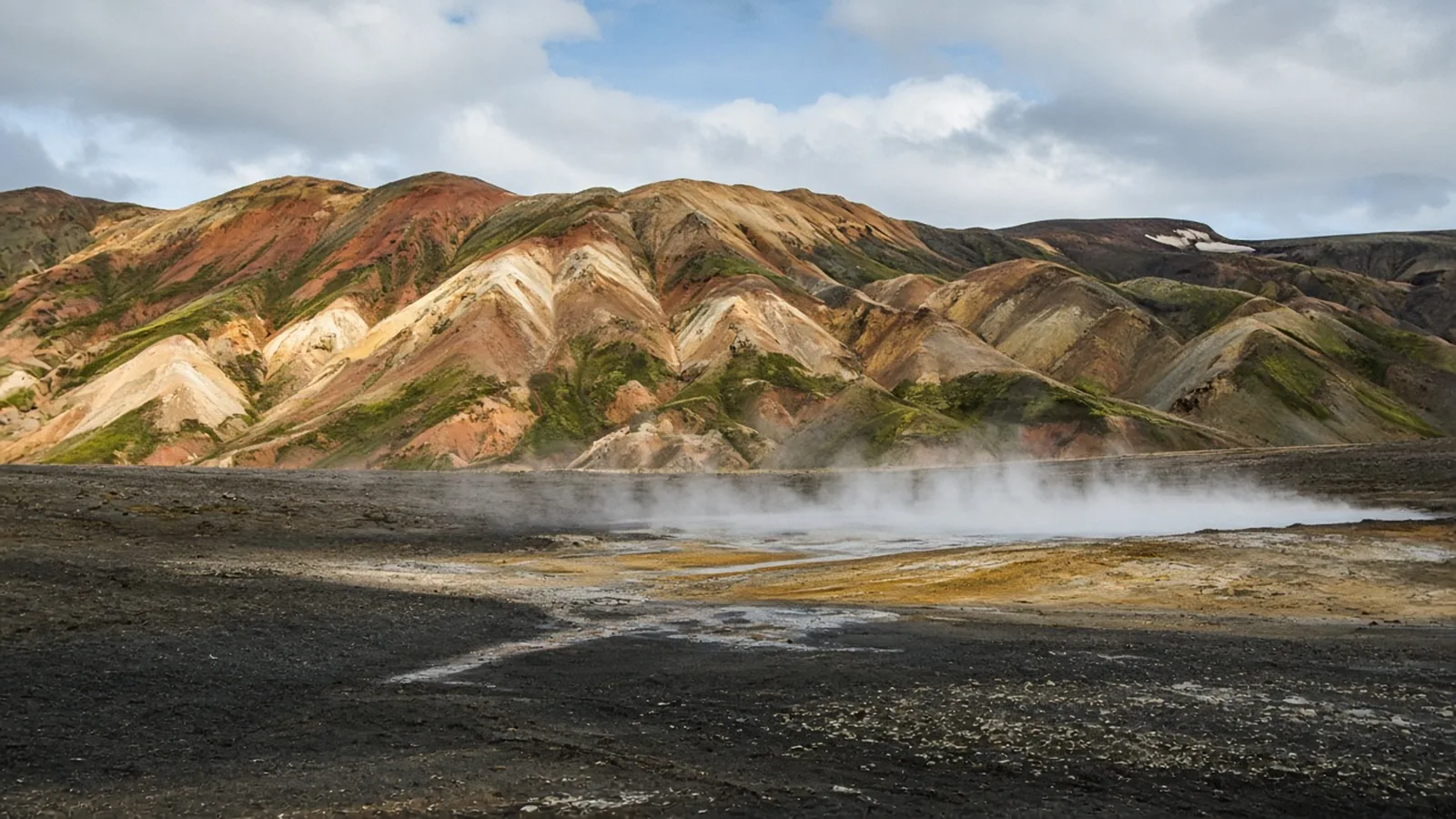
The Laugavegur Trail strings landscapes together in about 55 km. Landmannalaugar is rhyolite hills and steaming ground. Then a high plateau streaked with snow and obsidian, glacier-fed lakes, river fords, a black volcanic desert, and the green birch valley of Thorsmork under three glaciers. The highest point is around Hrafntinnusker, at about 1,050 m, and that night is often the coldest and windiest of the trek.
The nights are spaced by the huts of Ferðafélag Íslands: Hrafntinnusker, Álftavatn, and Emstrur (Botnar). Beds sell out months ahead. Book them, or bring a tent for the marked campsites beside each hut. A tent is the overflow plan inside the season. It is not a plan for the weeks the huts are unstaffed.
Rivers are unbridged. The Þröngá, on the final day, is the biggest crossing. Sandals or wading shoes belong in the pack, and the page says never to cross alone in high water. Snow can linger on the high plateau even in July, so a late-June start still packs for a white section, inside a season that has officially begun.
Most people ride the highland bus from Reykjavik to Landmannalaugar and the bus back out of Thorsmork. Both run only during the season. The trail and the buses open and close together.
What “huts staffed” means
Staffed means a warden is there and the hut is open for the job the route expects: a bed you can reserve, a campsite that belongs to a working hut, and a summer in which the highland buses are part of the transport. The Waymark season line is not “the path exists on the map from late June to early September.” It is “the huts are staffed and open,” and the good-to-know line repeats it: the trail is only open once the huts are staffed, roughly late June to early September.
Inside that window you still have to book. Popular beds go months ahead. If the booking fails, the campsite beside the hut is the alternative the page gives you, and you carry the tent from the start. Walking up to a full hut in July with neither a reservation nor a tent is not what “staffed” promises. Staffed promises that the system is operating. It does not promise a free bed.
Outside that window the system is not operating. The page does not describe a shoulder season in which empty huts, a private car, and good luck replace the wardens. It describes an open trail and a closed one. Late June to early September is open. The practical meaning for anyone holding dates is simple. If the huts are not staffed, you are not on the Laugavegur as this route defines it.
Early June is too early
Early June feels, from Reykjavik, like the start of summer. On this page it is before the route.
The staffed window begins in late June. An arrival in the first or second week of June is outside it. The huts at Hrafntinnusker, Álftavatn, and Emstrur are not the open, warden-run stops the four days are built around. The highland buses that run in season are not running yet. Snow can linger on the high plateau even into July, which means early June is not a slightly whiter version of the same walk. It is earlier than a plateau that may still be snowed in after the huts have opened.
There is no clever reading in which you start early to avoid crowds. The crowds, and the beds, and the buses, and the wardens, arrive together at the end of June. Before that you are in the highlands without the thing the grade assumes: a staffed hut at the end of the day. Where to walk in June makes the same point for this trail and for the other hut tours that open late in the month. June, for the Laugavegur, means the end of June.
If your only dates are early June, choose a lowland walk and keep this trail for another year. Do not move the itinerary forward and hope the plateau agrees.
Mid-September is too late
Early September is the close. Mid-September is past it.
The same definition of staffed applies from the other side. When the wardens finish, the huts are no longer the open system, and the season buses stop. A mid-September walker arrives to a route the page has already closed, with the same problem as early June: no staffed bed to count on, and no seasonal bus at Landmannalaugar or Thorsmork. Autumn weather in the highlands does not add a grace week the page forgot to mention.
The tent does not repair this. A campsite beside a hut is the in-season alternative to a full bunkroom. It is not a permit to camp the route after the staff have gone and the buses have stopped. River crossings, including the Þröngá, are still there, and the page’s rule about high water does not relax because the huts are shut. If anything, you have fewer people to cross with, and the page already says not to cross alone when the water is up.
Finish the four days inside the early-September end of the window. If the flight home is the middle of the month, the walking has to be done before that, not during it.
Inside the window
Once the dates sit in late June, July, August, or the first days of September, the decisions get ordinary and specific.
Book the three hut nights, or commit to the tent, before you buy the highland bus. Four days and 55 km is about 14 km a day, with 1,200 m of ascent spread over the whole trail, graded moderate. That grade assumes you are walking in the season, with the rivers crossable and a night at about 1,050 m that may be the cold one. Pack a shell for sleet even if the Reykjavik forecast is fair. Take wading shoes. Start the last day ready for the Þröngá, and turn the group around rather than cross it high and alone.
Late June is the first honest week, with a real chance of snow still on the plateau and with the huts actually staffed. July and August are the core, and the beds go first. The opening of September is the last honest week. Write the trip inside those sentences. Early June and mid-September are popular mistakes, and the route page is written to refuse both of them.
Questions
- How many days is the Laugavegur Trail?
- Four days, 55 km and 1,200 m of ascent, graded moderate, from Landmannalaugar to Thorsmork. The huts that space the days are at Hrafntinnusker, Alftavatn, and Emstrur (Botnar). The highest point is around Hrafntinnusker at about 1,050 m.
- What does it mean that the huts are staffed?
- The page ties the open season to staffed, open huts, roughly late June to early September. Wardens are present, beds can be booked, and the highland buses from Reykjavik run. Outside those weeks the trail is not in season. Beds sell out months ahead inside the season, so a tent for the campsite beside each hut is the backup, not a way to arrive early.
- Can you start the Laugavegur in early June?
- Early June is too early. The staffed window begins in late June. Snow can linger on the high plateau even into July, so the start of June is before the route is open, not a quiet preview of it. The season buses are not running yet.
- Is mid-September still Laugavegur season?
- Mid-September is too late. Early September is the end of the staffed window. After that the huts are no longer the open, warden-run system the route is built on, and the buses that exist for the season have stopped. Plan to finish inside early September.
Sources
Routes in this post
-
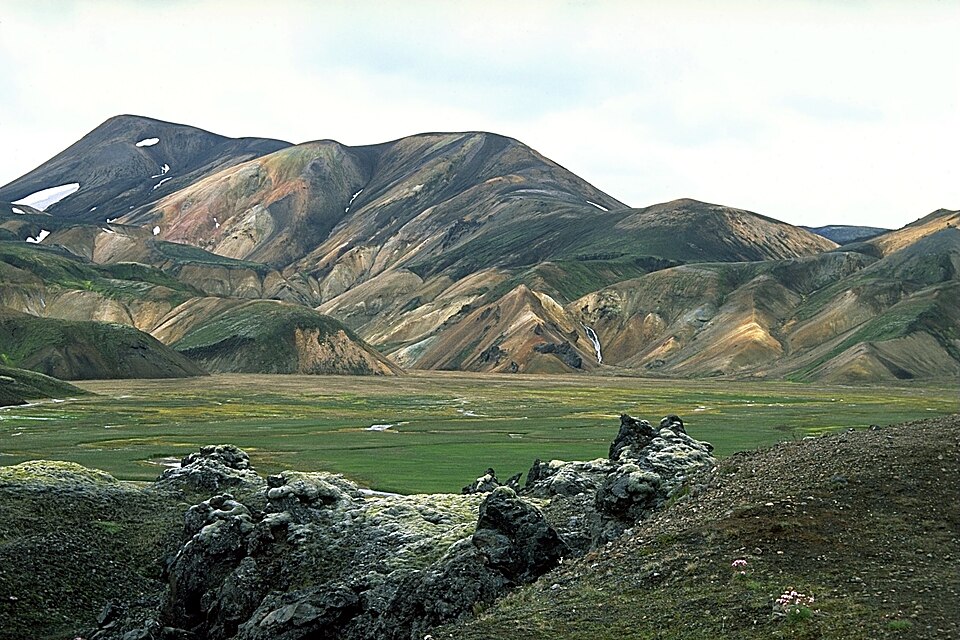 Photo: Andreas Tille · CC BY-SA 4.0Trek Iceland
The Laugavegur Trail — Landmannalaugar to Þórsmörk
Four days across Iceland's southern highlands, from the rhyolite mountains and hot springs of Landmannalaugar over an obsidian plateau and black-sand deserts to the birch woods of Þórsmörk.
- Duration
- 4 days
- Distance
- 55 km
- Difficulty
- Moderate