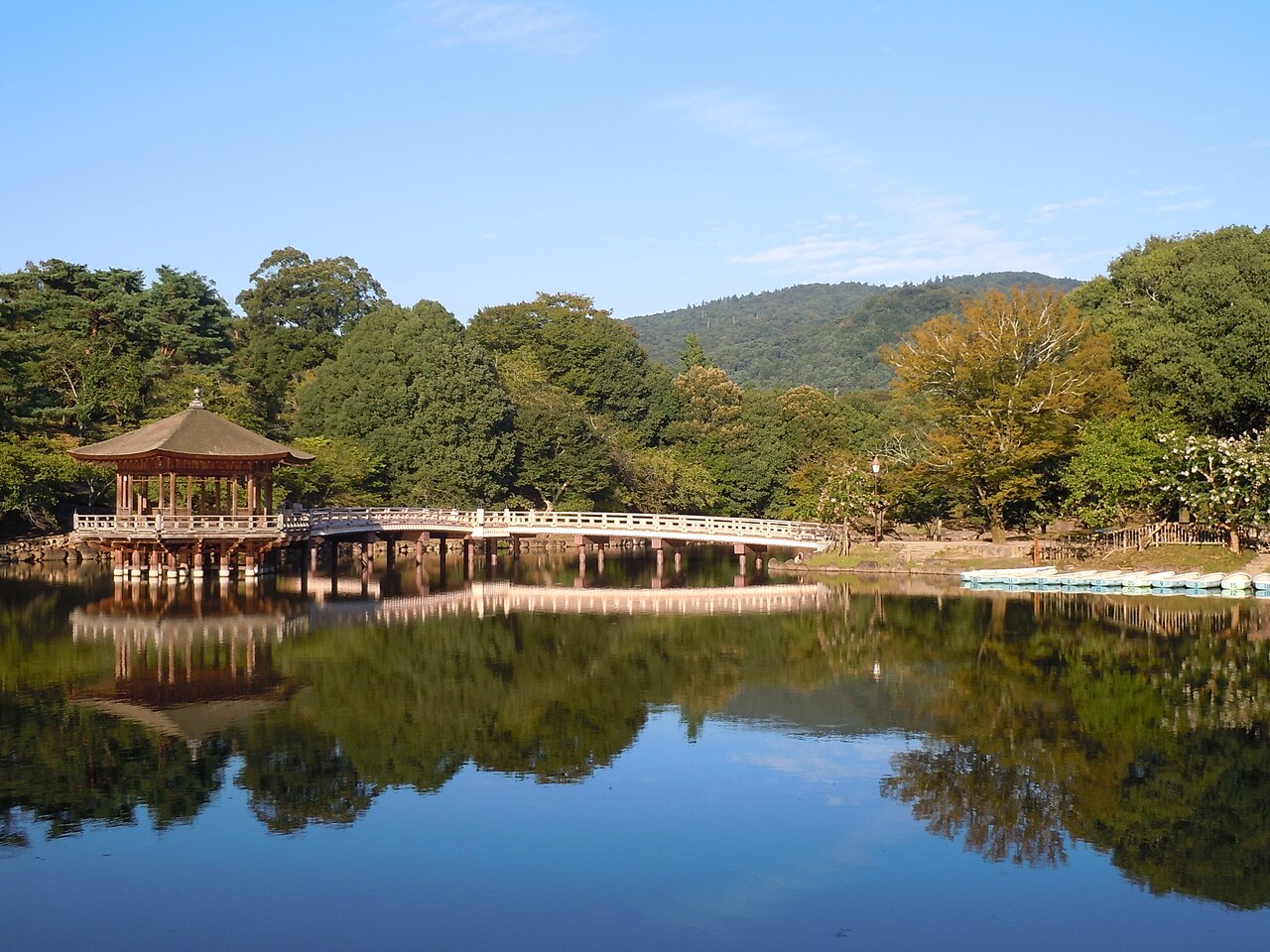
From a hilltop pagoda across open deer parkland to Japan’s largest Buddha, up a forested lantern avenue, then down into a quarter of Edo-period merchant houses.
مقاطع
- Kōfuku-ji
Kintetsu Nara Station ← Kōfuku-ji five-storied pagoda
Paved streets and temple steps
The temple of the Fujiwara clan, and one of Nara's UNESCO World Heritage sites. Its five-storied pagoda is among the tallest in Japan and long vied with Tō-ji in Kyoto for the title. The Eastern Golden Hall charges a small admission; the grounds are open and free. Allow about 45 minutes.
- Nara Park and the deer
Kōfuku-ji ← Nandai-mon gate
Open parkland paths
Cross the open lawns where several hundred sika deer wander among the trees. They are wild but thoroughly used to people, and can be fed the crackers sold at park stalls — expect to be followed. The path runs east past ponds and stone lanterns to Tōdai-ji's colossal Nandai-mon gate and its pair of guardian statues.
- Tōdai-ji and the Great Buddha
Nandai-mon gate ← Great Buddha Hall
Temple precinct
The Daibutsu-den houses the Great Buddha, the largest bronze Buddha statue in Japan, and is itself said to be among the largest wooden buildings in the world — and the present hall is smaller than the original. Small admission. Allow about an hour, and climb on to the Nigatsu-dō terrace above for a free view back over the city.
- The Kasuga-taisha lantern approach
Tōdai-ji ← Kasuga-taisha
Gravel forest avenue, gentle climb
A long wooded avenue climbs gently into the primeval forest of Mount Kasuga, flanked the whole way by stone lanterns — roughly two thousand of them, moss-covered and donated over the centuries. At the top, the vermilion shrine hangs hundreds of bronze lanterns from its eaves. The approach is free; the inner precinct charges a small fee.
- Naramachi old town
Kasuga-taisha ← Naramachi
Park paths and narrow streets
Drop back down through the park and head south into Naramachi, the former merchant quarter, where narrow lanes of Edo-period machiya townhouses now hold cafés, craft shops, small museums and a working sake brewery offering tastings. A quiet, low-key end to the day, about ten minutes' walk from Kintetsu Nara Station.
التعليقات
سجّلوا الدخول للانضمام إلى النقاش.
لا توجد تعليقات بعد — كونوا أوّل المعلّقين.