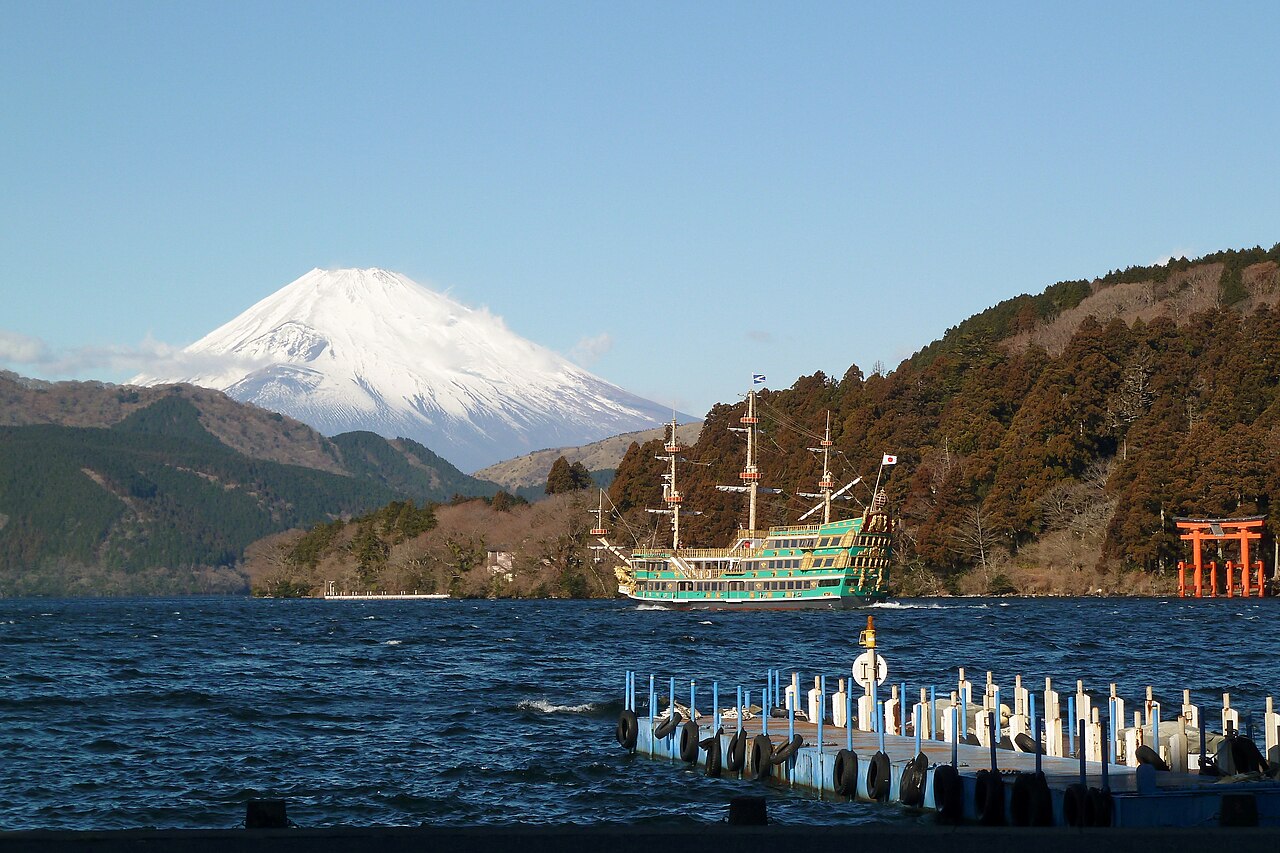
Up the mountain by switchback railway and cable car, over a sulphur valley by ropeway, across the crater lake by boat, and back along the shore to a shrine standing in the water.
مقاطع
- Hakone-Yumoto
Odawara ← Hakone-Yumoto Station
Town streets
The gateway to Hakone and its oldest hot-spring town, sat where two rivers meet. The main street is a run of soba shops, sweet stalls and day-use bathhouses. Buy the Free Pass here if you haven't already, and save the onsen for the way home.
- The switchback railway to Gōra
Hakone-Yumoto Station ← Gōra Station
Mountain railway, then station streets
The Hakone Tozan Line is one of the steepest adhesion railways in Japan, and it climbs by reversing direction at a series of switchbacks — the driver and conductor swap ends of the train at each one. Hydrangeas line the track in June. Break at the Hakone Open-Air Museum a stop short of Gōra if you have time.
- Cable car and ropeway to Ōwakudani
Gōra Station ← Ōwakudani
Funicular, aerial ropeway and crater walkways
A funicular climbs to Sōunzan, where the ropeway lifts you over Ōwakudani — a bare, steaming valley of sulphur vents blasted open by an eruption some three thousand years ago. Get out and walk the boardwalks: the smell is spectacular, and the stalls sell black eggs boiled in the hot springs, their shells stained by the sulphur. Fuji looms behind on a clear day.
- Down to Lake Ashi
Ōwakudani ← Tōgendai
Aerial ropeway
The ropeway carries on down the far side, and the view opens all at once — Lake Ashi below, filling the floor of the caldera, with Fuji standing over the far end of it. Land at Tōgendai on the northern shore, where the boats leave.
- Pirate ship across Lake Ashi
Tōgendai ← Moto-Hakone
Sightseeing boat
The sightseeing boats are gilded mock galleons, which is silly and completely committed to, and they cross the crater lake in about half an hour. Sit on the open deck facing back up the lake: this is the classic Fuji view, and the only one you get without walking.
- Hakone Shrine and the lake torii
Moto-Hakone ← Hakone Shrine
Cedar avenue and stone steps
A path of stone steps climbs through towering cedars to a shrine founded well over a thousand years ago and long revered by samurai. Below it, the vermilion Torii of Peace stands in the shallows with the lake behind — the most photographed thing in Hakone, with a queue to prove it. Buses run back to Hakone-Yumoto from Moto-Hakone.
التعليقات
سجّلوا الدخول للانضمام إلى النقاش.
لا توجد تعليقات بعد — كونوا أوّل المعلّقين.