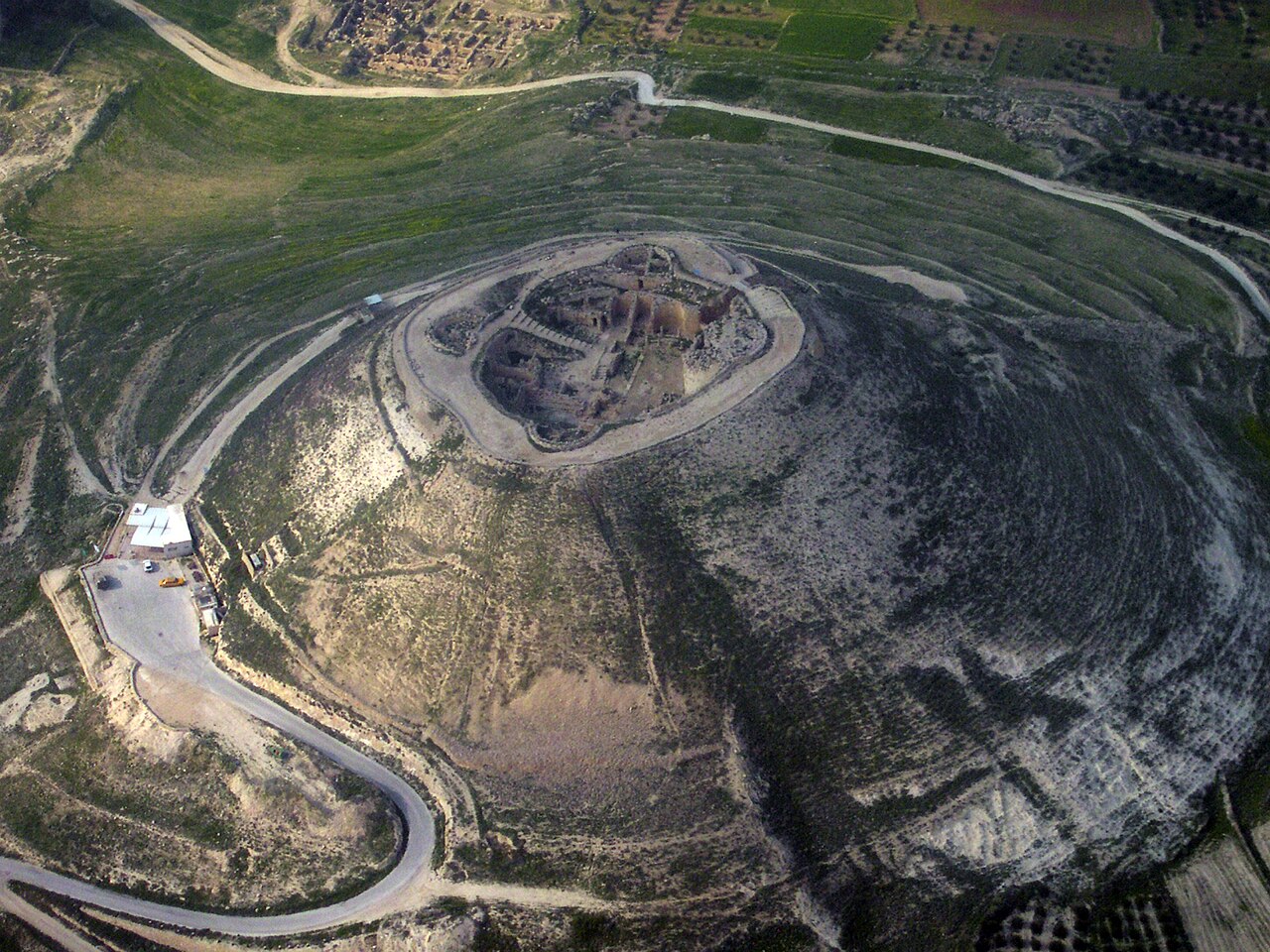
A compact loop that climbs the cone, circles the summit fortress and drops to the discoveries on the northern slope.
Segments
- The climb up the cone
Park entrance → Summit rim
Steep stepped ascent, fully exposed
Start at the foot of the artificial mound and climb its steep flank. Josephus wrote that Herod approached the summit by 'two hundred steps of hewn stone'; today a modern path takes you up the same volcano-like cone to a rim that stands roughly 758 metres above sea level. It is a short climb but a steep one, and the view widens with every step. Allow about 30 minutes.
- The round towers and the palace
Summit rim → Inner courtyard
Ancient stone ruins
The summit is ringed by a double circular wall set with four towers — three semicircular and, to the east, a great round tower about 18 metres across at its base that once rose several storeys. Inside sat a luxurious palace with a colonnaded garden and a Roman-style bathhouse of hot, warm and cold rooms. During the First Jewish–Roman War, defenders turned one of the rooms into a synagogue, among the earliest known. About 40 minutes.
- The theatre and the royal box
Summit → Theatre on the northern slope
Slope paths and steps
On the northern slope, below the summit, Ehud Netzer's team uncovered a private theatre seating roughly 450 people. Above the ordinary seats sat an elaborately decorated royal box, or loggia, its walls painted with frescoes and windows — a viewing room built for the king and his guests. It was deliberately buried when the tomb below it was constructed. About 30 minutes.
- The Bar Kokhba tunnels
Theatre → Tunnel network in the hillside
Dug tunnels and stairs, low ceilings
Some 130 years after Herod, rebels of the Bar Kokhba Revolt (about 132–135 CE) turned Herodium into a stronghold and carved a network of tunnels through the hill, linking Herod's old water cisterns into hidden passages for guerrilla warfare. You can walk part of the system today, ducking through the dug corridors that once let fighters move unseen inside the mountain. About 30 minutes.
- Herod's tomb and mausoleum
Tunnels → Mausoleum site, northern slope
Slope paths
The route ends where the long search ended. After decades of digging, in 2007 the archaeologist Ehud Netzer identified the base of a monumental mausoleum on the northern slope, along with fragments of a finely carved sarcophagus, as the tomb of Herod the Great. Netzer died in 2010 after a fall at this very spot. Stand here and look out over the desert Herod chose for his final monument. About 20 minutes.
Comments
Sign in to join the conversation.
No comments yet — be the first.