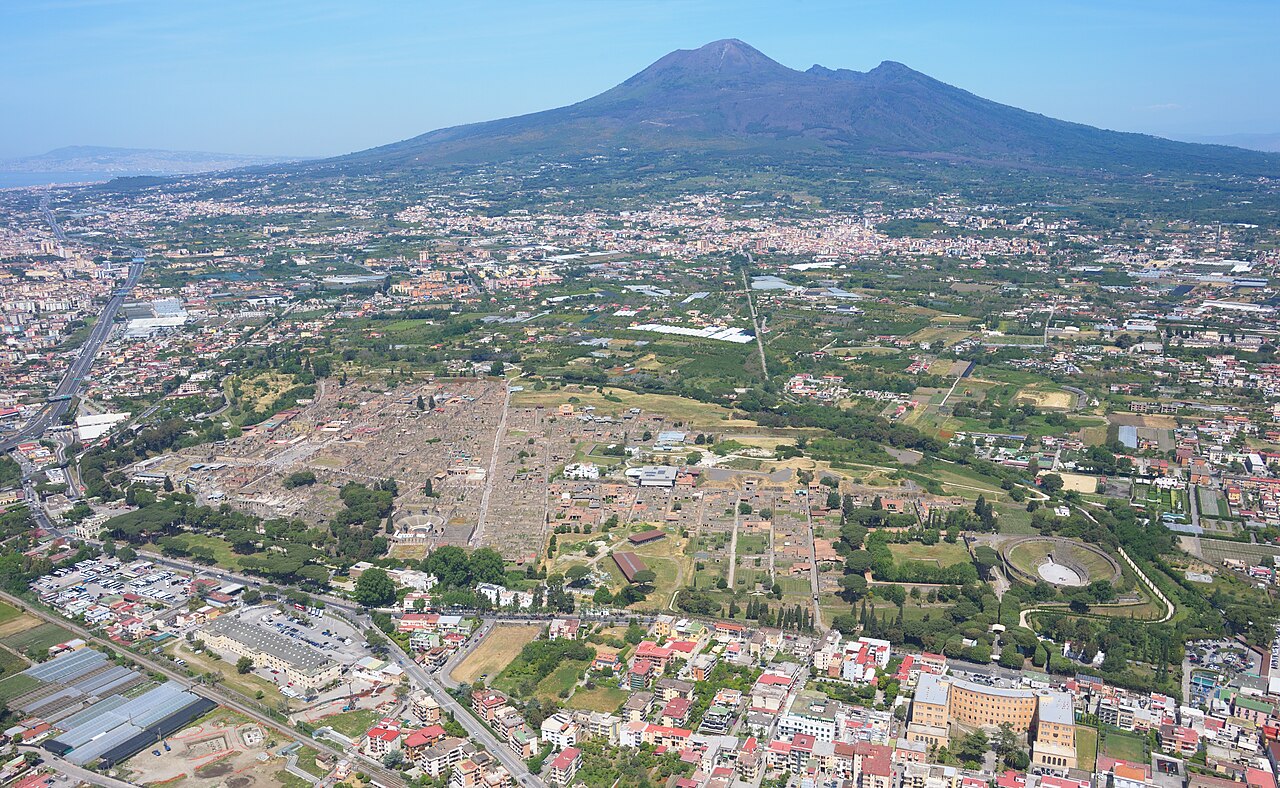
A morning crossing the buried city from the Forum to the Villa of the Mysteries, then a transfer up Vesuvius for the walk to the crater.
مقاطع
-
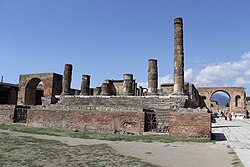 The Forum
Porta Marina gate ← Forum of Pompeii
Ancient paving, gentle ramp
Enter through the Porta Marina and climb into the civic heart of the town: a long colonnaded square with the Temple of Jupiter at its north end and Vesuvius framed perfectly behind it — the postcard that explains the whole site in one look. Basilica, market hall and municipal offices ring the square. About 45 minutes.
عن هذا المكان
The Temple of Jupiter, Capitolium, or Temple of the Capitoline Triad, was a temple in Roman Pompeii, at the north end of its forum. Initially dedicated to Jupiter alone, it was built in the mid-2nd century BC at the same time as the Temple of Apollo was being renovated – this was the area at which Roman influence over Pompeii increased. So Roman Jupiter superseded the Greek Apollo as the town's leading divinity. Jupiter was the ruler of the gods and the protector of Rome, where his temple was the center of Roman religion and of the cult of state.
اقرأوا المزيد في ويكيبيدياصورة: Carla Brain · CC BY-SA 2.0
-
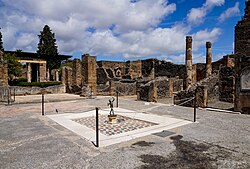 House of the Faun
Forum ← House of the Faun
Ancient paving with stepping stones
Walk north into the grandest private house in Pompeii, built in the 2nd century BC in the Samnite period and occupying most of a city block. The dancing faun in the atrium gives it its name; the vast Alexander Mosaic once floored the room beyond — the original is in the archaeological museum in Naples, with a copy laid in place here. About 30 minutes.
عن هذا المكان
The House of the Faun, constructed in the 2nd century BCE during the Samnite period, was a grand Hellenistic residence that was framed by peristyle in Pompeii, Italy. The historical significance in this impressive estate is found in the many great pieces of art that were well preserved from the ash of the eruption of Mount Vesuvius in 79 CE. It is one of the most luxurious aristocratic houses from the Roman Republic, and reflects this period better than most archaeological evidence found even in Rome itself.
اقرأوا المزيد في ويكيبيدياصورة: NikonZ7II · CC BY-SA 4.0
-
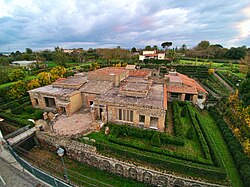 Villa of the Mysteries
House of the Faun ← Villa of the Mysteries
Ancient paving, then a walled lane outside the gate
Head out through the Herculaneum Gate and along the road of tombs to a suburban villa on the town's edge. Room 5 holds the reason to come: a continuous frieze of near life-size figures on a deep red ground, usually read as a bride's initiation into a mystery cult, and among the best-preserved Roman paintings anywhere. About 45 minutes including the walk.
عن هذا المكان
The Villa of the Mysteries is a well-preserved suburban ancient Roman villa on the outskirts of Pompeii, southern Italy. It is famous for the series of exquisite frescos in Room 5, which are usually interpreted as showing the initiation of a bride into a Greco-Roman mystery cult. These are now among the best known of the relatively rare survivals of Ancient Roman painting from the 1st century BC.
اقرأوا المزيد في ويكيبيدياصورة: ElfQrin · CC BY-SA 4.0
-
 The casts — Garden of the Fugitives
Villa of the Mysteries ← Garden of the Fugitives
Ancient paving
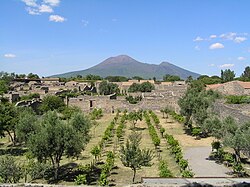
Cross the site to its quiet southeastern corner, where an old vineyard holds the casts of thirteen people caught by the eruption — made by pouring plaster into the voids their bodies left in the hardened ash. Adults and children together, lying where they fell. It is the most affecting thing in Pompeii and the right note to leave on. About 40 minutes.
عن هذا المكان
The Garden of the Fugitives is an archaeological site located in the ancient destroyed city of Pompeii, in Regio 1 Insula 21. It contains the casts of 13 victims of the eruption of Mount Vesuvius in 79 AD.
اقرأوا المزيد في ويكيبيدياصورة: Lordwigg · CC BY-SA 3.0
-
 Up Vesuvius to the crater rim
Vesuvius summit car park ← Gran Cono crater rim
Loose volcanic gravel on a graded switchback path
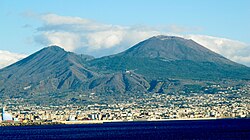
A bus carries you from the excavations up the mountain to the car park below the summit; the last stretch is on foot. The path zigzags up the Gran Cono on ankle-deep cinder to a rim at about 1,200 m, where you can walk part of the way around and look down into a crater roughly 300 m deep, steam still leaking from the walls. The Bay of Naples spreads out below — and so does the modern city built back onto the volcano's slopes. Allow about 1.5–2 hours return.
عن هذا المكان
Mount Vesuvius is a somma–stratovolcano located on the Gulf of Naples in Campania, Italy, about 9 km (5.6 mi) east of Naples and a short distance from the shore. It is one of several volcanoes forming the Campanian volcanic arc. Vesuvius consists of a large cone partially encircled by the steep rim of a summit caldera, resulting from the collapse of an earlier, much higher structure.
اقرأوا المزيد في ويكيبيدياصورة: pietro scerrato · CC BY 3.0
التعليقات
سجّلوا الدخول للانضمام إلى النقاش.
لا توجد تعليقات بعد — كونوا أوّل المعلّقين.