A morning in Pisa’s Piazza dei Miracoli and along the Arno, a short train east, then an afternoon on the walls and lanes of Lucca. Not a single walk — two towns joined by rail.
مقاطع
-
 Pisa's Piazza dei Miracoli
Pisa city centre ← Piazza dei Miracoli
City streets and grassed square
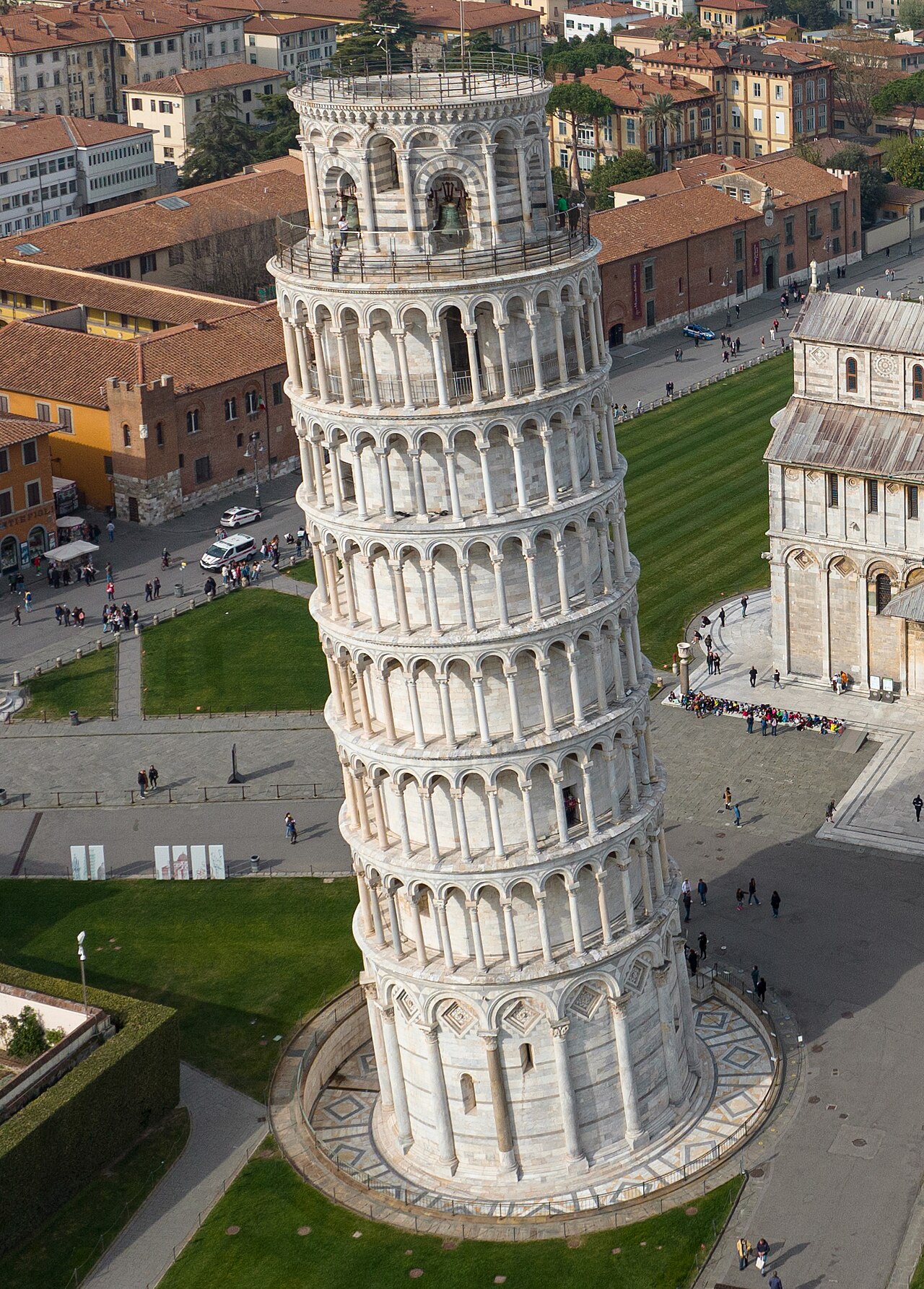
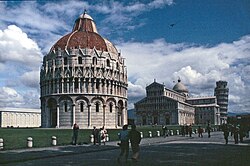
Start in the Piazza dei Miracoli, a walled compound of green lawns and white marble that is one of the finest architectural ensembles in Europe. Four great buildings share it: the Romanesque Pisa Cathedral, consecrated in 1118; the round Baptistery, the largest in Italy; the Camposanto Monumentale, a monumental cemetery along the northern edge; and the Leaning Tower itself. Allow about 90 minutes to take in the ensemble.
عن هذا المكان
The Piazza dei Miracoli, formally known as Piazza del Duomo, is a walled 8.87-hectare (21.9-acre) compound in central Pisa, Tuscany, Italy, recognized as an important center of European medieval art and one of the finest architectural complexes in the world. It was all owned by the Catholic Church and is dominated by four great religious edifices: Pisa Cathedral, the Pisa Baptistery, the Leaning Tower of Pisa, and the Camposanto Monumentale. Partly paved and partly grassed, the Piazza dei Miracoli is also the site of the Ospedale Nuovo di Santo Spirito, which now houses the Sinopias Museum and the Cathedral Museum.
اقرأوا المزيد في ويكيبيدياصورة: Gerd Eichmann · CC BY-SA 4.0
- The Leaning Tower
Piazza dei Miracoli ← Top of the Leaning Tower
Spiral marble staircase
The Leaning Tower is the free-standing bell tower, or campanile, of Pisa Cathedral, famous for its nearly four-degree tilt — the result of soft, unstable ground beneath its foundations. If you have a timed ticket, the spiral climb up the tilting marble stair is a curious, slightly disorienting experience, and the view over the square is worth it. Allow about 45 minutes with the climb.
-
 The Arno & the train to Lucca
Piazza dei Miracoli ← Lucca (by train)
Riverside streets, then rail
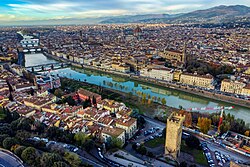
Walk south to the Arno, the river that slides through the middle of Pisa between the honey-coloured palazzi of the Lungarni. Follow the embankments to Pisa Centrale, then take a regional train east — about 30 minutes — to Lucca. This is the hinge of the day: you leave one town and arrive in another, so allow time for the walk and the transfer, roughly 90 minutes in all.
عن هذا المكان
The Arno is a river in the Tuscany region of Italy. It is the most important river of central Italy after the Tiber.
اقرأوا المزيد في ويكيبيدياصورة: Hagai Agmon-Snir حچاي اچمون-سنير חגי אגמון-שניר · CC BY-SA 4.0
-
 Lucca's Renaissance walls
Lucca station ← Atop the city walls
Broad tree-lined rampart path
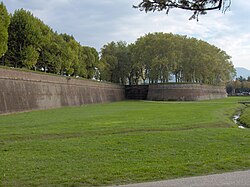
Lucca is ringed by some of the best-preserved Renaissance fortifications in Europe — a wall about four kilometres around, built between the early sixteenth and mid-seventeenth centuries and never breached in war. Their broad tops are now a tree-lined promenade encircling the whole town; walk or cycle a stretch of the ramparts to see Lucca laid out below you. Allow about an hour to walk part of the circuit.
عن هذا المكان
The walls of Lucca are a series of stone, brick, and earthwork fortifications surrounding the central city of Lucca in Tuscany, Italy. They are among the best preserved Renaissance fortifications in Europe, and at 4 kilometers and 223 meters in circumference they are the second largest intact example of a fully walled Renaissance city after Nicosia, Cyprus. The current walls of Lucca, which replaced earlier medieval and Roman fortifications, are the result of a construction campaign that started on May 7, 1504, and ended a century and a half later in 1648, with additional structural updates in the second half of the seventeenth century based on new knowledge and construction techniques. These walls play an important role in the cultural identity of the city of Lucca and its surroundings, and as a physical monument to the region's history, and Lucca's longstanding independence as a republic.
اقرأوا المزيد في ويكيبيدياصورة: No machine-readable author provided. JoJan assumed (based on copyright claims). · CC BY-SA 3.0
-
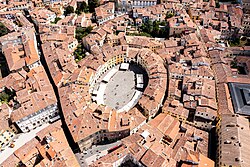 Piazza dell'Anfiteatro
The city walls ← Piazza dell'Anfiteatro
Old-town lanes
Drop down into the old town to the Piazza dell'Anfiteatro, an enclosed oval of houses that traces the footprint of a Roman amphitheatre from the second century. The ring of buildings follows the ellipse exactly, and four low gateways at the corners lead you in and out. It is one of the most atmospheric squares in Tuscany — allow about 30 minutes and a coffee.
عن هذا المكان
Piazza dell'Anfiteatro is a public square in the northeast quadrant of the walled center of Lucca, region of Tuscany, Italy. The ring of buildings surrounding the square follows the elliptical shape of the former second century Roman amphitheater of Lucca. The square can be reached through four gateways located at the four vertices of the ellipse. A Cross is carved into the central tile of the square with the arms pointing to the four gateways of the square.
اقرأوا المزيد في ويكيبيدياصورة: Kasa Fue · CC BY-SA 4.0
- The Guinigi Tower
Piazza dell'Anfiteatro ← Top of the Guinigi Tower
Narrow tower staircase
Finish at the Torre Guinigi, a Romanesque-Gothic tower about 45 metres high and famous for the small grove of holm oaks growing in a garden on its rooftop. The climb of roughly 230 steps brings you out among the trees, with a wide view over Lucca's red roofs and the surrounding plain — a fitting last stop. Allow about 45 minutes.
عن هذا المكان
The Torre Guinigi is a tower in Lucca in the region of Tuscany, central Italy. It is a typical example of local Romanesque-Gothic architecture. The height of the tower is 45 metres (148 ft) with a total of 230 steps over 28 flights to reach the top.
اقرأوا المزيد في ويكيبيديا
التعليقات
سجّلوا الدخول للانضمام إلى النقاش.
لا توجد تعليقات بعد — كونوا أوّل المعلّقين.