A single line through the historic centre, from the cathedral square across the Arno.
مقاطع
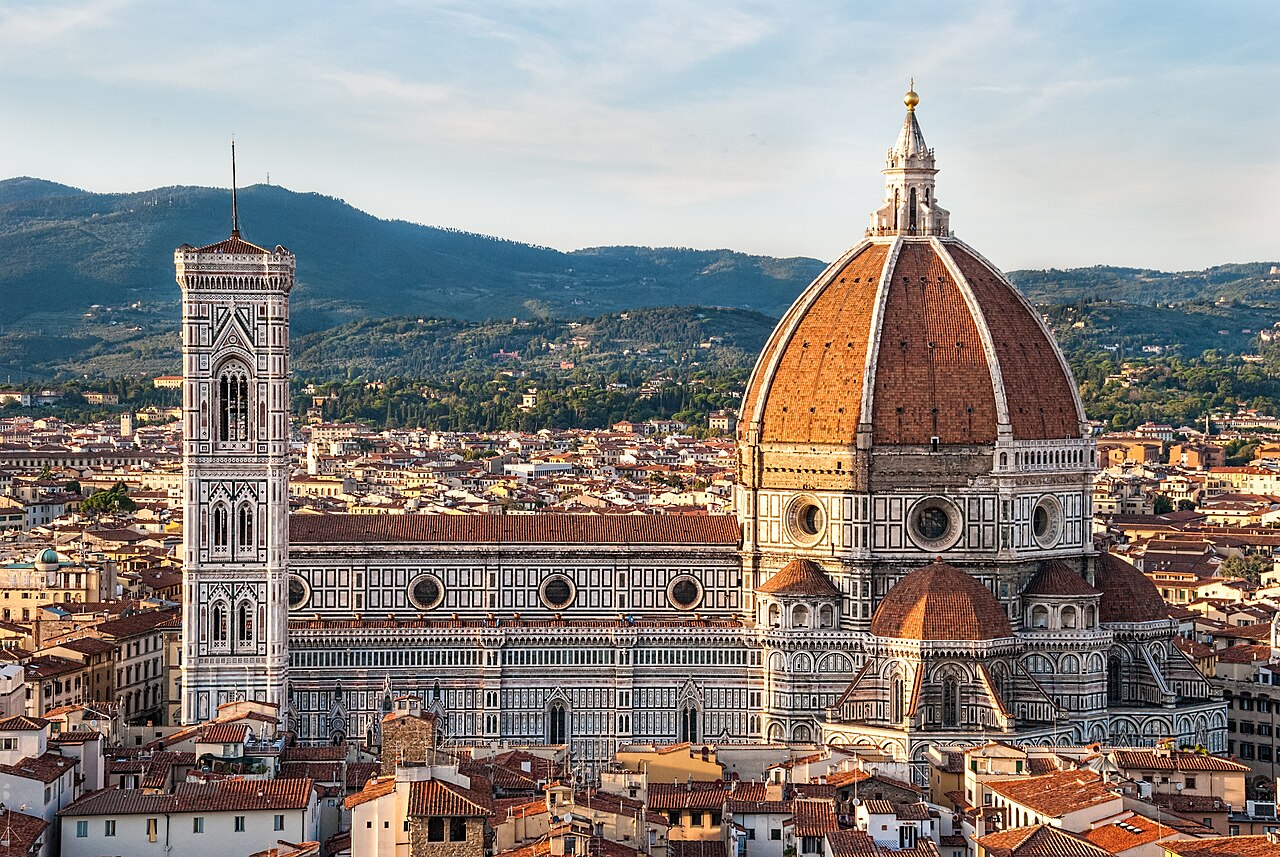
- The Duomo and Brunelleschi's Dome
Piazza del Duomo ← Cathedral dome
City streets and stairs
Begin under the green, pink and white marble of Santa Maria del Fiore, begun in 1296 and crowned in 1436 by Filippo Brunelleschi's dome — still the largest masonry dome ever raised. The climb between its inner and outer shells brings you out over the rooftops of Tuscany. Allow about 90 minutes with the ascent.
- The Baptistery of Saint John
Florence Cathedral ← Piazza San Giovanni
City streets
Cross the square to the octagonal baptistery dedicated to the city's patron saint, John the Baptist. Its bronze doors — Ghiberti's east pair nicknamed the Gates of Paradise — are among the founding objects of the Renaissance; the panels here are copies, the originals now indoors nearby. About 30 minutes.
- To Piazza della Signoria
Florence Baptistery ← Piazza della Signoria
City streets
Walk south down Via dei Calzaiuoli into the political stage of Florence, dominated by the fortress-like Palazzo Vecchio. The Loggia dei Lanzi on one side is an open-air sculpture hall, free to walk into; the David standing by the palace door is a copy of Michelangelo's original. About 40 minutes.
-
 The Uffizi Gallery
Piazza della Signoria ← Uffizi riverfront
City streets
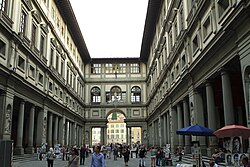
Duck into the long courtyard beside the piazza and up into Italy's most visited museum, built in the 1560s as government offices — uffizi means exactly that. Botticelli, Leonardo, Michelangelo and Caravaggio hang along its corridors. Allow about two hours, more if you linger.
عن هذا المكان
The Uffizi Gallery is a prominent art museum adjacent to the Piazza della Signoria in the Historic Centre of Florence in the region of Tuscany, Italy. One of the most important Italian museums and the most visited, it is also one of the largest and best-known in the world. It holds a collection of priceless works, particularly from the period of the Italian Renaissance.
اقرأوا المزيد في ويكيبيديا -
 Across the Ponte Vecchio
Uffizi ← Ponte Vecchio
City streets and bridge
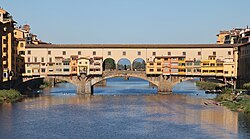
Step onto the medieval stone bridge lined with shops — the only Florentine bridge left standing after the Second World War. Butchers and tanners once traded here; today it is jewellers and art dealers. The covered Vasari Corridor runs above the shopfronts. About 20 minutes.
عن هذا المكان
The Ponte Vecchio is a medieval stone closed-spandrel segmental arch bridge over the Arno, in Florence, Italy. The only bridge in Florence spared from destruction during World War II, it is noted for the shops built along it; building shops on such bridges was once a common practice. Butchers, tanners, and farmers initially occupied the shops; the present tenants are jewellers, art dealers, and souvenir sellers. The Ponte Vecchio's two neighbouring bridges are the Ponte Santa Trinita and the Ponte alle Grazie.
اقرأوا المزيد في ويكيبيديا - Palazzo Pitti and the Oltrarno
Ponte Vecchio ← Palazzo Pitti
City streets
Finish on the south bank in the Oltrarno, where workshops still outnumber souvenir stands. The huge Palazzo Pitti — begun in 1458 for the banker Luca Pitti, later the Medici seat — closes the walk, with the Boboli gardens rising behind it. About an hour, or a whole afternoon if you go in.
التعليقات
سجّلوا الدخول للانضمام إلى النقاش.
لا توجد تعليقات بعد — كونوا أوّل المعلّقين.