Walk the long cedar-lined avenue of tombs to Kōbō Daishi’s mausoleum, cross the town to the founder’s temple complex and the head temple, and settle into a monks’ lodging for the night.
مقاطع
- Arriving on the mountain
Kōyasan basin (cable car / bus, or the chōishi-michi trail) ← Ichinohashi bridge
Town streets, or mountain pilgrim trail
Most arrive by the Nankai cable car and a short bus ride; pilgrims climb the Kōyasan chōishi-michi, a trail of about 24 km marked by stone stupas set roughly every chō. Either way, begin at the Ichinohashi bridge, the traditional entrance to the Okunoin approach.
-
 The Okunoin avenue
Ichinohashi bridge ← Gobyō-bashi bridge
Stone-paved avenue under old cedars
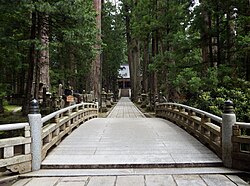
The approach to Okunoin runs for about two kilometres beneath towering cryptomeria cedars, past more than two hundred thousand tombstones, memorials and moss-covered stupas — feudal lords, monks and merchants all buried close to the mountain's holiest ground. It is considered the largest cemetery in Japan.
عن هذا المكان
Okunoin or Oku-no-in is a sacred Buddhist site and cemetery on Mount Kōya, in Wakayama Prefecture, Japan. Opened in 835, it houses the mausoleum of Kūkai, founder of the Shingon school of esoteric Buddhism. It is considered the largest cemetery in Japan, with more than two hundred thousand graves and memorial monuments.
اقرأوا المزيد في ويكيبيديا -
 Kōbō Daishi's mausoleum
Gobyō-bashi bridge ← Gobyō (mausoleum) and Tōrō-dō
Sacred inner precinct, no photography
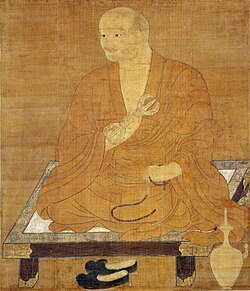
Beyond the Gobyō-bashi bridge lies the mausoleum of Kūkai, Kōbō Daishi, whom Shingon believers hold to rest here in eternal meditation. Before it stands the Tōrō-dō, the Hall of Lamps, where thousands of lanterns are kept burning. This is the spiritual heart of the mountain; photography stops at the bridge.
عن هذا المكان
Kūkai , born Saeki no Mao posthumously called Kōbō Daishi , was a Japanese Buddhist monk, calligrapher, and poet who founded the esoteric Shingon school of Buddhism. He travelled to China, where he studied Tangmi under the monk Huiguo. Upon returning to Japan, he founded Shingon—the Japanese branch of Vajrayana Buddhism. With the blessing of several Emperors, Kūkai was able to preach Shingon teachings and found Shingon temples. Like other influential monks, Kūkai oversaw public works and constructions. Mount Kōya was chosen by him as a holy site, and he spent his later years there until his death in 835 CE.
اقرأوا المزيد في ويكيبيديا - The Danjō Garan
Okunoin ← Danjō Garan
Town streets and temple grounds
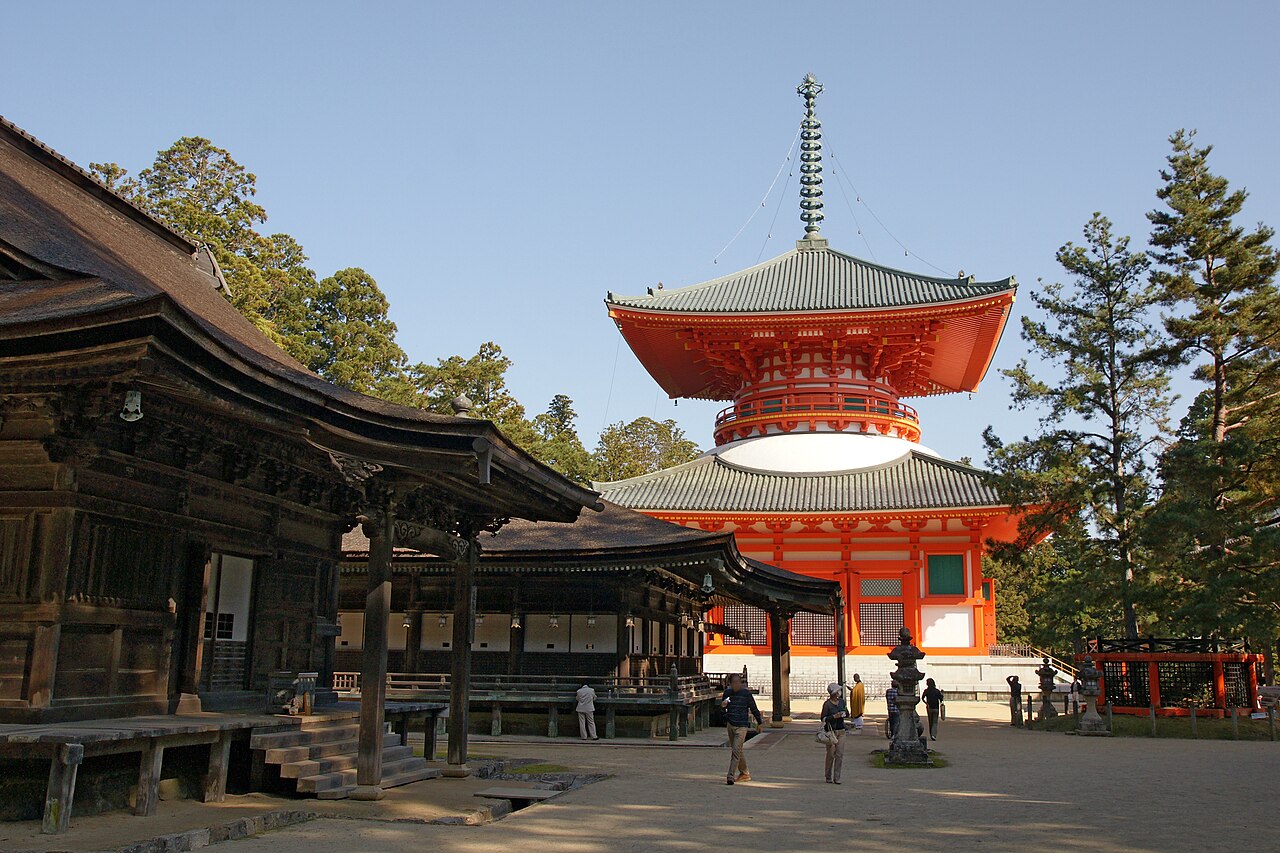
Across the town lies the Danjō Garan, the central temple complex Kūkai first laid out. Its vermilion Konpon Daitō, the Great Stupa, rises above the trees, and beside it stands the Kondō main hall — the ceremonial core of Shingon on the mountain.
-
 Kongōbu-ji
Danjō Garan ← Kongōbu-ji
Temple grounds
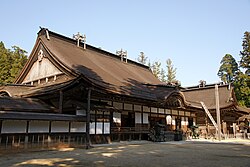
Kongōbu-ji is the head temple of Kōyasan Shingon Buddhism, its name meaning Temple of the Diamond Mountain Peak. Inside are painted sliding screens and the Banryūtei, a large raked-gravel rock garden. Visitors are often served tea in its halls.
عن هذا المكان
Kongōbu-ji (金剛峯寺) is the ecclesiastic head temple of Kōyasan Shingon Buddhism, located on Mount Kōya , Wakayama Prefecture, Japan. Its name means Temple of the Diamond Mountain Peak. It is part of the "Sacred Sites and Pilgrimage Routes in the Kii Mountain Range" UNESCO World Heritage Site.
اقرأوا المزيد في ويكيبيديا - A night in a shukubo
Kongōbu-ji ← A temple lodging (shukubo)
Town streets
Many of Kōya's temples take in guests as shukubo, temple lodgings, with tatami rooms, a vegetarian shōjin-ryōri dinner and an early-morning Buddhist service you are welcome to join. Staying over is the classic way to feel the rhythm of the mountain.
التعليقات
سجّلوا الدخول للانضمام إلى النقاش.
لا توجد تعليقات بعد — كونوا أوّل المعلّقين.