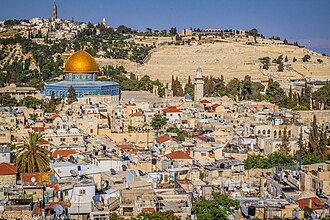
From Jaffa Gate through the Armenian and Jewish Quarters to the Western Wall, then along the Via Dolorosa through the Muslim Quarter to the Church of the Holy Sepulchre in the Christian Quarter.
Segments
-
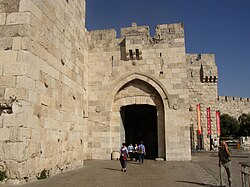 Jaffa Gate & the Armenian Quarter
Jaffa Gate → Armenian Quarter
Stone lanes
Enter through Jaffa Gate, the main western gate, beside the Ottoman Citadel and the Tower of David. Walk south into the quiet Armenian Quarter, the smallest of the four and home to a community present in the city for some 1,600 years. About 30 minutes.
About this place
Jaffa Gate is one of the seven main open gates of the Old City of Jerusalem.
Read more on Wikipedia Photo: Herwig Reidlinger · CC BY-SA 3.0 -
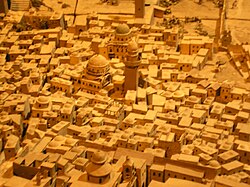 The Jewish Quarter & the Cardo
Armenian Quarter → Hurva Square
Stone lanes and steps
Cross into the Jewish Quarter, rebuilt after 1967, and walk the Cardo — the colonnaded main street of Roman and Byzantine Jerusalem, partly excavated below today's shops — to the restored Hurva Synagogue on its square. About 45 minutes.
About this place
The Jewish Quarter is one of the four traditional quarters of the Old City of Jerusalem. The area lies in the southwestern sector of the walled city, and stretches from the Zion Gate in the south, along the Armenian Quarter on the west, up to the Street of the Chain in the north and extends to the Western Wall and the Temple Mount in the east. In the early 20th century the Jewish population of the quarter reached 19,000.
Read more on Wikipedia Photo: Deror avi · Attribution -
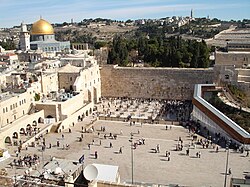 The Western Wall
Hurva Square → Western Wall plaza
Steps down to the plaza
Descend to the Western Wall, the exposed retaining wall of the Second Temple platform and the holiest place where Jews may pray. Approach the great limestone courses, where folded notes fill the cracks. About 45 minutes.
About this place
The Western Wall is an ancient retaining wall of the built-up hill known to Jews and Christians as the Temple Mount of Jerusalem. Its most famous section, known by the same name, often shortened by Jews to the Kotel or Kosel, is known in the West as the Wailing Wall, and in the Arab world and Islamic world as the Buraq Wall. In a Jewish religious context, the term Western Wall and its variations is used in the narrow sense, for the section used for Jewish prayer; in its broader sense it refers to the entire 488-metre-long (1,601 ft) retaining wall on the western side of the Temple Mount.
Read more on Wikipedia Photo: Golasso · CC BY-SA 4.0 -
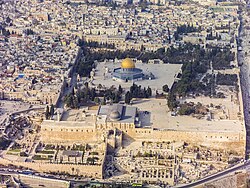 Temple Mount viewpoint
Western Wall plaza → Temple Mount (Mughrabi Gate)
Wooden ramp and open esplanade
If visiting hours allow, cross the Mughrabi Bridge onto the Temple Mount (Haram al-Sharif) to stand before the golden Dome of the Rock and al-Aqsa Mosque; otherwise take in the view over the esplanade from the plaza. About 40 minutes.
About this place
The Temple Mount or al-Haram al-Sharif is an elevated plateau in the Old City of Jerusalem that comprises the Islamic religious compound known as al-Aqsa, which includes the al-Aqsa Mosque and the Dome of the Rock. Historically the location of two successive Jewish temples, the area has been venerated as a holy site for thousands of years including in Judaism, Christianity, and Islam.
Read more on Wikipedia Photo: Godot13 · CC BY-SA 4.0 -
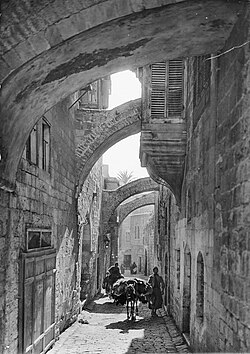 The Via Dolorosa
Lions' Gate → Muslim Quarter
Covered bazaar streets
Pick up the Via Dolorosa, the 'Way of Sorrows', near Lions' Gate and follow its Stations of the Cross through the crowded, vaulted lanes of the Muslim Quarter — the traditional route of Jesus toward crucifixion. About 45 minutes.
About this place
The Via Dolorosa, sometimes known as the Via Crucis is a processional route in the Old City of Jerusalem. It represents the path that Jesus took, forced by the Roman soldiers, on the way to his crucifixion. The winding route from the former Antonia Fortress to the Church of the Holy Sepulchre—a distance of about 600 metres (2,000 ft)—is a celebrated place of Christian pilgrimage. The current route has been established since the 18th century, replacing various earlier versions. Today, it is marked by 14 Stations of the Cross, nine of which are outside, in the streets, with the remaining five stations being currently inside the Church of the Holy Sepulchre.
Read more on Wikipedia Photo: Wikimedia Commons · Public domain -
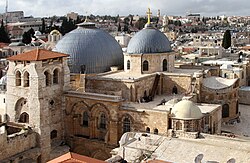 Church of the Holy Sepulchre
Muslim Quarter → Church of the Holy Sepulchre
Stone courtyard and church interior
End at the Church of the Holy Sepulchre in the Christian Quarter, built over the sites revered as Calvary and the tomb of Jesus, and shared by six Christian denominations. Climb the ramparts near Jaffa Gate afterward for a last view over the roofs. About 60 minutes.
About this place
The Church of the Holy Sepulchre, also known as the Church of the Resurrection, is a fourth-century church in the Christian Quarter of the Old City of Jerusalem. The church is simultaneously the seat of the Armenian Patriarchate of Jerusalem, Greek Orthodox Patriarchate of Jerusalem, and the Catholic Latin Patriarchate of Jerusalem. It is the holiest site in Christianity, and it has been an important pilgrimage site for Christians since the fourth century.
Read more on Wikipedia Photo: Gerd Eichmann · CC BY-SA 4.0
Comments
Sign in to join the conversation.
No comments yet — be the first.